Tilapia in Coconut Milk with Carrots
Tilapia fillets poached in a smooth coconut-carrot sauce, flavored with fresh ginger and tomatoes, gentle controlled cooking for pearly flesh.
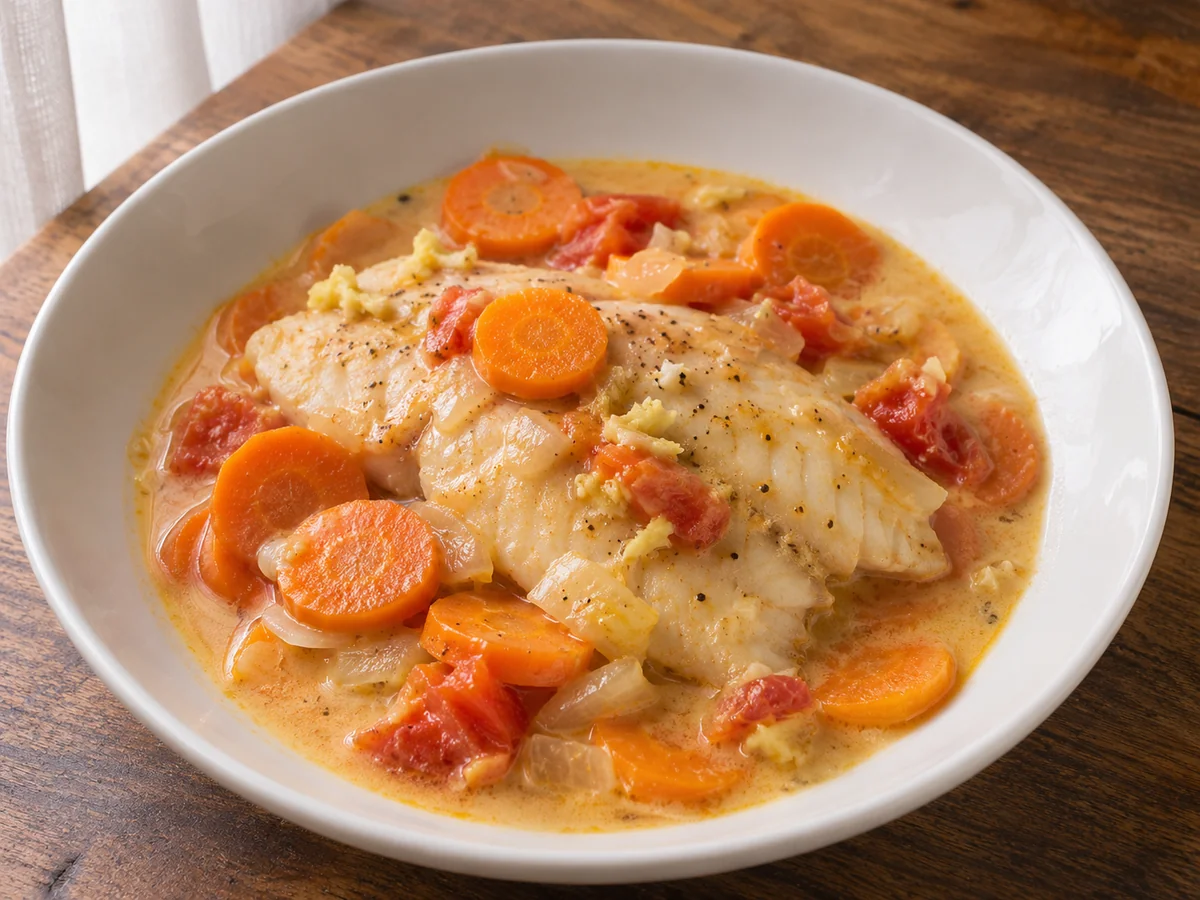
Ingredients
- 600 g boneless tilapia fillets
- 450 g carrots
- 250 ml unsweetened coconut milk
- 150 g tomatoes
- 120 g onion
- 15 g ginger
- 20 ml oil
- 250 ml water
- 4 g salt
- 1 g pepper
Preparation
Peel the 450 grams of carrots, trim the ends and cut them into regular slices of three to four millimeters thickness using a paring knife or a mandoline set to the fine setting; weigh exactly 120 grams of yellow onion, peel it, cut it in half lengthwise and slice it finely into regular half-moons so it melts quickly into the fat. Rinse the 150 grams of tomatoes under running water, roughly seed them with a spoon and dice them into one-centimeter cubes; peel the 15 grams of fresh ginger using the edge of a spoon, then grate it finely on a microplane grater directly over a small bowl to catch all the juice.
In a wide 28-centimeter diameter sauté pan, pour the 20 milliliters of neutral vegetable oil and heat it over medium-low heat for one minute until it shimmers without smoking; add the sliced onion and a pinch of the 4 grams of total salt, then sweat for six to eight minutes stirring often with a wooden spatula until the strips become translucent, tender and fragrant, without any brown coloring. Incorporate the grated ginger and continue cooking for one additional minute stirring constantly to release the aromas without letting the bottom stick.
Add the diced tomatoes to the sauté pan, mix thoroughly to coat them with the aromatic base and let them compote over medium heat for five minutes lightly crushing the pieces against the side with the spatula until obtaining a pulpy and shiny base; then pour in the 250 milliliters of cold water and the carrot slices, bring to a gentle simmer by slightly increasing the heat, then partially cover with an offset lid and cook for twenty minutes checking at mid-point that the liquid maintains a regular simmer without violent boiling.
At the end of the twenty minutes, pierce a carrot slice with the tip of a paring knife: it must penetrate without resistance but the carrot must not fall apart into mush; adjust seasoning with the remaining salt and the gram of freshly ground black pepper, then pour the 250 milliliters of unsweetened coconut milk in a thin stream while stirring gently with a wooden spoon to emulsify the sauce without boiling it. Maintain a very gentle simmer, barely a few bubbles at the edges, for two minutes to bind everything.
While the coconut sauce simmers, inspect the 600 grams of tilapia fillets: run a finger over each side to detect any missed bones and remove them with tweezers; pat the fillets dry superficially with paper towels without pressing so as not to mark the flesh, then very lightly season the top side with a tiny pinch of salt if desired.
Slide the tilapia fillets one by one into the simmering sauce, skin side down if they have one, spacing them so they do not overlap; tilt the sauté pan slightly and baste the top of the fillets with the sauce using a ladle to coat them entirely without turning them, which preserves their integrity.
Cover the sauté pan hermetically, reduce the heat to the absolute minimum and poach the fillets for ten to fifteen minutes depending on their maximum thickness: for two-centimeter fillets, aim for twelve minutes; check doneness by inserting a probe thermometer into the center of the thickest fillet, the temperature must reach 63 °C, and the flesh must become opaque, pearly and detach easily into flakes under the gentle pressure of the knife tip.
Turn off the heat, let the covered sauté pan rest for two minutes off the heat to stabilize the temperature; lift the fillets using a wide slotted spoon supporting them well so as not to break them, place them in warm deep plates, generously coat with the carrot sauce and serve immediately without reheating the sauce to a boil.
Introduction
This contemporary recipe highlights tilapia, a widely available farmed fish in Côte d'Ivoire, pairing it with a base of melting carrots and fresh tomatoes bound by unsweetened coconut milk. The choice of boneless fillets, approximately 150 grams each, ensures even cooking and hassle-free eating; one checks for residual bones by running a finger over the flesh before starting. The carrots, peeled and cut into thin slices of three to four millimeters, cook quickly while retaining a slight firmness that structures the sauce. The yellow onion, finely sliced, and fresh ginger, finely grated at the moment of use, build a discreet but present aromatic base, without dominating the delicate taste of the fish. The preparation organization follows a rigorous mise en place logic: all vegetables are ready before lighting the stove, the coconut milk is measured and kept at hand, the cold water is weighed at 250 milliliters to adjust the final consistency. The major distinction of this dish lies in cooking the tilapia directly in the simmering liquid, without prior searing, which preserves the natural moisture of the flesh and avoids any drying out; the target temperature of 63 °C at the core of the fillet ensures an opaque and pearly texture, flaking easily under the knife tip, without ever reaching a rolling boil that would toughen the proteins.
Cultural context
Contemporary creation for the Côte d'Ivoire collection of RecettesAfricaines.com, without claim of traditional origin. General composition and food safety references: https://www.fao.org/infoods/infoods/tables-and-databases/faoinfoods-databases/en/ ; https://www.who.int/teams/nutrition-and-food-safety/multisectoral-actions-in-food-systems/five-keys-to-safer-food-poster ; https://www.foodsafety.gov/food-safety-charts/safe-minimum-internal-temperatures. No nutritional calculation has been performed.
Tips
Prepare the tomato-onion-ginger-carrot base up to the addition of coconut milk up to four hours in advance: let cool at room temperature for twenty minutes, cover and refrigerate; at serving time, gently reheat the base for five minutes before incorporating the coconut milk and poaching the fish, which divides the work into two calm sequences.
Choose an unsweetened coconut milk at 17-19% fat, well homogenized: shake the can or carton vigorously before opening to reunite the cream and coconut water; if the sauce seems too thick after addition, dilute with one tablespoon of hot water at a time until the desired coating consistency.
For even more precise cooking without a probe, use the visual-tactile method: the flesh turns from translucent to opaque pearly white from the edges toward the center, and light finger pressure on the top of the fillet reveals a firm but yielding elastic resistance, a sign that proteins are coagulated without excess.
If you must keep the dish warm for a few minutes before plating, turn off the heat, leave the lid on and place the sauté pan on a warm corner of the worktop (oven off door ajar at 40 °C maximum); never keep on active low heat on pain of overcooking the tilapia in less than three minutes.
Nutrition notes
Carbohydrates come in part from vegetables. Protein is supplied in part by fish. Fats come in part from coconut milk and oil. Allergens to flag in the listed ingredients: fish. These notes describe the ingredients rather than a calculated nutritional analysis of the dish. Actual composition varies with the products chosen, their water content and the way the food is divided among four plates. Evaporation changes serving weight without establishing calories per portion. Added salt must also be considered alongside any salt in packaged ingredients. Check their labels and possible allergen contact on equipment. The stated proportions are for preparing the recipe; they do not define a suitable dietary portion for every person. Garnishes or side dishes served separately should be considered separately because they are not included in this formulation.
Conclusion
Serve this tilapia in coconut milk with carrots in pre-warmed bowls, accompanied by long-grain white rice cooked according to package directions, drained and kept warm, or by plantain banana foutou for a contemporary Ivorian plate; the smooth sauce naturally coats the accompaniments. Leftovers keep in the refrigerator in an airtight container for forty-eight hours maximum: reheat very gently over low heat adding a spoonful of water if the sauce has thickened, without ever bringing to a boil to preserve the fish texture; discard any portion left at room temperature for more than two hours.
Enjoy your meal
Bon appétit