White beans with green plantains and ginger
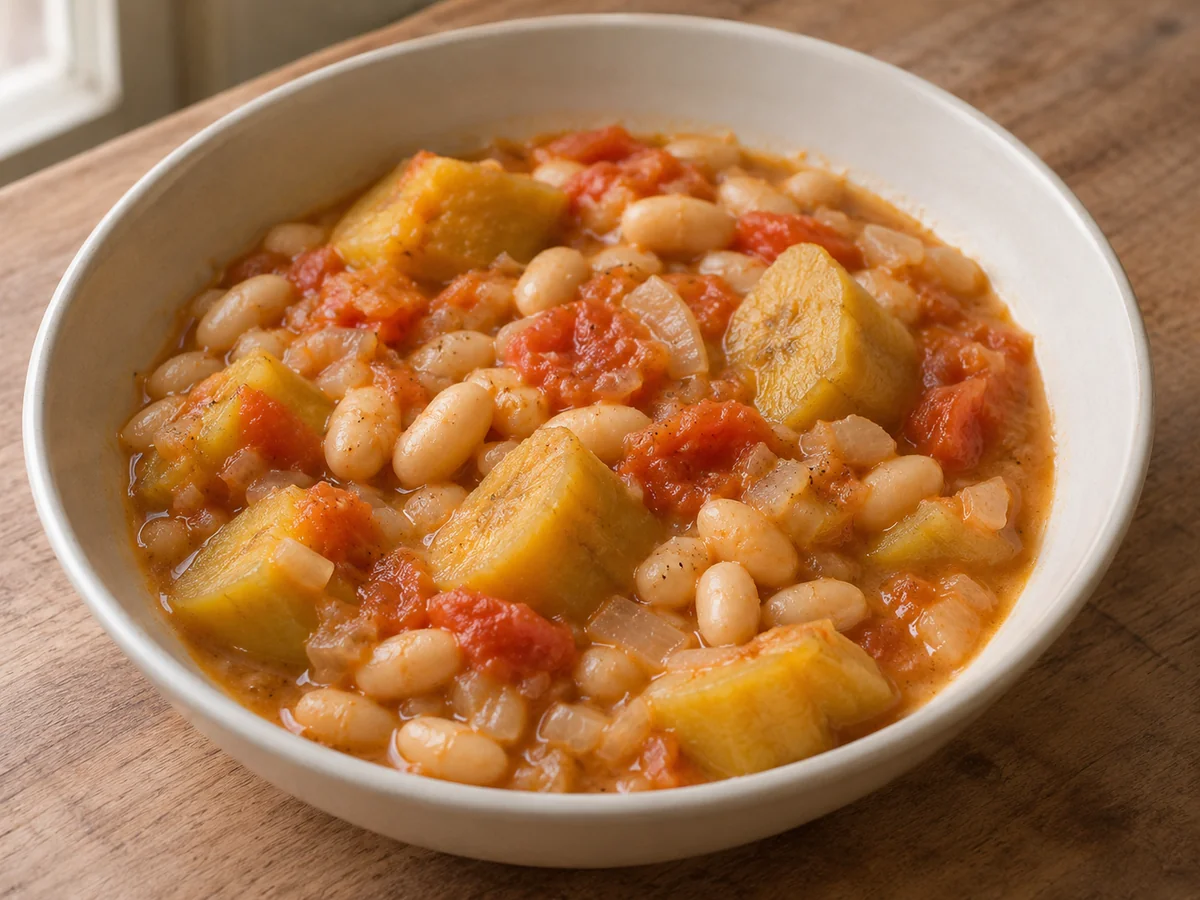
White beans simmered with green plantains, tomatoes, onion and ginger. Ivorian vegetarian main dish ready in 40 minutes, melting texture and fresh aroma.
Ingredients
- 500 g cooked white beans, drained
- 600 g green plantains, peeled
- 400 g tomatoes
- 150 g onion
- 20 g ginger
- 25 ml oil
- 600 ml water
- 4 g salt
- 1 g pepper
Preparation
Heat the 25 ml of oil in a heavy-bottomed Dutch oven over medium heat for one minute. Add the 150 g of onion, finely sliced into regular half-moons. Stir constantly with a wooden spoon for 5 minutes until the pieces become translucent, shiny and very tender, without brown coloring. Incorporate the 20 g of peeled ginger, finely grated on a microplane. Continue cooking 1 minute while stirring to release the aromas without burning the ginger. Pour in the 400 g of roughly crushed tomatoes with their juice. Mix, bring to a simmer and cook 10 minutes uncovered, stirring often, until the tomato vegetation water largely evaporates and the mixture thickens into a dark red, shiny and fragrant base.
Add the 600 g of green plantains, peeled and cut into regular 2 cm cubes. Stir gently to coat each cube with the tomato base. Pour the 600 ml of cold water all at once. Increase the heat to bring to a rolling boil, then immediately lower to maintain a gentle simmer. Cover the Dutch oven with its lid slightly offset to let a trickle of steam escape. Cook for 25 minutes without stirring, until the tip of a knife penetrates the core of a cube without resistance, a sign that the starch is gelatinized and the plantain perfectly tender.
Check the plantain doneness by taking a cube from the center of the Dutch oven: it must crush under the pressure of a fork without having dissolved into the liquid. If some cubes still resist, extend 3 minutes covered. Once tenderness is confirmed, incorporate the 500 g of cooked white beans, drained, by pouring them in gently. Stir only once with the edge of the spoon to distribute them without breaking them. Sprinkle the 4 g of salt and the 1 g of pepper evenly over the surface. Simmer 8 minutes uncovered, very low heat, watching that the juice reduces slightly to coat the beans without drying out completely.
Monitor the final texture during the 8 minutes: the liquid must become syrupy, shiny, adhering to the plantain cubes and the beans. If the juice evaporates too fast and risks sticking to the bottom, add 30 ml of hot water, stir once, and continue. Never add cold water which would stop the cooking. Taste at 6 minutes to adjust seasoning if necessary, keeping in mind that salt enhances the perception of the plantain's sweetness. The beans must be hot at the core, swollen by partial rehydration in the juice, but intact.
Turn off the heat. Let the Dutch oven rest covered for 5 minutes off the heat. This pause allows the flavors to harmonize, the juice to finish thickening by retrogradation of the plantain starch, and the temperature to drop to a pleasant serving heat (about 65 °C). Do not stir during this rest to preserve the integrity of the cubes. The surface may show a fine skin of concentrated juice, a sign of a good reduction.
Serve in preheated deep plates. Distribute first a ladle of juice at the bottom, then the plantain cubes and beans in equal parts. Smooth the surface with the back of the ladle. The dish must present a generous, shiny appearance, without excess free liquid at the bottom of the plate. Serve immediately while the temperature contrast between the very hot plantain and the warm beans is perceptible.
If the dish waits more than 10 minutes before serving, keep the Dutch oven on minimum heat (setting 1 out of 9) with lid, stirring every 3 minutes to avoid sticking. Never reheat over high heat: the gelatinized plantain starch sticks instantly. For deferred service the next day, cool quickly by transferring to a wide dish, film in contact, refrigerate at 4 °C maximum 24 hours. Reheat gently with 50 ml of water.
Store leftovers in an airtight glass container in the refrigerator at 4 °C maximum 48 hours. The plantain texture refines slightly, the beans absorb the residual juice. Reheat in a saucepan over low heat with 2 tablespoons of water per portion, covered 5 minutes. Do not freeze: the cellular structure of cooked plantain degrades upon thawing, giving an unappetizing mush. Discard if sour smell or stringy appearance appears.
Introduction
This contemporary recipe combines the floury sweetness of precooked white beans with the slightly sweet firmness of green plantain, all enhanced by a tomato-onion-ginger aromatic base. The goal is to obtain a coherent vegetarian main dish, neither soup nor purée, where each ingredient keeps its textural identity: the plantain must remain in distinct cubes, tender at the core but not disintegrated, while the beans soak up the reduced cooking juices without mashing. The choice of drained cooked white beans (canned or leftover from home cooking) eliminates the uncertainty of soaking and long cooking, guaranteeing a reproducible result in under an hour. Green plantains, selected very firm, thick yellow-green skin without black spots, provide the starch needed to naturally bind the sauce during covered cooking. Fresh ginger, finely grated, diffuses its lemony pungency without unpleasant fibers. Standard yellow onion and ripe but firm tomatoes form the flavor foundation. Neutral vegetable oil (sunflower or peanut) serves only for the initial sweating. The measured water (600 ml) ensures the plantain cooks and the bound juices form; it must not be replaced by broth to preserve the purity of the vegetable flavors. Salt (4 g) and pepper (1 g) are dosed to enhance without masking. This organization — sweating, plantain cooking, final bean incorporation — avoids overcooking the legumes and ensures a natural binding by the plantain starch.
Cultural context
Contemporary creation for the Côte d'Ivoire collection of RecettesAfricaines.com, not claiming traditional anchorage. General references composition and food safety: https://www.fao.org/infoods/infoods/tables-and-databases/faoinfoods-databases/en/ ; https://www.who.int/teams/nutrition-and-food-safety/multisectoral-actions-in-food-systems/five-keys-to-safer-food-poster ; https://www.foodsafety.gov/food-safety-charts/safe-minimum-internal-temperatures. No nutritional analysis has been carried out on this recipe.
Tips
Choose green plantains that are heavy for their size, smooth skin without cracks: they contain more starch, less sugar, guaranteeing good cube hold and optimal binding power. Avoid yellowing plantains which would melt into purée.
Drain the white beans in a fine sieve under running water for 30 seconds to eliminate the canning liquid (often salty, gelatinous). Let drain well for 5 minutes before adding them: excess water would dilute the cooking juice.
Grate the ginger at the last moment on a microplane directly above the Dutch oven: the volatile oils oxidize in 10 minutes in the air. Do not use powdered ginger (woody flavor, different pungency) nor commercial paste (often sweetened, preservatives).
Slice the onion into fine, regular half-moons (2 mm): a coarse cut leaves unpleasant crunchy pieces, a too-fine cut burns before melting. Use a well-sharpened paring knife to avoid crushing the cells and releasing the water too quickly.
Nutrition notes
Carbohydrates come in part from plantain. Protein is supplied in part by legumes. Fats come in part from oil. These notes describe the ingredients rather than a calculated nutritional analysis of the dish. Actual composition varies with the products chosen, their water content and the way the food is divided among four plates. Evaporation changes serving weight without establishing calories per portion. Added salt must also be considered alongside any salt in packaged ingredients. Check their labels and possible allergen contact on equipment. The stated proportions are for preparing the recipe; they do not define a suitable dietary portion for every person. Garnishes or side dishes served separately should be considered separately because they are not included in this formulation.
Conclusion
This vegetarian main dish is served hot in a deep plate, optionally accompanied by plain white rice cooked according to package directions (cooled quickly and refrigerated if prepared in advance) or a slice of country bread to sauce the bound juice. The portion of 400 to 450 g per person ensures lasting satiety thanks to the starch-fiber combination. Leftovers keep 48 hours in the refrigerator in an airtight glass container, reheated gently with a trickle of water to regain creaminess. Do not freeze. Discard beyond 48 hours or if signs of fermentation (bubbles, sour smell, stringy appearance). The simplicity of the recipe allows it to be easily integrated into a balanced weekly vegetarian meal plan.
Enjoy your meal
Bon appétit