Cassava Salad with Tomato and Basil
Fresh salad of cooked cassava, tomatoes, cucumber, red onion and basil, dressed with a lemon vinaigrette. Light no-final-cook starter, ready in one hour.
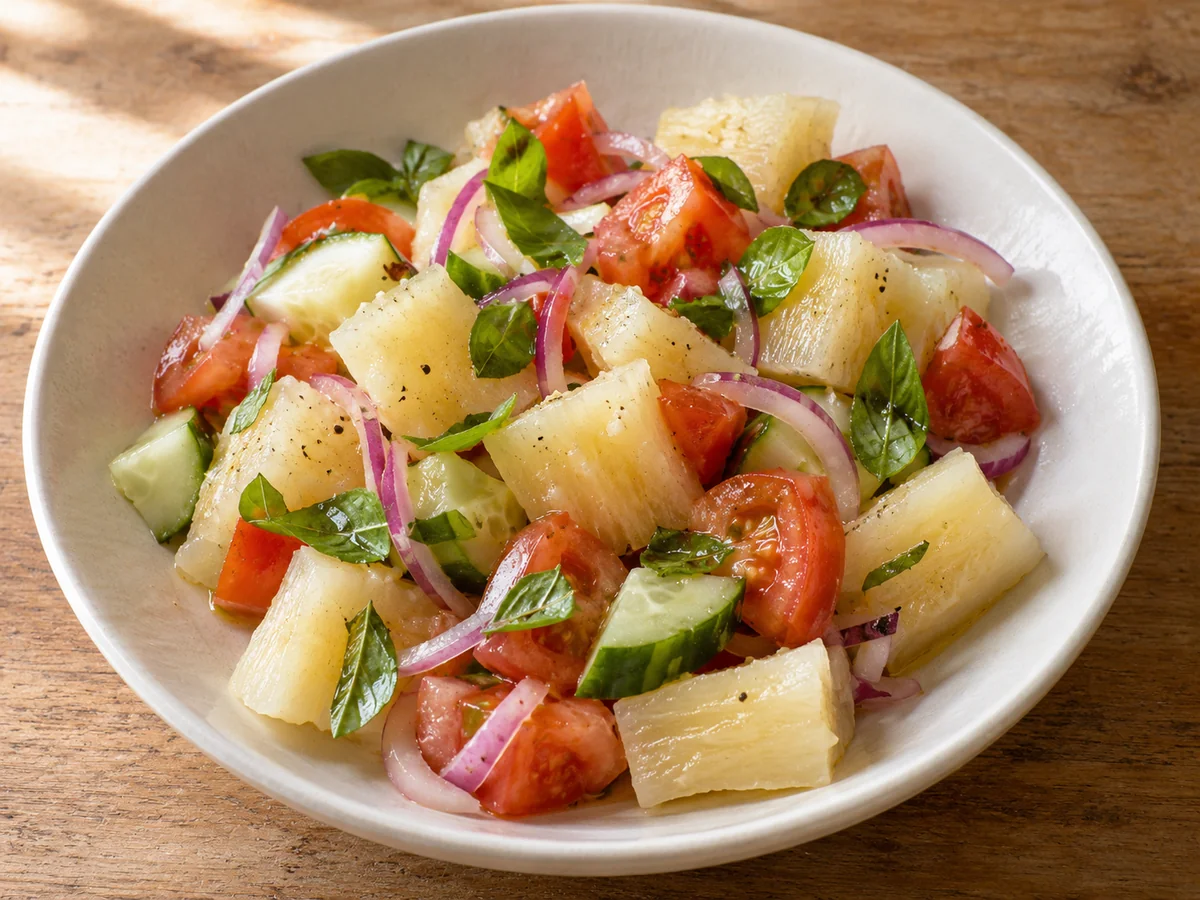
Ingredients
- 650 g peeled edible cassava
- 350 g tomatoes
- 200 g cucumber
- 80 g red onion
- 15 g basil
- 1 lime
- 25 ml oil
- 3 g salt
- 1 g pepper
- abundant water to cook the cassava
Preparation
Plunge the 650 g of peeled edible cassava, rid of its central fibrous core, into a large saucepan filled with abundant unsalted water; bring to a vigorous boil over high heat, then maintain a moderate simmer for 25 to 30 minutes until the tip of a knife sinks without resistance into the center of the pieces, a sign of complete tenderness; drain immediately in a colander and discard all the cooking water which contains residual cyanogenic residues.
Spread the cooked cassava pieces in a single thin layer on a large tray or baking sheet; let warm at room temperature for ten minutes, then place in the refrigerator for at least 30 minutes to lower the internal temperature below 10 °C, which sets the starch and avoids a pasty texture during subsequent mixing.
While the cassava cools, wash the 350 g of tomatoes, 200 g of cucumber and 80 g of red onion thoroughly under cool running water; dry them on absorbent paper; cut the tomatoes into 1.5 cm dice, recovering their juice, dice the cucumber into identical cubes without peeling it, and finely slice the red onion into regular half-moons.
Chop the 15 g of fresh basil just before assembly by rolling the leaves and slicing them finely with a knife to limit oxidation; reserve the herbs in a small bowl covered with a damp cloth in the cold.
Press the lime juice through a fine sieve to retain seeds and pulp; in a bowl, whisk vigorously the 25 ml of neutral vegetable oil, the 3 g of fine salt, the 1 g of ground black pepper and the lime juice until a shiny, slightly thick emulsion is obtained.
Remove the cooled cassava from the refrigerator and cut it into 2 cm cubes; transfer them to a large salad bowl, add the tomato dice with their juice, the cucumber cubes and the red onion slices; pour the prepared vinaigrette.
Mix gently using two wooden or silicone spoons by lifting the mass from bottom to top to coat each piece evenly without crushing the cassava or breaking the tomato dice; taste and adjust seasoning if necessary.
Immediately sprinkle the chopped basil over the salad, give a final very light toss to distribute the herbs, then serve without delay in deep plates or individual bowls while maintaining the cold chain until the moment of tasting.
Introduction
This cassava salad with tomato and basil offers a contemporary starter designed for the Côte d'Ivoire collection on RecettesAfricaines.com. It makes no claim to a traditional origin or historical heritage, but fits within a current culinary creation approach highlighting accessible local products. Edible cassava, sweet variety certified fit for consumption, forms the starchy base of the dish; it is selected firm, without blemishes or blackened parts, then peeled entirely to remove the brown bark and the fine pinkish film underneath. The tough central fibrous core, harder and less digestible, is methodically removed before cooking. Tomatoes are chosen perfectly ripe, firm to the touch, preferably cluster or beefsteak type for their juicy flesh and sugar-acidity balance. The cucumber, thin-skinned and few-seeded variety, is washed, dried and diced regularly without peeling to retain its crunchy texture. The red onion, mild and slightly sweet, is finely sliced to diffuse its aroma without assaulting the palate. Fresh basil, large green leaf variety, is chopped at the last moment to preserve its volatile oils. The vinaigrette, a simple emulsion of neutral vegetable oil and freshly squeezed lime juice, binds the whole without masking the vegetable flavors. The work organization provides for cooking the cassava first, its rapid cooling in a thin layer in the refrigerator, then the preparation of raw vegetables and final assembly just before serving to guarantee the cold chain and optimal freshness of each component.
Cultural context
This recipe is a contemporary creation included in the Côte d'Ivoire collection of RecettesAfricaines.com; it is based on no documented tradition or historical terroir. General composition and food safety references: https://www.fao.org/infoods/infoods/tables-and-databases/faoinfoods-databases/en/ ; https://www.who.int/teams/nutrition-and-food-safety/multisectoral-actions-in-food-systems/five-keys-to-safer-food-poster ; https://www.foodsafety.gov/food-safety-charts/safe-minimum-internal-temperatures. No nutritional calculation has been performed for this recipe.
Tips
Cook the cassava the day before: after draining and rapid cooling, keep the cubes in the refrigerator in an airtight container for up to 24 h; the texture remains firm and the time saving on the day is considerable.
Prepare the vinaigrette up to four hours in advance and keep it cold in a closed jar; shake vigorously before incorporating to reform the emulsion.
Dice tomatoes, cucumber and onion at the last quarter hour to preserve their crunch and limit water release which would dilute the seasoning.
If the cassava still shows slight firmness after 30 minutes, extend cooking in 5-minute increments checking with the knife tip; never salt the cooking water to avoid hardening the starch.
Nutrition notes
Carbohydrates come in part from cassava. Fats come in part from oil. These notes describe the ingredients rather than a calculated nutritional analysis of the dish. Actual composition varies with the products chosen, their water content and the way the food is divided among four plates. Evaporation changes serving weight without establishing calories per portion. Added salt must also be considered alongside any salt in packaged ingredients. Check their labels and possible allergen contact on equipment. The stated proportions are for preparing the recipe; they do not define a suitable dietary portion for every person. Garnishes or side dishes served separately should be considered separately because they are not included in this formulation.
Conclusion
Serve this salad well chilled as a starter for four people, accompanied by country bread or grilled cassava flatbreads for a complete meal. Leftovers, kept in the refrigerator in an airtight container, are consumed within 24 hours; the cassava may soften slightly and the vegetables release water, remix before reserving. Do not freeze this dish: the texture of cooked cassava and raw vegetables would degrade irreversibly upon thawing. Respect the cold chain at all times to guarantee food safety.
Enjoy your meal
Bon appétit !