Sesame and Orange Biscuits
Crisp biscuits with toasted sesame and fresh orange zest, unsalted butter, controlled baking at 175 °C for a balanced snack.
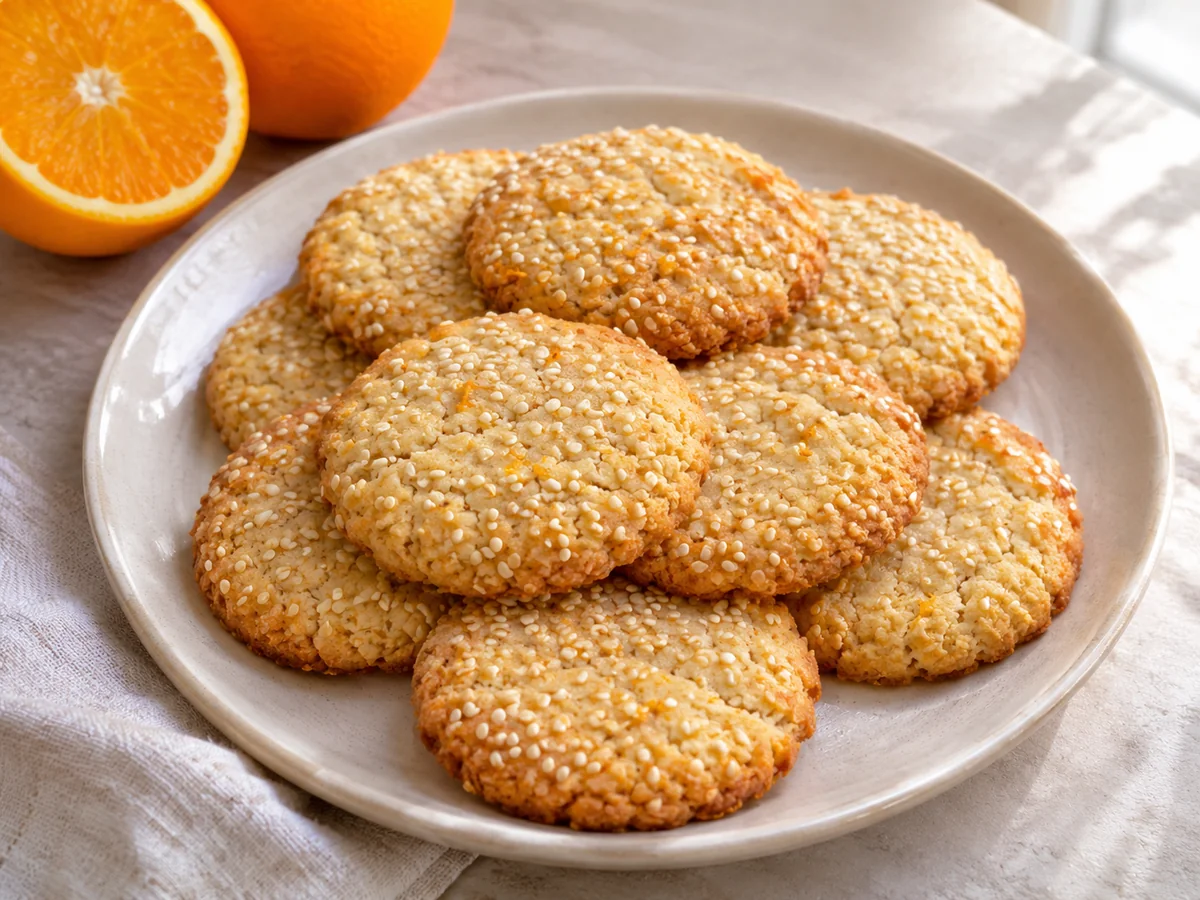
Ingredients
- 180 g wheat flour
- 60 g sesame
- 80 g softened butter
- 70 g sugar
- 1 egg
- 1 orange
- 4 g baking powder
- 1 g salt
Preparation
Preheat the oven to one hundred and seventy-five degrees Celsius fan-assisted and prepare two baking sheets lined with parchment paper. In the bowl of a stand mixer fitted with the paddle, work the softened butter at medium speed for two minutes until a shiny creamy texture is obtained. Add the sugar in three additions, continuing to beat for one minute after each addition to aerate the mixture. Incorporate the whole egg at low speed, scrape the sides, then beat for thirty seconds until perfectly homogeneous.
Wash the orange in hot water, dry, then take the fine zest of half an orange using a microplane grater, avoiding the bitter white pith. Press the orange, strain the juice through a fine sieve and measure exactly fifteen millilitres. Add zest and juice to the dough, mix at minimum speed for five seconds, just enough to distribute the aroma without developing gluten.
In a separate bowl, sift the wheat flour, baking powder and the one gram of salt. Pour this dry mixture onto the liquid dough all at once. Run the mixer at low speed for ten seconds, stop as soon as the flour disappears. Add forty grams of sesame, give three pulses of two seconds to disperse them evenly without heating the dough.
Form a flattened ball, wrap it in cling film and place in the refrigerator for thirty minutes. This rest firms the butter, stabilises hydration and makes cutting easier. Meanwhile, pour the remaining twenty grams of sesame into a shallow dish for the final coating.
Remove the dough from the cold, divide it into sixteen equal portions of about twenty-two grams each using a scale. Roll each portion between the palms to obtain a smooth ball, then press it gently into the reserved sesame so as to coat one side only. Place on the baking sheet, sesame side up, spacing three centimetres apart.
Bake the first sheet at mid-height for twelve minutes. At the timer, check the colouring: the edges must be golden and the centre still pale but firm to a light touch. If necessary, extend by two to three minutes maximum. Do not open the door before ten minutes to avoid temperature drop.
Remove the sheet, leave the biscuits on the paper for one minute so they firm up, then transfer them delicately with a spatula to a cooling rack. Bake the second sheet under the same conditions. Leave to cool completely for fifteen minutes on the rack before any handling or storage.
Once cold, the biscuits present a matte surface sprinkled with toasted seeds and a clean break. Store them in an airtight metal or glass box, interleaving a sheet of parchment paper between layers. They keep for five days at room temperature without softening.
Introduction
These sesame and orange biscuits offer a clean, crumbly and slightly crunchy texture, where the lemony fragrance of the zest balances the toasted note of the seeds. The recipe uses softened butter creamed with sugar until the mixture becomes pale and fluffy, then the whole egg is incorporated to bind the dough without making it elastic. The zest of half an untreated orange and fifteen millilitres of filtered juice provide the aroma without excess moisture, which preserves the biscuits' structure during baking. Forty grams of sesame are mixed into the dough to diffuse the flavour, while twenty grams are reserved for the final coating, creating a visual and taste contrast. Wheat flour, salt and baking powder are sifted together before being added all at once, then the dough is just combined without prolonged kneading. A thirty-minute rest in the refrigerator firms the butter, makes shaping easier and limits spreading in the oven. Baking at one hundred and seventy-five degrees Celsius for twelve to fifteen minutes browns the edges while leaving the centre just set. Cooling on a rack for fifteen minutes completes the structure setting before tasting or storage.
Cultural context
Contemporary creation for the Côte d'Ivoire collection of RecettesAfricaines.com, without claim of traditional heritage. General composition and food safety references: https://www.fao.org/infoods/infoods/tables-and-databases/faoinfoods-databases/en/ https://www.who.int/teams/nutrition-and-food-safety/multisectoral-actions-in-food-systems/five-keys-to-safer-food-poster https://www.foodsafety.gov/food-safety-charts/safe-minimum-internal-temperatures
Tips
Use butter at exactly eighteen degrees Celsius: too cold it will not cream, too melted it will leak during baking. Take it out of the refrigerator forty minutes before starting. Before shaping, check that the butter is soft but not melted. An oily and warm dough spreads more during baking; put it back in the cold rather than adding flour at random. Take regular portions, then flatten them to the same thickness so that the biscuits brown together. Sesame seeds must be distributed throughout the dough: gather it with a spatula passing to the bottom of the bowl. For the zest, wash and dry the orange, then grate only its coloured layer avoiding the white part. Let the biscuits firm up for a few minutes on their sheet before moving them with a flat spatula.
Sifting flour and baking powder together avoids lumps and distributes the raising agent evenly, guaranteeing a uniform rise across the sixteen pieces.
Reserving twenty grams of sesame for the final coating creates a visual contrast and a fresher flavour than seeds baked inside the dough.
Raw dough keeps for forty-eight hours in the refrigerator wrapped in contact; you can also shape the balls and freeze them raw on a tray before baking them directly without thawing, adding two minutes.
Nutrition notes
Carbohydrates come in part from the flours. Protein is supplied in part by eggs. Fats come in part from butter and sesame. Allergens to flag in the listed ingredients: wheat, sesame, milk and egg. These notes describe the ingredients rather than a calculated nutritional analysis of the dish. Actual composition varies with the products chosen, their water content and the way the food is divided among four plates. Evaporation changes serving weight without establishing calories per portion. Added salt must also be considered alongside any salt in packaged ingredients. Check their labels and possible allergen contact on equipment. The stated proportions are for preparing the recipe; they do not define a suitable dietary portion for every person. Garnishes or side dishes served separately should be considered separately because they are not included in this formulation.
Conclusion
Serve the biscuits at room temperature with unsweetened green tea or a light filter coffee. For children, offer two pieces accompanied by a fresh fruit. Leftovers keep for five days in an airtight box away from humidity; beyond that, the seeds may turn rancid. Do not reheat in the oven on pain of hardening the texture. Discard any biscuit presenting a rancid butter smell or visible mould.
Enjoy your meal
Bon appétit