Rice cake with mango and coconut
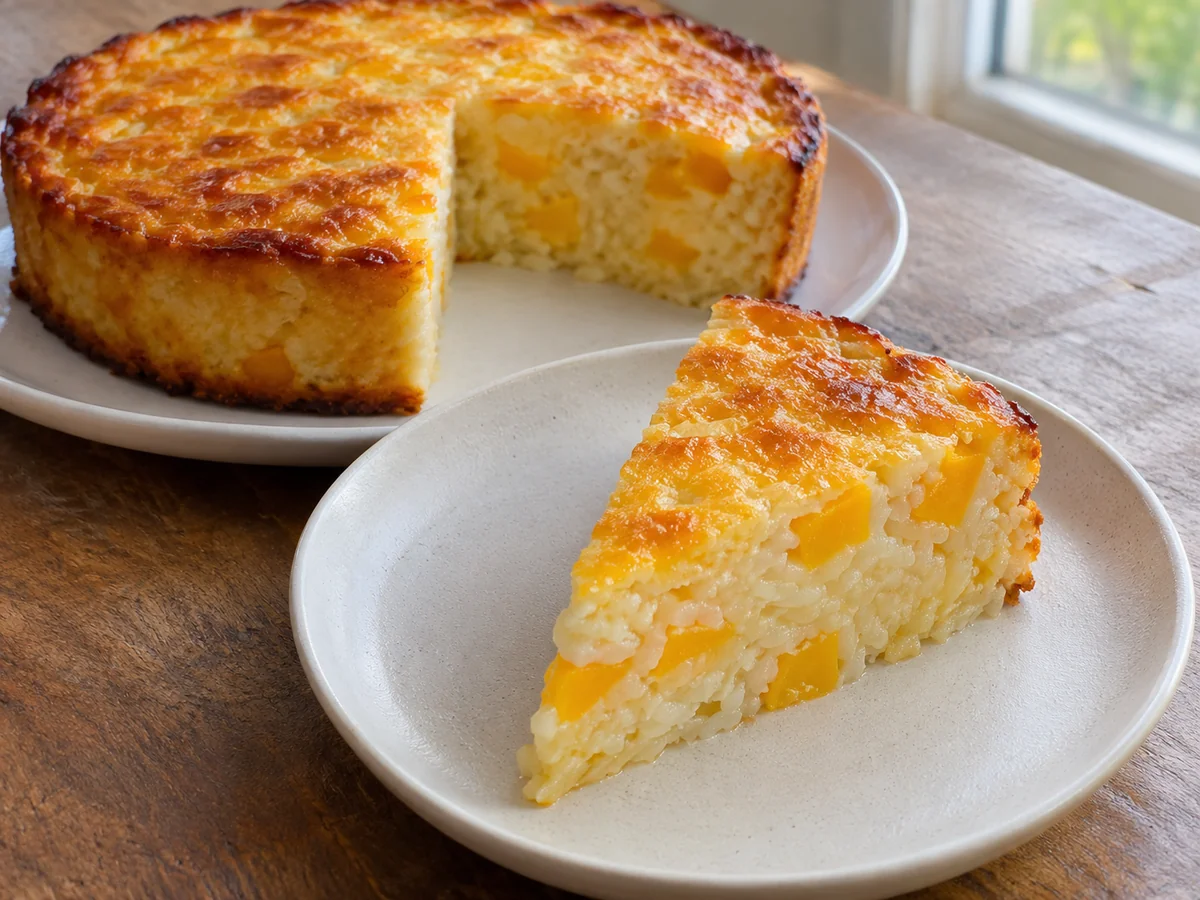
Moist cake made with round rice cooked in milk and coconut milk, enriched with fresh mango and eggs, baked in the oven without caramel.
Ingredients
- 150 g raw round rice
- 500 ml semi-skimmed milk
- 200 ml unsweetened coconut milk
- 3 eggs
- 70 g sugar
- 300 g firm mango flesh
- 10 ml neutral oil
- 1 g salt
Preparation
Pour the semi-skimmed milk and unsweetened coconut milk into a heavy-bottomed saucepan, add the gram of salt and bring to a gentle simmer over medium heat while stirring to prevent the milk from sticking to the bottom. Add the one hundred and fifty grams of raw round rice in a rain, lower the heat to minimum and cook for thirty-five minutes stirring very regularly with a wooden spatula, until the grains are tender and the mixture thickens into a smooth porridge; if the liquid evaporates too quickly before the rice is tender, add a tablespoon of cold water and continue cooking.
Immediately spread the cooked rice preparation in a large shallow dish or on a baking sheet, smooth with a spatula to a uniform thickness of about two centimeters to maximize the surface area in contact with the air, and let cool at room temperature for twenty minutes, then place in the refrigerator for at least forty minutes until the mass is very cold at the core, which prevents the eggs from cooking on contact during incorporation.
Preheat the oven to one hundred and seventy degrees Celsius in static heat, position a rack in the middle of the oven. Brush the inside of a cake pan or a twenty-centimeter diameter pastry ring with the ten milliliters of neutral oil using a brush, insisting on the sides for a clean release.
In a bowl, crack the three whole eggs, add the seventy grams of sugar and whisk vigorously for two minutes until the mixture whitens, becomes frothy and the sugar is almost completely dissolved, without seeking to make a thick ribbon.
Incorporate the cold rice base in three additions into the egg-sugar mixture, mixing gently with a spatula after each addition to obtain a homogeneous batter without overworking the structure, then fold in the three hundred grams of firm mango dice with a spatula to coat them evenly.
Pour the batter into the greased mold, smooth the surface with an offset spatula, tap the mold lightly on the work surface to chase out large air bubbles, then bake immediately for thirty-five to forty-five minutes.
Monitor the baking from the thirtieth minute: the cake should rise slightly, the surface should be matte and firm to the touch, and a probe inserted in the center should indicate a minimum of seventy-one degrees Celsius; the texture should be set, with no visible liquid part, and the edges should begin to pull away from the mold.
Remove the cake from the oven, place it on a rack and let it warm for ten minutes, then run a thin blade between the cake and the mold, unmold delicately onto the rack and let cool completely at room temperature for thirty minutes before placing in the refrigerator for at least two hours before serving.
Introduction
This rice cake with mango and coconut offers a melting and fragrant texture, obtained by the slow cooking of round rice directly in a mixture of semi-skimmed milk and unsweetened coconut milk. The choice of round rice, rich in starch, guarantees a natural binding without the addition of flour or starch, while the coconut milk provides a vegetable creaminess that balances the sweetness of animal milk. The mango, selected firm and perfectly ripe, is cut into small regular dice to distribute its fruity flavor and slight acidity throughout the batter, without making the mixture too liquid. The organization of the preparation rests on two key stages: first the cooking of the rice in the milks, which requires constant monitoring and frequent stirring for about thirty-five minutes, until the grains are tender and have absorbed almost all the liquid, with a possible adjustment of a trickle of water if evaporation is too rapid; then the rapid cooling of this rice-milk base, an essential step before incorporating the eggs beaten with sugar, in order to avoid any premature coagulation. Molding in a greased twenty-centimeter ring, followed by baking in the oven at one hundred and seventy degrees Celsius for thirty-five to forty-five minutes, allows the cake to acquire a firm but moist consistency, reaching a minimum core temperature of seventy-one degrees Celsius and a set texture, without caramelized coloring. This contemporary recipe, created for the Côte d'Ivoire collection of the RecettesAfricaines.com site, claims no traditional origin or therapeutic virtue; it showcases accessible ingredients and a mastered technique for a simple and elegant family dessert.
Cultural context
Contemporary recipe created for the Côte d'Ivoire collection of RecettesAfricaines.com, without claim of traditional origin or heritage history. General references on food composition and food safety: https://www.fao.org/infoods/infoods/tables-and-databases/faoinfoods-databases/en/ ; https://www.who.int/teams/nutrition-and-food-safety/multisectoral-actions-in-food-systems/five-keys-to-safer-food-poster ; https://www.foodsafety.gov/food-safety-charts/safe-minimum-internal-temperatures. No nutritional calculation has been performed for this recipe.
Tips
Use a firm mango of Kent or Keitt variety, peeled and pitted just before use, to prevent it from releasing too much water into the batter; cut it into dice of one centimeter maximum per side.
If the rice is not tender enough after thirty-five minutes, extend the cooking by five minutes adding two tablespoons of water, but never let the mixture stick to the bottom of the saucepan.
The rapid cooling of the rice-milk base on a baking sheet speeds up the process and guarantees a temperature below twenty degrees before adding the eggs, a sine qua non condition for the final hold.
For a perfect release, line the bottom of the mold with a disc of parchment paper cut to size, in addition to the oil on the sides.
Nutrition notes
Carbohydrates come in part from rice. Protein is supplied in part by eggs and dairy. Fats come in part from coconut milk and oil. Allergens to flag in the listed ingredients: eggs and milk. These notes describe the ingredients rather than a calculated nutritional analysis of the dish. Actual composition varies with the products chosen, their water content and the way the food is divided among four plates. Evaporation changes serving weight without establishing calories per portion. Added salt must also be considered alongside any salt in packaged ingredients. Check their labels and possible allergen contact on equipment. The stated proportions are for preparing the recipe; they do not define a suitable dietary portion for every person. Garnishes or side dishes served separately should be considered separately because they are not included in this formulation.
Conclusion
The cake is enjoyed very cold, cut into neat slices using a knife dipped in hot water and wiped between each cut. It keeps in the refrigerator, wrapped in contact film or in an airtight container, for a maximum of forty-eight hours; beyond that, the rice texture hardens and the mango may ferment slightly. Do not freeze, thawing alters the cake structure and releases the mango water. Serve plain or accompanied by a drizzle of fresh mango coulis blended and passed through a sieve, without added sugar.
Enjoy your meal
Bon appétit !