Cabbage Soup with White Beans and Cassava
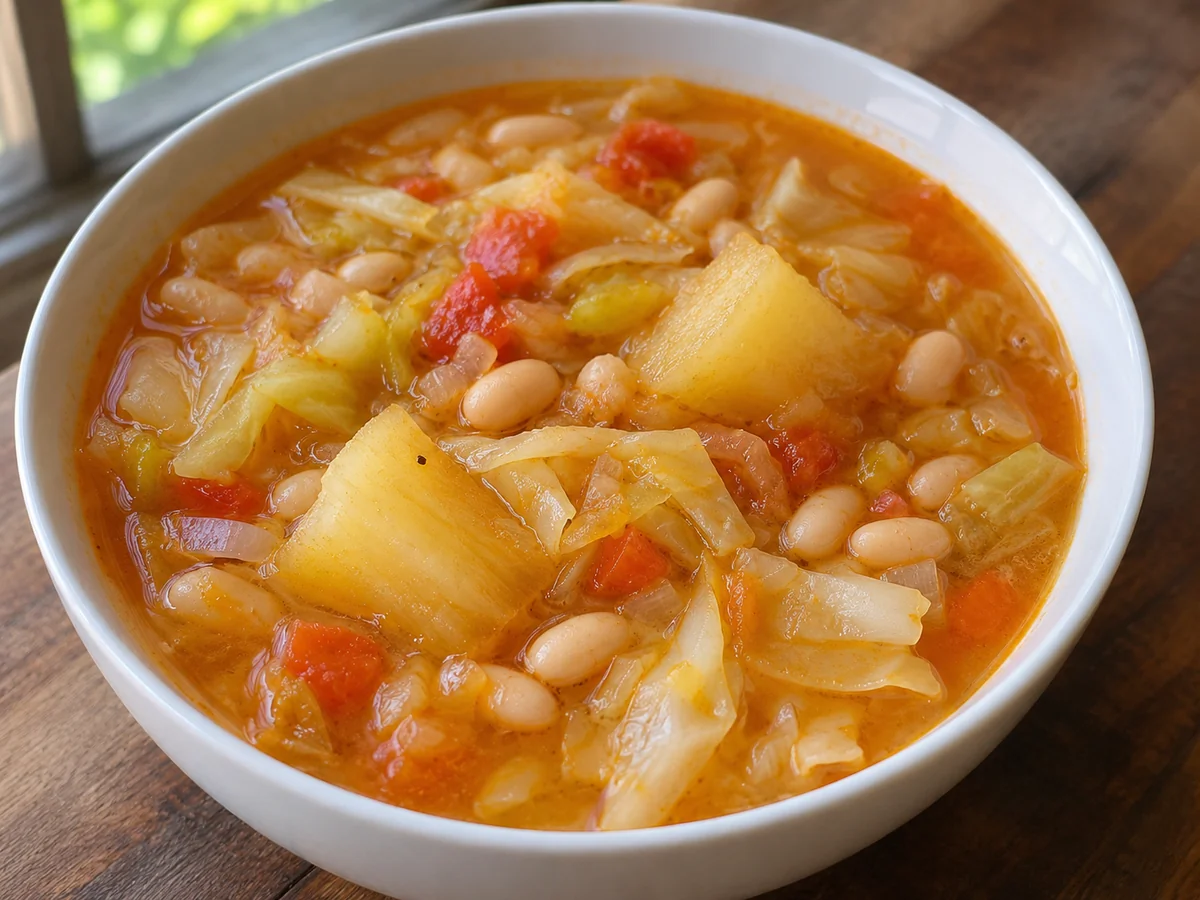
Contemporary Ivorian soup combining precooked cassava, white cabbage, and white beans in a tomato-onion-ginger broth. Complete main dish for four people.
Ingredients
- 500 g of peeled food cassava
- 400 g of cooked white beans drained
- 350 g of white cabbage
- 300 g of tomatoes
- 120 g of onion
- 15 g of ginger
- 20 ml of oil
- 1 liter of water for the soup
- 4 g of salt
- 1 g of pepper
- abundant water for the precooking of the cassava
Preparation
Carefully peel the five hundred grams of food cassava by removing the brown skin and the thin underlying pink layer, then cut the tuber into four to five centimeter sections to access the fibrous central core which must be removed entirely with a knife. Plunge the pieces into a large pot, cover widely with cold unsalted water, bring to a vigorous boil and maintain a rolling boil for twenty-five to thirty minutes until the tip of a knife passes through the flesh without resistance. Drain immediately in a colander and discard the cooking water entirely without reusing it, then briefly rinse the pieces under lukewarm running water to eliminate any surface residue. Reserve the precooked cassava on a tray.
While the cassava cooks, prepare the aromatic base: finely mince the one hundred twenty grams of onion, grate the fifteen grams of peeled fresh ginger, roughly chop the three hundred grams of tomatoes. Heat the twenty milliliters of oil in a heavy-bottomed pot over medium heat, sweat the onion for four to five minutes until it becomes translucent without coloring, add the ginger and cook for one additional minute while stirring, then incorporate the tomatoes and let reduce for eight to ten minutes until obtaining a thick and fragrant pulp, crushing the pieces against the wall.
Pour the liter of water for the soup over the tomato-onion-ginger base, bring to a gentle simmer, add the four grams of salt and the one gram of pepper, then plunge the three hundred fifty grams of white cabbage cut into strips one centimeter wide. Let cook uncovered for fifteen minutes at a low boil, checking that the cabbage retains a slight bite while being cooked through. Do not cover hermetically to preserve the green color of the cabbage and avoid mushy overcooking.
Then incorporate the five hundred grams of precooked cassava cut into two centimeter cubes, distributing them evenly in the broth. Maintain a moderate simmer for five minutes to reheat the cassava through without breaking it up, stirring gently with a wooden spoon so as not to break the cubes. The texture must remain firm, the cassava must not turn into a puree nor thicken the broth by excess starch released.
Finally add the four hundred grams of cooked white beans drained, pouring them with their preservation liquid if any remains, and extend the cooking for five additional minutes, that is ten minutes total since the addition of the cassava, just the time to bring the whole to a uniform serving temperature. Taste and adjust seasoning if necessary, keeping in mind that the beans already bring a sweet flavor that balances the pepper.
Turn off the heat, let the soup rest for two minutes off the heat so that the flavors meld without excessive residual cooking. Visually check that the broth remains clear, slightly cloudy from the tomato juices, that the cassava cubes are intact, the cabbage strips green and the beans whole. No liaison, no blending, no addition of final fat are planned.
Distribute the soup into four preheated deep bowls, ensuring an equitable distribution of the three solid components: cassava, cabbage, beans. Serve immediately, without additional garnish, to appreciate the clarity of textures and the frankness of the broth. The ideal serving temperature is around ninety degrees Celsius at the core of the liquid.
Store any leftovers in an airtight container after rapid cooling at room temperature for thirty minutes maximum, then refrigerate at four degrees Celsius and consume within twenty-four hours. Reheat gently in a saucepan or microwave until simmering, without boiling violently to preserve the texture of the cassava and cabbage. Do not freeze, the texture of the cabbage and cassava would degrade irreversibly.
Introduction
This contemporary soup of Ivorian inspiration highlights three staple ingredients from the local market: food cassava, white cabbage, and already cooked white beans. The desired result is a generous bowl where each component retains its identity: cassava in tender but firm cubes, cabbage in slightly crunchy strips, whole and creamy beans, all bound by a broth flavored with tomato, onion, and ginger. The selection of cassava demands absolute vigilance: only a sweet so-called food cassava, of reliable origin and never bitter or of uncertain origin, is suitable for this recipe. Its preparation follows a non-negotiable safety rule: complete peeling, removal of the fibrous central core, precooking in a large volume of boiling water for twenty-five to thirty minutes until perfect tenderness, then total elimination of this cooking water which will under no circumstances be reused in the soup. This preliminary step, carried out in advance, guarantees the innocuousness of the tuber and allows the final cooking to be chained serenely. The work organization therefore clearly separates two phases: the precooking of the cassava on one side, the construction of the aromatic base and the quick cooking of the green vegetables on the other. The white beans, bought already cooked and drained, only require a final reheating of ten minutes. The cabbage, added after the tomato base, will cook for fifteen minutes to maintain a clean texture. No liaison, no cream, no added starch comes to mask the clarity of the broth. The major distinction of this recipe lies in this refusal of raw cassava simmered directly in the soup, a risky practice, in favor of a rigorous precooking validated by food safety standards.
Cultural context
Contemporary creation for the Côte d'Ivoire collection of RecettesAfricaines.com, without claim of traditional anteriority or historical origin. General references for composition and food safety: https://www.fao.org/infoods/infoods/tables-and-databases/faoinfoods-databases/en/ ; https://www.who.int/teams/nutrition-and-food-safety/multisectoral-actions-in-food-systems/five-keys-to-safer-food-poster ; https://www.foodsafety.gov/food-safety-charts/safe-minimum-internal-temperatures. No nutritional calculation has been performed.
Tips
Precook the cassava the day before: once drained and rinsed, keep it in the refrigerator in a closed container; it will gain in firmness and be easier to cut into clean cubes on the day.
Use quality jarred white beans, well rinsed under running water to reduce excess sodium, or cook them yourself without salt the day before to control the final seasoning.
Cut the cabbage into regular strips with a mandoline or a well-sharpened knife: pieces too large cook poorly, too fine fall apart in the broth.
Prepare the tomato-onion-ginger base in advance and keep it chilled; on the day, all that remains is to add the water, the cabbage, the cassava and the beans according to the indicated times.
Nutrition notes
Carbohydrates come in part from cassava. Protein is supplied in part by legumes. Fats come in part from oil. These notes describe the ingredients rather than a calculated nutritional analysis of the dish. Actual composition varies with the products chosen, their water content and the way the food is divided among four plates. Evaporation changes serving weight without establishing calories per portion. Added salt must also be considered alongside any salt in packaged ingredients. Check their labels and possible allergen contact on equipment. The stated proportions are for preparing the recipe; they do not define a suitable dietary portion for every person. Garnishes or side dishes served separately should be considered separately because they are not included in this formulation.
Conclusion
This soup is eaten hot, as a main dish for evening or lunch, accompanied optionally by a corn bread or plain white rice for larger appetites. The portions are calibrated for four generous bowls of approximately four hundred fifty milliliters each. Rapid cooling before refrigeration is essential: do not leave the pot at room temperature for more than thirty minutes. In the refrigerator, the soup keeps for twenty-four hours maximum in an airtight container. Reheating is done over low heat until the first simmer, without prolonged boiling which would soften the cassava and cabbage. Freezing is not recommended: the cellular structure of the cabbage and precooked cassava bursts upon thawing, giving a mushy texture and a cloudy broth. Serving in preheated bowls maintains the serving temperature longer.
Enjoy your meal
Bon appétit