Yam gratin with spinach and fish
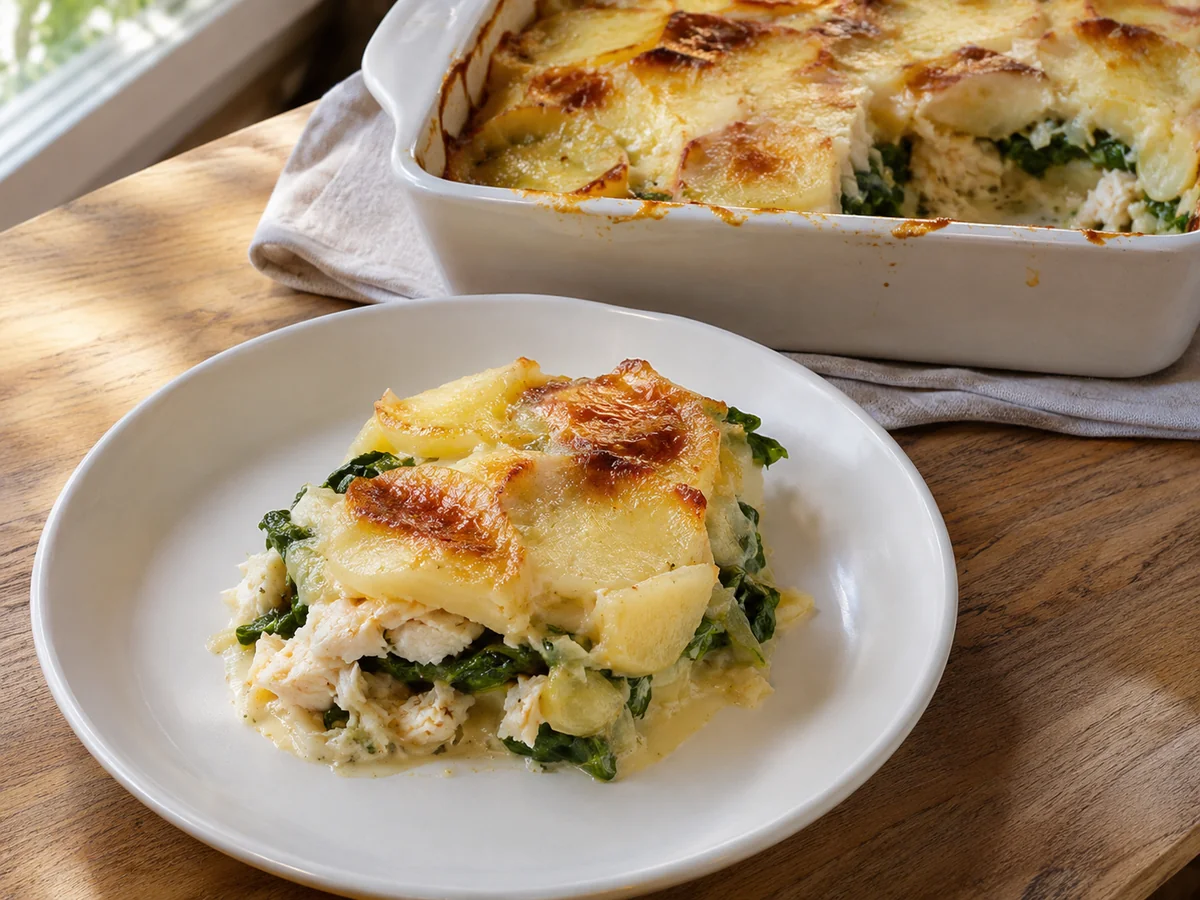
Ivorian yam gratin with spinach and white fish, light white sauce without cheese, oven baked at 190°C for a balanced family meal.
Ingredients
- 800 g of peeled food yam
- 400 g of boneless white fish fillet
- 300 g of spinach
- 350 ml of semi-skimmed milk
- 30 g of wheat flour
- 25 ml of oil
- 120 g of onion
- 4 g of salt
- 1 g of pepper
- water for cooking the yam
Preparation
Bring a large pot of unsalted water to a boil, plunge in the peeled yam slices two centimeters thick, maintain a steady simmer for exactly twenty minutes until the tip of a knife passes through the flesh without resistance, then drain immediately in a colander letting the steam escape to prevent the yam from continuing to cook and becoming pasty.
While the yam cooks, finely mince the one hundred twenty grams of onion, melt them over low heat in a sauté pan with twenty milliliters of oil for eight minutes stirring often until they become translucent and fragrant without brown coloring, set aside off the heat.
In the same sauté pan, heat the remaining five milliliters of oil, sprinkle the thirty grams of wheat flour in a rain while whisking vigorously for two minutes to obtain a smooth blond roux, then gradually pour the three hundred fifty milliliters of cold semi-skimmed milk while continuing to whisk until obtaining a smooth and shiny sauce.
Bring the sauce to a gentle simmer for five minutes stirring constantly at the bottom so that it thickens and coats the spoon, incorporate the four grams of salt and the gram of pepper, add the reserved melted onions, mix then remove from heat.
Wash the three hundred grams of spinach thoroughly under running water, spin dry, wilt them for two minutes in a large dry skillet over high heat stirring, transfer immediately to a colander and press firmly with the back of a ladle to extract the maximum amount of vegetation water.
Place the four hundred grams of white fish fillets in a steamer basket above a pot of simmering water, cover and cook eight minutes until the core temperature reaches sixty-three degrees Celsius, the flesh becoming opaque and detaching in flakes with a fork, check for absence of residual bones.
Roughly flake the cooked fish into two centimeter pieces, distribute them evenly in a slightly oiled two liter gratin dish, add the drained yam slices and the pressed spinach, mix gently so as not to crush the yam, coat with the white onion sauce ensuring to cover the surface well.
Bake the dish in the middle of the oven preheated to one hundred ninety degrees Celsius for twenty minutes, monitor the setting on the surface which must become firm and lightly golden without burning, check that a probe inserted in the center indicates at least seventy-four degrees Celsius before removing the gratin.
Introduction
This contemporary yam gratin with spinach and white fish offers a complete plate where the melting texture of the tuber meets the green freshness of spinach and the delicacy of a steamed fish. The recipe was designed for four diners by prioritizing ingredients accessible on Ivorian markets: a food yam of sweet variety, carefully peeled to remove any fibrous part, boneless white fish fillets, and young spinach with tender stems. The absence of cheese in the ingredient list imposes a white sauce made with a blond roux, where wheat flour cooked in oil binds the semi-skimmed milk into a smooth coating without heaviness, flavored only by the melted onion, salt and pepper. The work organization follows a logic of separate cooking: the yam boiled for twenty minutes in a large volume of salted water until perfect tenderness, the fish steamed until 63°C core to guarantee an opaque flesh that flakes without resistance, the spinach wilted briefly then pressed to eliminate excess water that would dilute the sauce. Each element thus preserves its taste identity before the final assembly in an oiled dish, where the heat of the oven at 190°C for twenty minutes is enough to bind the whole and bring the internal temperature to 74°C, safety threshold for a preparation recomposed from already cooked elements. This approach avoids overcooking the yam which would become pasty, preserves the structure of the roughly flaked fish, and allows the sauce to set on the surface without excessive browning, offering a light golden gratin, stable when cut and reheatable without loss of quality.
Cultural context
Contemporary creation for the Côte d'Ivoire collection of RecettesAfricaines.com, without claim of traditional origin. General composition and food safety references: https://www.fao.org/infoods/infoods/tables-and-databases/faoinfoods-databases/en/ ; https://www.who.int/teams/nutrition-and-food-safety/multisectoral-actions-in-food-systems/five-keys-to-safer-food-poster ; https://www.foodsafety.gov/food-safety-charts/safe-minimum-internal-temperatures. No nutritional calculation has been performed.
Tips
Cook the yam the day before, drain it, cool it on a tray and refrigerate in an airtight container; it holds better at assembly and does not absorb the sauce. To check the milk binding, lift a spoonful of sauce before pouring it into the dish: it must coat lightly, without showing flour lumps. If lumps are visible, whisk this base alone before reuniting it with the fish. The yam pieces must be tender enough to be easily pierced with the tip of a knife; the oven pass serves to finish the whole, not to cook a still hard root. Drain the spinach well so that their water does not excessively thin the sauce. Finally distribute the fish in comparable pieces to check its cooking at the center of the thickest parts.
Prepare the white sauce until thickening, film it on contact and keep it two hours at room temperature; reheat it gently while whisking before incorporating onions and fish.
Use a firm-fleshed fish type hake or pollock; too delicate flesh disintegrates when flaked and disappears into the sauce.
Press the spinach by small handfuls in a fine sieve rather than in a cloth to save time and recover a maximum of water without losing leaves.
Nutrition notes
Carbohydrates come in part from yam. Protein is supplied in part by fish. Fats come in part from oil. Allergens to flag in the listed ingredients: fish, milk and wheat. These notes describe the ingredients rather than a calculated nutritional analysis of the dish. Actual composition varies with the products chosen, their water content and the way the food is divided among four plates. Evaporation changes serving weight without establishing calories per portion. Added salt must also be considered alongside any salt in packaged ingredients. Check their labels and possible allergen contact on equipment. The stated proportions are for preparing the recipe; they do not define a suitable dietary portion for every person. Garnishes or side dishes served separately should be considered separately because they are not included in this formulation.
Conclusion
Serve the gratin hot, cut into regular portions with a flat spatula, accompanied by a green salad seasoned with a drizzle of lemon to contrast the creaminess. Leftovers keep forty-eight hours in the refrigerator in a closed container; reheat in the oven at one hundred sixty degrees Celsius for fifteen minutes or in the microwave at medium power covered, until seventy-four degrees Celsius at core. Do not refreeze after thawing. Discard any portion left more than two hours at room temperature.
Enjoy your meal
Bon appétit