Roasted butternut squash with lentils and sesame
Oven-roasted butternut squash cubes served on a bed of warm green lentils with melted onions, flavored with lime and sprinkled with toasted sesame.
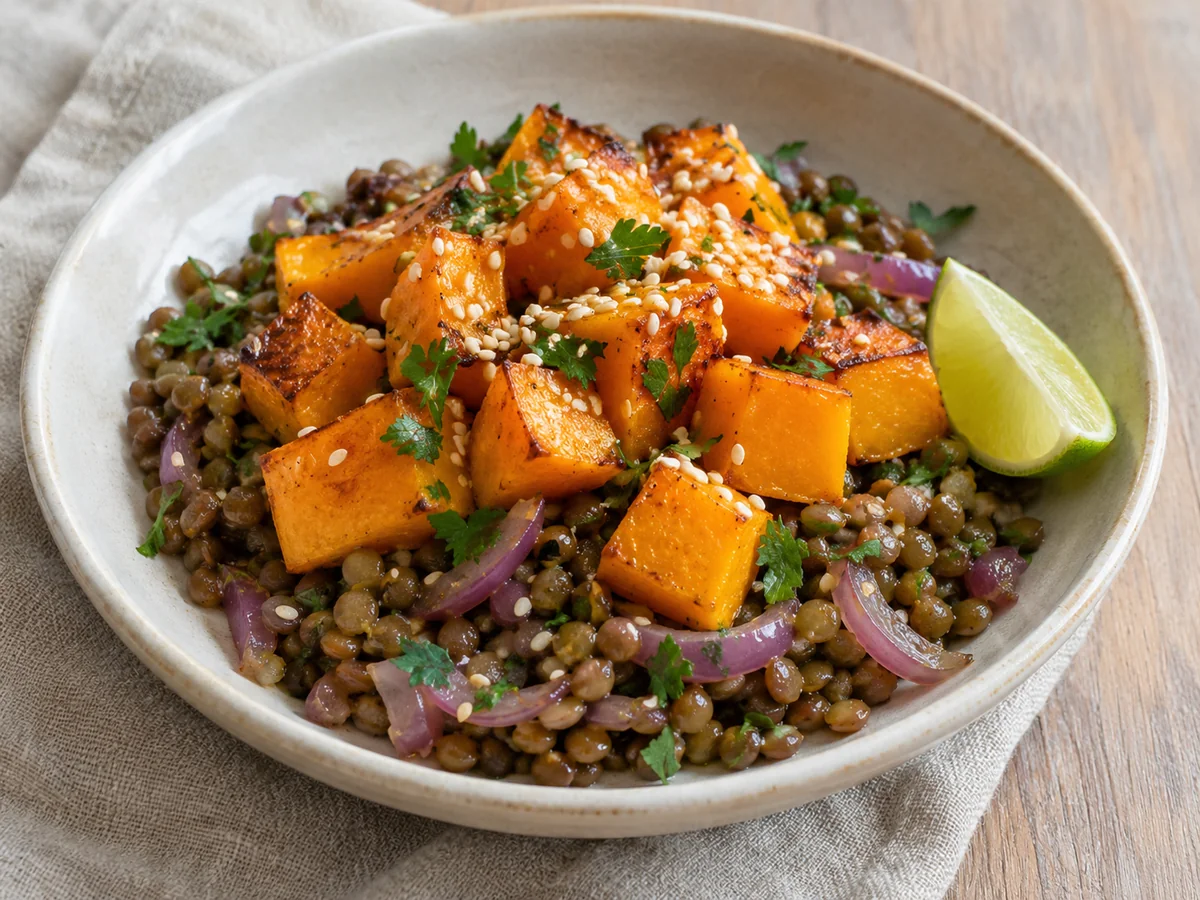
Ingredients
- 800 g peeled butternut squash
- 500 g cooked green lentils, drained
- 120 g red onion
- 25 g sesame
- 25 ml oil
- 1 lime
- 10 g parsley
- 100 ml water
- 4 g salt
- 1 g pepper
Preparation
Preheat the oven to 200 °C fan-assisted. Cut the peeled butternut squash into regular cubes two and a half centimeters on each side, taking care to thoroughly remove the stringy fibers and central seeds. Spread the cubes on a baking sheet lined with parchment paper without overlapping, drizzle evenly with fifteen milliliters of oil out of the twenty-five milliliters total, sprinkle with two grams of salt out of the four grams total and half the pepper, then toss gently by hand to coat each face. Bake at mid-height for thirty minutes, turning the cubes halfway through cooking with a metal spatula, until they show a deep golden color on the edges and tender flesh under the tip of a knife without collapsing.
While the squash cooks, finely slice the red onion into half-moons about three millimeters thick. Heat a wide sauté pan over medium heat with the remaining ten milliliters of oil. Add the onions, sprinkle with a pinch of the remaining salt to promote sweating, and cook for eight to ten minutes, stirring frequently with a wooden spoon, until they become translucent, melting, and slightly caramelized on the edges without burning. Then add the cooked green lentils, drained, pour in the one hundred milliliters of water, sprinkle with the remaining salt (about one gram) and the remaining pepper, then stir thoroughly to deglaze the fond from the bottom of the sauté pan.
Keep the lentils over low heat for five minutes, stirring every minute, until the water has almost completely evaporated and the legumes have absorbed the onion juices to form a cohesive, glossy, warm bed, without excess residual liquid. Taste and adjust seasoning if necessary, then remove the sauté pan from the heat and cover to maintain temperature while the squash finishes.
Place a dry non-stick skillet over medium-high heat. Add the twenty-five grams of sesame seeds and toast for exactly two minutes, shaking the pan in a constant circular motion to avoid any burning spots, until they release a roasted hazelnut aroma and take on a light amber hue. Transfer immediately to a small cold bowl to stop the cooking.
Remove the baking sheet from the oven. Check the tenderness of the squash cubes by inserting the tip of a knife into the largest ones: the blade should slide without resistance but the flesh must keep its structure. Let rest for two minutes out of the oven so that surface steam evaporates and the crust firms up slightly.
Wash the lime under running water, dry it, then zest using a fine grater, avoiding the bitter white pith. Press the fruit to extract the juice. Wash the flat-leaf parsley, spin it thoroughly dry in a clean kitchen towel, then finely chop the leaves, discarding the thick stems.
In the sauté pan containing the warm lentils, incorporate the lime juice, half the zest, and half the chopped parsley. Mix one last time to distribute the acidity and herbal freshness throughout the lentil bed.
Plate in four shallow bowls: spread the lentil bed on the bottom, arrange the roasted squash cubes harmoniously on top, sprinkle generously with toasted sesame, scatter the remaining zest and parsley, and serve immediately.
Introduction
This contemporary recipe combines the natural sweetness of oven-roasted butternut squash with the firm texture and earthy flavor of pre-cooked green lentils, all enhanced by the lively acidity of lime and the fragrant crunch of toasted sesame. The preparation is organized around parallel cooking management: while the squash develops its caramelized flavors in the oven at 200 °C for thirty minutes, the already-cooked lentils are simply reheated in a pan with thinly sliced red onions that melt slowly in the oil, creating a creamy base without the addition of cream or butter. The absence of dried lentils from the ingredient list eliminates any uncertainty about soaking time or initial cooking, guaranteeing a reproducible result in thirty-five minutes flat. The major distinction of this dish lies in the balance of textures: the two-and-a-half-centimeter squash cubes retain a firm hold under the golden crust, while the lentils remain distinct, coated in a reduced cooking juice from the one hundred milliliters of water and onion juices. The sesame, toasted dry at the end of the process, adds a roasted note that contrasts with the freshness of chopped flat-leaf parsley and lime zest added off the heat to preserve their volatile aromas. This vegan main dish, gluten-free and dairy-free, fits into an efficient everyday cuisine where the quality of the squash — firm, heavy for its size, matte skin — and the al dente cooking of store-bought green lentils determine the final success.
Cultural context
Contemporary creation for the Côte d'Ivoire collection of RecettesAfricaines.com, without claim of traditional heritage. General composition and food safety references: https://www.fao.org/infoods/infoods/tables-and-databases/faoinfoods-databases/en/ ; https://www.who.int/teams/nutrition-and-food-safety/multisectoral-actions-in-food-systems/five-keys-to-safer-food-poster ; https://www.foodsafety.gov/food-safety-charts/safe-minimum-internal-temperatures. No nutritional calculation has been performed.
Tips
The butternut squash must be chosen firm, heavy for its size, with a matte and intact skin; an overripe squash would yield mushy cubes that collapse during cooking. If preparing ahead, cut the raw cubes and store them in the refrigerator in an airtight container with a drizzle of oil for up to twenty-four hours before roasting.
Store-bought cooked green lentils vary in firmness; taste them before incorporating: if they are already very tender, reduce the reheating to three minutes and decrease the water to fifty milliliters to avoid a mushy texture. For a homemade version, cook two hundred fifty grams of dried green lentils in three times their volume of unsalted water for twenty minutes al dente, drain and weigh five hundred grams.
Sesame burns in seconds: use a heavy-bottomed pan, stay by the heat, and transfer the seeds as soon as the hazelnut aroma appears. You can toast the sesame up to forty-eight hours in advance and store it in an airtight box at room temperature.
The lime and parsley must be added off the heat to preserve their freshness; if service is delayed more than fifteen minutes, keep zest, juice, and parsley separate and mix at the last moment. The lentils keep for three days in the refrigerator in a closed box; reheat them gently with a tablespoon of water before plating.
Nutrition notes
Carbohydrates come in part from legumes. Protein is supplied in part by legumes. Fats come in part from sesame and oil. Allergens to flag in the listed ingredients: sesame. These notes describe the ingredients rather than a calculated nutritional analysis of the dish. Actual composition varies with the products chosen, their water content and the way the food is divided among four plates. Evaporation changes serving weight without establishing calories per portion. Added salt must also be considered alongside any salt in packaged ingredients. Check their labels and possible allergen contact on equipment. The stated proportions are for preparing the recipe; they do not define a suitable dietary portion for every person. Garnishes or side dishes served separately should be considered separately because they are not included in this formulation.
Conclusion
Serve this dish warm in shallow bowls to retain the heat of the lentils and the crunch of the sesame. It constitutes a balanced, complete vegan meal for four people. Leftovers keep in the refrigerator for up to three days in separate airtight containers: squash on one side, lentils on the other, sesame and herbs in small jars. To reheat, place the squash in the oven at 160 °C for ten minutes to regain crunch, and the lentils in a pan with a spoonful of water. Do not freeze roasted squash, which would lose its texture; plain lentils freeze well. Discard any leftovers left at room temperature for more than two hours.
Enjoy your meal
Bon appétit