Oven-Baked Fish with Orange and Fennel
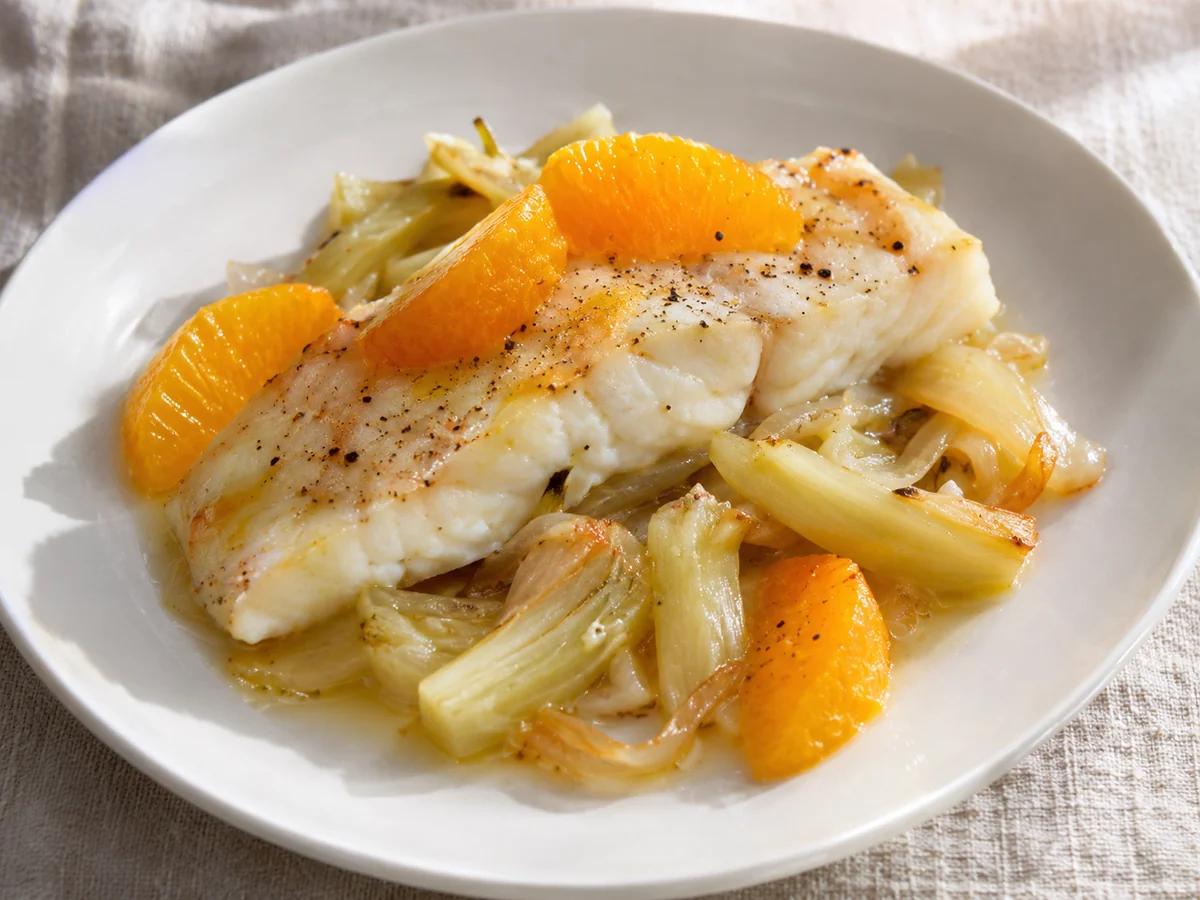
White fish fillets roasted on a bed of braised fennel, scented with fresh orange juice and supreme segments. Controlled cooking at 190°C for pearly flesh at 63°C core.
Ingredients
- 600 g boneless white fish fillets
- 450 g fennel
- 2 oranges
- 100 g onion
- 20 ml oil
- 100 ml water
- 4 g salt
- 1 g pepper
Preparation
Preheat the oven to one hundred ninety degrees Celsius in convection mode. While the oven heats, wash the fennel thoroughly under running water, remove the tough base and fibrous green stalks, cut the bulb in half lengthwise, remove the tough central core if present, then finely slice the half-bulbs on a mandoline or with a knife into strips two millimeters thick for even cooking.
Peel the onion, cut it in half, finely slice it into regular half-moons. In a wide heavy-bottomed sauté pan, heat ten milliliters of oil over medium heat without letting it smoke, add the onion and a pinch of the four grams of salt, sweat for three minutes stirring until transparent without coloring.
Add the sliced fennel to the sauté pan, stir gently to coat with oil, pour in one hundred milliliters of water, sprinkle the remaining salt and the one gram of pepper, bring to a simmer, cover tightly and lower to minimum. Braise for exactly fifteen minutes checking halfway that the liquid has not completely evaporated; the fennel must become melting, translucent and fragrant without browning.
During the braising, press one orange by hand or with a citrus press to extract all the juice, strain it to remove seeds and coarse pulp, set aside. Peel the second orange supreme-style: slice off the poles, stand the fruit on a flat side, follow the curve to remove skin and white membrane, then release the segments by cutting along the membranous partitions over a bowl to catch the residual juice; set aside the intact segments chilled.
Spread the braised fennel and its cooking juice evenly in a rectangular oven dish approximately twenty by thirty centimeters, form a compact bed. Place the four fish fillets side by side without overlapping, skin against fennel if any remains, flesh side up. Drizzle each fillet evenly with the pressed orange juice.
Brush the surface of the fillets with the remaining ten milliliters of oil using a soft brush to form a protective film. Place in the oven immediately at mid-height. Set timer for twelve minutes for fillets two centimeters thick, eighteen minutes for three centimeters, without opening the door during the first ten minutes.
At the end of the programmed time, remove the dish, check core doneness: insert a probe thermometer into the center of the thickest fillet, the temperature must reach sixty-three degrees Celsius; failing that, the flesh must be opaque, pearly, separate into clean flakes under the knife tip without gelatinous resistance.
If doneness is perfect, let the fish rest out of the oven for two minutes. Plate each serving: take a portion of fennel as base, place the fillet, arrange the supreme orange segments harmoniously around and on the fish, drizzle with a spoonful of cooking juice recovered from the dish. Serve immediately.
Introduction
This contemporary creation highlights the aniseed sweetness of long-braised fennel which forms a protective aromatic bed for delicate white fish fillets. The pairing with orange unfolds in two stages: the pressed juice of one whole fruit acidifies and moistens the cooking of the fennel then the fish, while the second fruit, peeled supreme-style with care, yields its intact segments for a fresh and juicy finish at serving time. The choice of fish requires a firm white flesh — pollock, cod or hake — cut into regular portions of one hundred fifty grams each, boneless and skinless for smooth eating. The preparation organization clearly separates two phases: first the braising of fennel finely sliced on a mandoline and diced onion in ten milliliters of oil and one hundred milliliters of water, covered, for fifteen minutes over low heat until meltingly tender and translucent; then the passage into the oven preheated to one hundred ninety degrees Celsius where the fish rests on this vegetable bed, coated with the orange juice and the remaining ten milliliters of oil. This structural distinction avoids overcooking the fish while concentrating the cooking juices in the dish. Doneness verification is done at core at sixty-three degrees Celsius or by pearly opacity and easy flake separation at the knife tip, guaranteeing a moist texture never dry. The absence of cream, butter or flour keeps the profile light and highlights the intrinsic quality of the three main ingredients.
Cultural context
Contemporary recipe created for the Côte d'Ivoire collection of RecettesAfricaines.com, without claim of traditional heritage. General composition and food safety references: https://www.fao.org/infoods/infoods/tables-and-databases/faoinfoods-databases/en/ ; https://www.who.int/teams/nutrition-and-food-safety/multisectoral-actions-in-food-systems/five-keys-to-safer-food-poster ; https://www.foodsafety.gov/food-safety-charts/safe-minimum-internal-temperatures. No nutritional calculation has been performed on this recipe.
Tips
The fennel can be sliced and the onion diced up to four hours in advance, stored separately in the refrigerator in airtight containers; the braising itself is done at the last moment to preserve the melting texture and avoid oxidation of the fine strips.
To supreme orange segments without loss, use a thin flexible knife, work over a bowl to recover the juice from the membranes which will be added to the cooking juice; the segments keep for one hour chilled on absorbent paper.
If the fillets are uneven, place the thicker ones in the center of the dish where heat is more stable, the thinner ones toward the edges; this evens out cooking without having to remove pieces early.
The oven dish can be replaced by a large oven-safe skillet: braise the fennel in it, place the fish on top, bake directly; this avoids a transfer and recovers all the juices.
Nutrition notes
Carbohydrates come in part from vegetables. Protein is supplied in part by fish. Fats come in part from oil. Allergens to flag in the listed ingredients: fish. These notes describe the ingredients rather than a calculated nutritional analysis of the dish. Actual composition varies with the products chosen, their water content and the way the food is divided among four plates. Evaporation changes serving weight without establishing calories per portion. Added salt must also be considered alongside any salt in packaged ingredients. Check their labels and possible allergen contact on equipment. The stated proportions are for preparing the recipe; they do not define a suitable dietary portion for every person. Garnishes or side dishes served separately should be considered separately because they are not included in this formulation.
Conclusion
Serve this fish straight from the oven to enjoy the contrast between the warm melting fennel and the fresh bursting orange segments. Ideally accompany with plain basmati rice cooked according to package directions, cooled quickly and refrigerated within two hours if leftovers. Leftover fish and fennel keep for a maximum of twenty-four hours in the refrigerator in a closed container; reheat gently in the oven at one hundred twenty degrees Celsius for ten minutes or by steam to preserve texture, never in the microwave which toughens the flesh. Remaining orange segments are eaten raw as dessert or in salad. Do not refreeze fish already thawed for this recipe. Discard any leftovers left at room temperature for more than two hours.
Enjoy your meal
Bon appétit