Cowpeas with Okra and Carrots
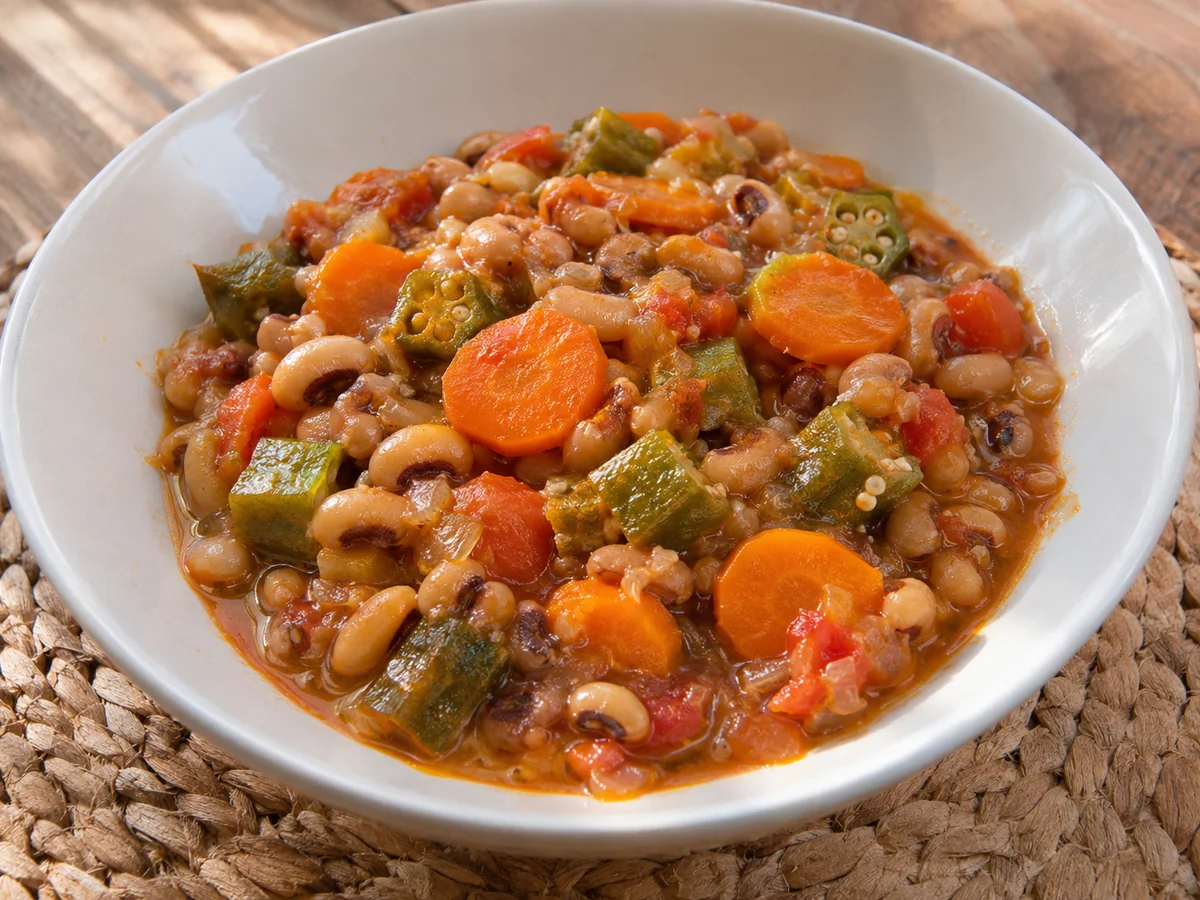
Contemporary Ivorian dish combining cooked cowpeas, fresh okra, and carrots in a smooth tomato sauce, ready in fifty minutes for four people.
Ingredients
- 500 g of cooked drained cowpeas
- 350 g of fresh okra
- 300 g of carrots
- 250 g of tomatoes
- 120 g of onion
- 15 g of ginger
- 25 ml of oil
- 350 ml of water
- 4 g of salt
- 1 g of pepper
Preparation
Peel the one hundred twenty grams of onion and the fifteen grams of ginger; finely dice the onion into regular three to four millimeter cubes and grate the ginger on a fine grater to extract maximum aroma without coarse fibers. In a four to five liter heavy-bottomed Dutch oven, pour the twenty-five milliliters of vegetable oil and heat over medium heat for about two minutes until the oil shimmers without smoking. Add the diced onion, stir constantly with a wooden spoon for six to seven minutes until it becomes translucent and slightly golden at the edges, without brown coloring. Incorporate the grated ginger, continue cooking for one minute thirty seconds while stirring to prevent it from sticking, then add the two hundred fifty grams of tomatoes roughly chopped with a knife; let simmer for eight to ten minutes over medium-low heat, stirring regularly, until the tomato releases its water and the oil begins to rise to the surface, a sign that the aromatic base is ready.
While the tomato base simmers, peel the three hundred grams of carrots using a peeler, trim the ends, then cut them into thin, regular rounds three millimeters thick using a mandoline or a sharp knife to ensure even cooking. As soon as the tomato base shows oil on the surface, add the carrot rounds to the Dutch oven, stir gently to coat them with sauce, then pour in the three hundred fifty milliliters of cold water. Bring to a gentle boil, cover partially with the lid ajar, and cook for twelve to fourteen minutes over medium-low heat until the carrots are tender under the tip of a knife but still retain a slight resistance, without crushing under finger pressure.
During the carrot cooking, prepare the three hundred fifty grams of fresh okra: rinse them under a stream of cold running water for thirty seconds, drain them carefully in a colander, then dry them one by one with paper towels to eliminate any surface moisture that would promote excessive viscous rendering. Cut the hard stem at the base of each okra without cutting into the flesh, then cut the okra into regular two-centimeter-long pieces. Set them aside on a flat plate in a single layer so they do not crush under their own weight.
At the end of the twelve to fourteen minutes of carrot cooking, check their tenderness by inserting the tip of a knife into a central round: it should penetrate without excessive force but meet a slight resistance. Then add the okra pieces to the Dutch oven, distribute them evenly on the surface without submerging them completely, sprinkle the four grams of fine salt and the one gram of freshly ground black pepper, stir gently once from the edge toward the center so as not to break the pieces. Replace the ajar lid, maintain a very gentle simmer, and cook for exactly ten to twelve minutes without stirring, monitoring that the liquid does not boil violently, which would break the okra structure.
During the okra cooking, open the container of five hundred grams of already cooked and drained cowpeas; if from a can, rinse briefly under cold water in a fine-mesh sieve for ten seconds to remove excess brine, then let drain completely by shaking the sieve. If the cowpeas are from a home cooking done the day before, ensure they have been stored in the refrigerator at four degrees maximum and show no trace of fermentation or sour smell. In both cases, weigh precisely five hundred grams after draining to respect the recipe proportions.
At the end of the ten to twelve minutes of okra cooking, check their doneness: the pieces should be tender but still slightly firm to the bite, of a deep olive green, and the sauce must have thickened naturally into a smooth velouté that coats the back of the spoon. Then incorporate the drained cowpeas by pouring them into the center of the Dutch oven, then gently fold the sauce over the beans using a flexible spatula with a bottom-up motion to avoid crushing the grains. Let the whole reheat for exactly five minutes over very low heat, lid closed, checking at mid-point that the core temperature reaches at least seventy degrees Celsius using a food probe.
At the end of the five minutes of reheating, taste the sauce and adjust seasoning if necessary by adding a pinch of salt or pepper, taking into account that canned cowpeas may already contain salt. Turn off the heat, let the Dutch oven rest covered off the heat for three minutes so the flavors diffuse harmoniously without further cooking. The final texture must present intact cowpea grains, okra pieces tender but not disintegrated, melting carrot rounds, all bound by a shiny green-brown sauce, neither too liquid nor gelatinous.
For serving, ladle generous portions using a wide ladle, ensuring an even distribution of cowpeas, okra, carrots, and sauce in each preheated deep plate. Optionally sprinkle with a few chopped flat-leaf parsley leaves at the last moment for a touch of visual freshness, without additional cooking. Serve immediately accompanied by plain white rice cooked according to package instructions, cooled quickly and refrigerated if prepared in advance, or by plantain banana foutou according to preferences. The dish keeps in the refrigerator at four degrees maximum for forty-eight hours maximum in an airtight container; reheat gently over low heat with a tablespoon of water if the sauce has thickened too much.
Introduction
This contemporary recipe, created for the Côte d'Ivoire collection of RecettesAfricaines.com, offers a modern interpretation of cowpeas by pairing them with the characteristic texture of fresh okra and the sweetness of carrots. The intended result is a complete main dish, where the already cooked cowpeas retain their shape while absorbing a sauce naturally thickened by the mucilage of the okra, without any artificial thickener. The ingredient selection favors fresh and accessible products: firm okra, of a vibrant green, without brown spots or signs of wilting; firm carrots with smooth skin; and perfectly ripe tomatoes to provide the acidity necessary for the sauce's balance. The preparation organization relies on rigorous management of distinct cooking times: the carrots, cut into thin, regular rounds, are pre-cooked in the onion-ginger-tomato aromatic base to achieve perfect tenderness without falling apart; the okra, washed, carefully dried, trimmed, and cut into two-centimeter pieces, are incorporated next for a short cooking time of ten to twelve minutes, thus preserving their slightly crunchy texture and thickening power; finally, the pre-cooked and drained cowpeas are only reheated for five minutes at the end to avoid any overcooking that would make them mushy. It is imperative not to confuse this already cooked cowpeas with dry cowpeas, which would require soaking and a long cooking time incompatible with the durations indicated here. The sauce thickens naturally thanks to the okra; we do not promise a total absence of mucilage, which is part of the culinary identity of this vegetable, but a smooth and homogeneous consistency that harmoniously coats all the ingredients.
Cultural context
This recipe is an original contemporary creation for the Côte d'Ivoire collection of RecettesAfricaines.com; it does not claim to reflect a traditional or historical preparation. General composition and food safety references (do not validate the origin or the exact recipe, no nutritional calculation has been performed): https://www.fao.org/infoods/infoods/tables-and-databases/faoinfoods-databases/en/ ; https://www.who.int/teams/nutrition-and-food-safety/multisectoral-actions-in-food-systems/five-keys-to-safer-food-poster ; https://www.foodsafety.gov/food-safety-charts/safe-minimum-internal-temperatures.
Tips
Meticulously dry each okra after washing with paper towels before cutting: residual surface moisture is the primary cause of excessive stringy mucilage; this step, though tedious, guarantees a clean texture and a velvety sauce rather than a slimy one.
Pre-cook the carrots in the tomato base before adding the okra: their density requires twelve to fourteen minutes to become tender without falling apart, whereas okra only needs ten to twelve; reversing the order would yield crunchy carrots and okra puree.
Imperatively use already cooked cowpeas (canned or home-cooked from the day before) and not dry cowpeas: dry cowpeas require eight hours of soaking and forty-five to sixty minutes of cooking, which would completely disrupt the timing of this recipe designed for a fifty-minute execution.
Prepare the onion-ginger-tomato aromatic base up to two hours in advance and store it covered in the refrigerator; reheat it gently before adding the carrots. This advance frees up time during final assembly and allows flavors to meld without haste.
Nutrition notes
Carbohydrates come in part from legumes. Protein is supplied in part by legumes. Fats come in part from oil. These notes describe the ingredients rather than a calculated nutritional analysis of the dish. Actual composition varies with the products chosen, their water content and the way the food is divided among four plates. Evaporation changes serving weight without establishing calories per portion. Added salt must also be considered alongside any salt in packaged ingredients. Check their labels and possible allergen contact on equipment. The stated proportions are for preparing the recipe; they do not define a suitable dietary portion for every person. Garnishes or side dishes served separately should be considered separately because they are not included in this formulation.
Conclusion
This cowpeas with okra and carrots is enjoyed hot, ideally within thirty minutes following the end of cooking to enjoy the texture contrast between firm cowpea grains, tender okra pieces, and melting carrot rounds, all united by a naturally thickened smooth sauce. For safe storage, transfer leftovers into a shallow airtight container as soon as they have cooled, and place them in the refrigerator at four degrees Celsius maximum within two hours following cooking; they keep there for forty-eight hours maximum. For reheating, add a tablespoon of water per portion if the sauce has thickened too much due to starch and mucilage retrogradation, and heat gently over low heat while stirring until seventy degrees Celsius at the core; avoid maximum power microwave which would create overheated zones and degrade the okra texture. Do not freeze this dish: thawing would break the okra structure and make the sauce watery. Serve with plain white rice cooked according to package instructions, cooled quickly to room temperature in less than two hours then refrigerated, or with plantain banana foutou prepared the same day.
Enjoy your meal
Bon appétit !