Braised Yam with Leeks and Coconut
Yam cubes simmered for a long time with leeks, onion, garlic, and coconut milk for a creamy plant-based main dish, without added starch or cream.
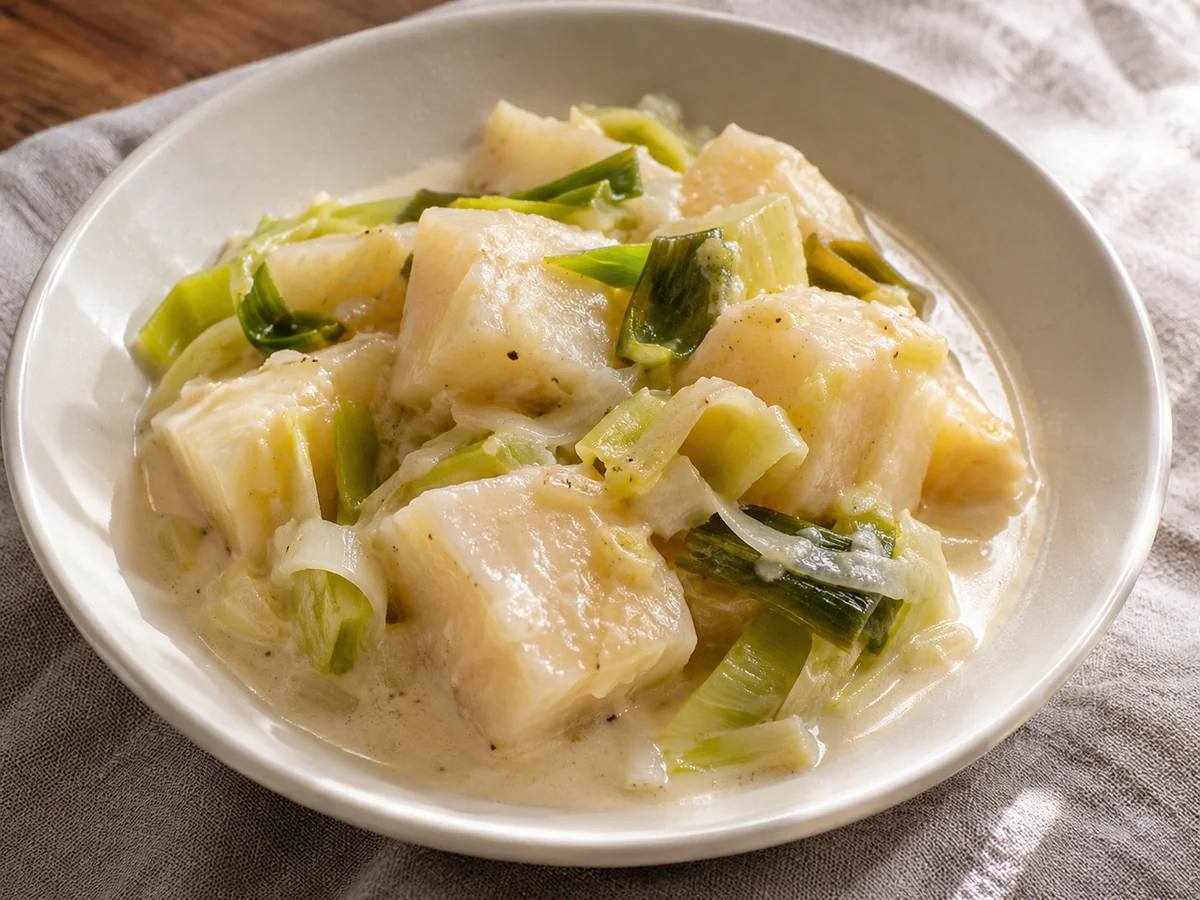
Ingredients
- 800 g peeled edible yam
- 350 g leeks
- 200 ml unsweetened coconut milk
- 350 ml water
- 120 g onion
- 2 garlic cloves
- 20 ml oil
- 4 g salt
- 1 g pepper
Preparation
In a heavy-bottomed Dutch oven, pour the 20 ml oil and heat over medium heat for about one minute until it shimmers without smoking, then add the 120 g finely chopped onion and the 2 minced garlic cloves, stir constantly with a wooden spoon for exactly 5 minutes until the onion becomes translucent and melting without taking on brown color, the garlic releasing its fragrance without burning.
Immediately incorporate the 350 g sliced leeks starting with the whites, mix thoroughly to coat them with the onion-garlic mixture, let sweat 3 minutes over medium heat stirring regularly until they begin to soften and reduce in volume, then add the tender green and continue for 2 additional minutes.
Add the 800 g of 3 cm sided yam cubes, turn them gently to coat them with the cooking juices without breaking them, pour the 350 ml cold water, bring to a simmer over high heat, then immediately lower to low heat, cover tightly and simmer 15 minutes without opening the lid.
After these 15 minutes, check doneness by inserting the tip of a knife into a yam cube: it should penetrate with slight resistance, the yam not yet being totally tender, adjust liquid level if necessary by adding water in 30 ml spoonfuls if the bottom sticks.
Sprinkle the 4 g salt and 1 g pepper evenly over the surface, mix once with caution to avoid crushing the cubes, replace the lid and continue cooking 10 additional minutes over low heat.
At 10 minutes before the end of total cooking time, i.e., after 25 minutes of total simmering, pour the 200 ml unsweetened coconut milk in a thin stream while stirring gently with a flexible spatula to create a homogeneous emulsion with the cooking juice, without bringing to a rolling boil.
Maintain at a very gentle simmer, uncovered, for exactly 10 minutes monitoring the texture: the yam must become perfectly tender, the knife penetrating without any resistance, and the sauce must thicken naturally by the released starch and the coconut emulsion, coating the back of the spoon.
Turn off the heat, let rest 5 minutes off heat with the lid ajar so flavors stabilize and the sauce finishes thickening by slight cooling, taste one last time to validate seasoning without adding salt or pepper, then plate immediately in warm dishes.
Introduction
This contemporary recipe for braised yam with leeks and coconut offers a complete plant-based main dish, designed to showcase the melting texture of edible yam paired with the aromatic sweetness of leeks and the natural creaminess of unsweetened coconut milk. The choice of yam is crucial: firm tubers with white or pale yellow flesh must be selected, free of blemishes or sprouts, of sufficient weight to yield 800 g net once peeled and rid of any fibrous parts. The leeks, two large or three medium to reach 350 g, are chosen for their well-developed white and tender green, ensuring even cooking and a sweet flavor without bitterness. The preparation organization follows a rigorous mise en place logic: the yam is cut into regular 3 cm cubes to ensure uniform cooking, the leeks are split lengthwise, washed meticulously under running water to eliminate any soil residue between the leaves, then sliced separating the white from the tender green, the onion is finely chopped and the garlic degermed then minced. This separation of the leek's green and white parts allows managing their distinct cooking times, the white requiring more time to melt while the tender green cooks faster. The absence of starch, cream, or butter imposes precise control of evaporation and water addition to obtain a sauce naturally thickened by the yam's starch and the coconut milk emulsion. Salt and pepper are dosed precisely (4 g salt, 1 g pepper) to season the whole without masking the delicate flavor of the vegetables. This dish stands on its own, without additional accompaniment, and constitutes a nourishing and balanced option for lunch or dinner.
Cultural context
This recipe is a contemporary creation included in an Ivory Coast collection; it does not claim to represent a traditional or historical dish. General references on food composition and food safety: https://www.fao.org/infoods/infoods/tables-and-databases/faoinfoods-databases/en/ ; https://www.who.int/teams/nutrition-and-food-safety/multisectoral-actions-in-food-systems/five-keys-to-safer-food-poster ; https://www.foodsafety.gov/food-safety-charts/safe-minimum-internal-temperatures. No nutritional calculation has been performed for this recipe.
Tips
To save time on the day, peel and cut the yam into cubes the day before, keep them immersed in cold water in an airtight container in the refrigerator to prevent oxidation and drying out; the leeks can be washed, sliced, and separated white/green the day before as well, stored in separate boxes in the fridge.
If the coconut milk used is very thick or has solidified in cool weather, thin it beforehand with 50 ml warm water taken from the 350 ml total to obtain a fluid texture that will incorporate without lumps into the sauce at the end of cooking.
The yam continues to cook slightly after turning off the heat thanks to residual heat; for an ideal texture neither firm nor puree, stop the covered cooking when the knife tip still meets an infinitesimal resistance at the center of the cubes, the 5-minute rest will finish cooking to the core.
In case of reheating the next day, add 2 to 3 tablespoons of water per portion in the saucepan, reheat over very low heat stirring gently to avoid breaking the cubes, and do not bring to a boil to preserve the coconut milk emulsion.
Nutrition notes
Carbohydrates come in part from yam. Fats come in part from coconut milk and oil. These notes describe the ingredients rather than a calculated nutritional analysis of the dish. Actual composition varies with the products chosen, their water content and the way the food is divided among four plates. Evaporation changes serving weight without establishing calories per portion. Added salt must also be considered alongside any salt in packaged ingredients. Check their labels and possible allergen contact on equipment. The stated proportions are for preparing the recipe; they do not define a suitable dietary portion for every person. Garnishes or side dishes served separately should be considered separately because they are not included in this formulation.
Conclusion
Serve the braised yam piping hot as a one-dish meal, optionally accompanied by a crunchy green salad dressed with a light vinaigrette to contrast with the creaminess of the dish. Leftovers keep for a maximum of 48 hours in the refrigerator in an airtight container, after rapid cooling to room temperature (no more than 2 hours). For reheating, favor low heat with a little water as indicated in the tips; avoid the microwave which breaks the emulsion and makes the yam pasty. Do not freeze: the yam texture and coconut emulsion degrade irreversibly upon thawing. Discard any portion left at room temperature for more than 2 hours.
Enjoy your meal
Bon appétit