Cassava, coconut and cocoa loaf cake
A cocoa loaf made with food-grade cassava flour, coconut milk and grated coconut, with a centre check before cooling and slicing.
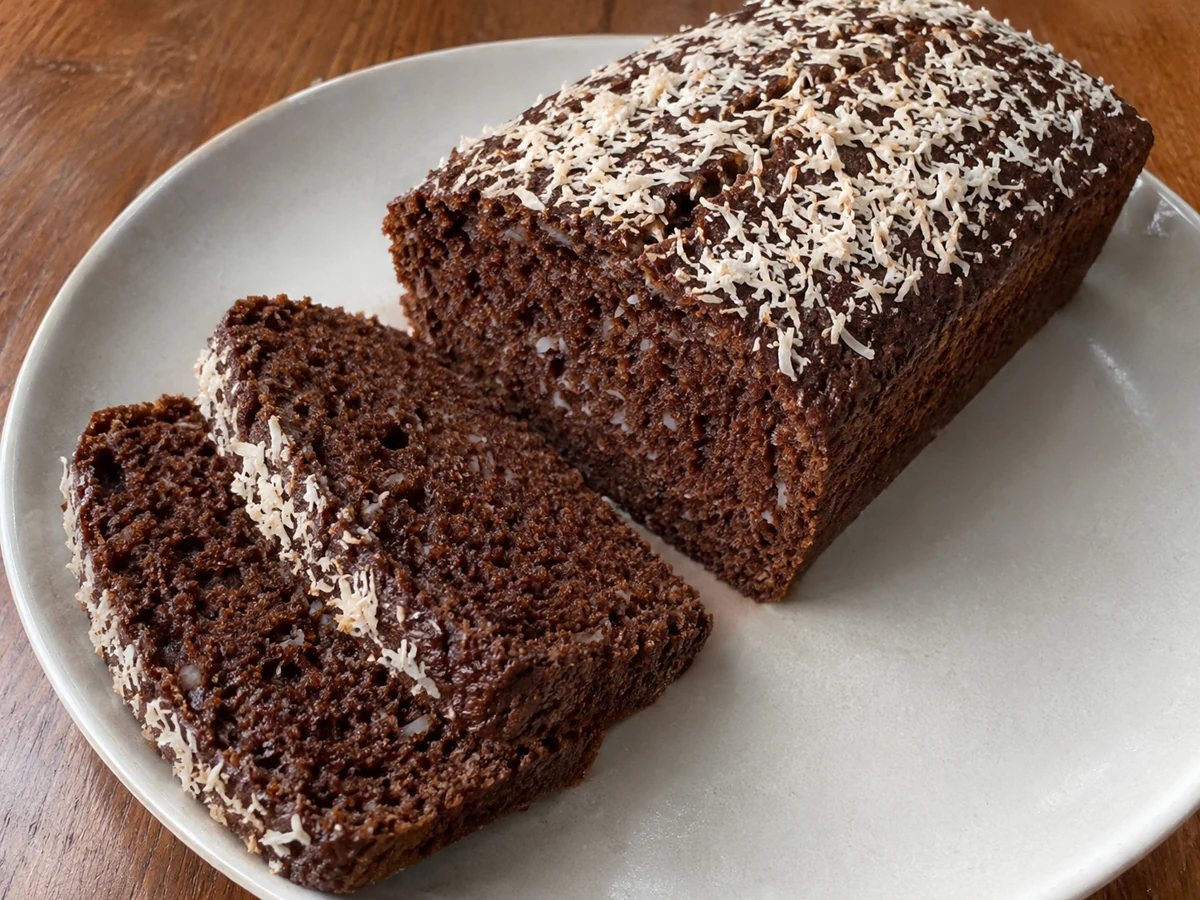
Ingredients
- 160 g food-grade cassava flour
- 3 eggs
- 180 ml unsweetened coconut milk
- 80 g sugar
- 50 ml neutral oil
- 25 g unsweetened cocoa powder
- 30 g unsweetened grated coconut
- 8 g baking powder
- 1 g salt
Preparation
Preheat the oven to 175 °C. Oil the tin, including corners, with a little of the measured oil. Mix cassava flour, cocoa, baking powder, salt and 20 g grated coconut in one bowl. Sift lumpy cocoa first. Even distribution prevents dense, bitter areas in the finished cake.
In the second bowl, whisk eggs and sugar until evenly combined and slightly paler; a very voluminous foam is unnecessary. Gently whisk in remaining oil and stirred coconut milk. Scrape the sides to recover sugar. Distribute liquids before adding the powders, since the final batter should be mixed briefly.
Add dry ingredients in two or three stages, folding with a spatula across the bottom. Stop when no dry flour or large cocoa streaks remain. A batter thicker than pancake batter is normal. Do not automatically add milk to make it runny: cassava flour absorbs moisture and varies with milling.
Immediately transfer into the prepared tin, level gently and scatter the reserved 10 g coconut. Bake on a middle rack about 40–45 minutes. Avoid repeated early opening. The surface should set gradually. Coconut may brown first, so its colour alone does not establish that the middle is cooked.
Insert a skewer into the centre: it should emerge dry or with crumbs, without liquid batter. The centre should also reach at least 71 °C for the egg mixture, but that temperature alone does not guarantee a fully baked crumb. Extend baking if necessary. Loosely protect an over-browning top with suitable covering without pressing down. Distinguish moist cocoa crumbs from flowing raw batter.
Rest in the tin about twenty minutes before carefully unmoulding. Cool further on a rack if desired. Slice with a clean knife without compressing the fragile crumb. Divide according to the intended service for four people; one loaf can yield several small slices. Do not seal while very hot, since condensation would wet the top and coconut.
Introduction
Cassava flour gives this cocoa cake a crumb different from an all-wheat cake. Coconut milk and grated coconut complete the mixture; the sugar is measured for the whole tin. Use commercially prepared food-grade flour: this recipe does not describe processing raw grated cassava at home. Distribute unsweetened cocoa thoroughly to avoid bitter pockets. The cake should remain moist but set enough to slice after resting. This is a contemporary creation without an invented traditional local name; an even crumb matters more than a very dark surface.
Cassava flour and tapioca starch do not behave alike and cannot simply be exchanged by weight. Check the product label and instructions. Use unsweetened coconut milk, pure unsweetened cocoa and grated coconut without added sugar. Stir separated coconut milk before measuring. Prepare a roughly 22 cm loaf tin, two bowls, whisk and spatula. Take the tin's oil from the measured 50 ml. Reserve 10 g coconut for the top and 20 g for the batter. Use baking powder, not baker's yeast. An overly small, deep tin can dry the surface before the centre is ready.
Cultural context
Contemporary creation using ingredients from the West African repertoire, proposed for this volume devoted to Côte d’Ivoire. No exclusive regional origin or particular tradition is attributed to this formulation.
Institutional references FAO INFOODS : https://www.fao.org/infoods/infoods/tables-and-databases/faoinfoods-databases/en/ — Food composition tables for Western Africa; general context, without a nutritional calculation for this recipe. World Health Organization : https://www.who.int/teams/nutrition-and-food-safety/multisectoral-actions-in-food-systems/five-keys-to-safer-food-poster — Principles of cleanliness, food separation, cooking and temperature control. FoodSafety.gov : https://www.foodsafety.gov/food-safety-charts/safe-minimum-internal-temperatures — Core cooking temperature guidance; timings depend on the ingredients and equipment.
Tips
Read the label: cassava flour and tapioca starch are not interchangeable here. An improvised equal-weight substitution can produce sticky or very different structure.
Dark cocoa can conceal pale flour at the bottom. Scrape the sides and lift through the batter with complete movements rather than prolonged whisking that misses the base.
Coconut milk varies in fat content. Stir before measuring rather than taking only the thick top and leaving liquid behind, which would change hydration.
Respect the resting period and wait longer for fine slices. Wipe a crumb-coated blade between cuts. Resting stabilises texture but should not become prolonged waiting in a hot kitchen before storage.
Nutrition notes
Cassava flour and sugar mainly supply carbohydrates. Eggs provide structure and protein; oil and coconut products supply fats, including saturated fats from coconut. Egg is a major allergen. Check labels and cross-contact, especially where gluten exclusion is essential: cassava flour alone does not guarantee this across products or kitchens. No nutritional calculation per slice has been made.
Conclusion
Serve once it can be sliced cleanly, warm or cooled. Protect the slices once excess heat has dissipated and use storage conditions appropriate to preparation. Do not describe it as sugar-free or light merely because of the flour: it also contains oil, sugar and coconut. The method emphasises straightforward mixing, checking the centre and distinguishing food-grade cassava flour from tapioca starch.
Enjoy your meal
Enjoy your meal!