Green plantain, fish and spring onion patties
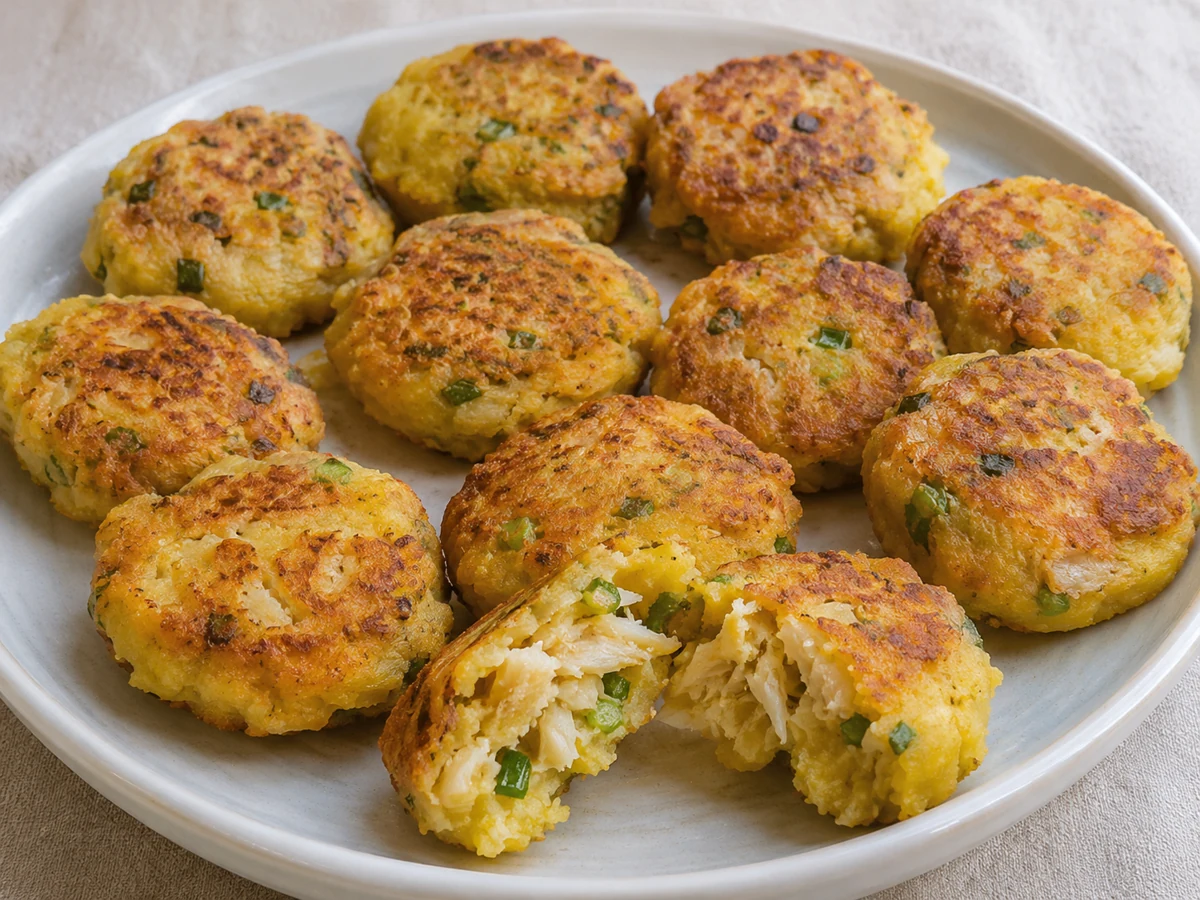
Twelve oven-baked green plantain and fish patties, with spring onion and lime zest. The fish is checked for bones before mixing.
Ingredients
- 700 g peeled green plantains
- 300 g boneless white fish fillets
- 1 egg
- 40 g fine maize flour
- 60 g spring onions
- 1 lime
- 25 ml oil
- 3 g salt
- 1 g black pepper
Preparation
Cut the peeled plantains into similarly sized sections. Simmer in a large saucepan of water for about twenty-five minutes until tender in the centre. Drain thoroughly and briefly allow steam to escape. Test a thick piece: undercooked plantain would leave hard pieces that are difficult to mash. A softened surface does not necessarily mean that all the flesh is cooked.
Place the fillets in the steamer basket and cook for around eight to twelve minutes, depending on thickness. Check that their centre reaches 63 °C, or that the flesh is no longer translucent and separates easily. Transfer to a clean plate and flake with two forks once manageable. Remove any bones at this stage. Do not turn the fish into a paste: small flakes give the finished patties a more pleasant texture.
Mash the drained plantains and spread in a shallow dish to cool promptly in the refrigerator for around fifteen minutes. Avoid a thick mass that would remain very hot in the middle. Meanwhile, slice the spring onions and finely grate some zest from the washed lime, avoiding the white pith. The base must be lukewarm or cold when the egg is added, rather than hot enough to cook it on contact.
Preheat the oven to 200 °C. Combine the mashed plantain, flaked fish, egg, maize flour, spring onion, zest, salt and pepper. Mix with a spoon until evenly distributed. If the mixture seems wet, let it stand briefly so the flour absorbs some liquid. Do not aim for completely smooth dough. Excessive mixing compresses the fish fibres and gives denser patties.
Divide into twelve portions and shape even discs of similar thickness. Space them on the baking sheet lined with baking paper. Brush with the twenty-five millilitres of oil, covering both sides where possible. Bake for about twenty minutes and carefully turn halfway through, once the first side has firmed. Check that the centre reaches 74 °C. Although the fish is already cooked, the incorporated egg also needs sufficient cooking throughout each patty.
Let the patties settle for two or three minutes outside the oven before lifting with a wide spatula. Serve three per person and offer the remaining lime at the table. Serve hot without immediately stacking every patty in a deep container: trapped steam would soften the golden surface. If one cracks slightly, serve it first instead of handling repeatedly. A tender texture can still hold well on a spatula.
Introduction
Green plantains provide a firm base for these fish patties. Their less sweet flavour leaves room for spring onion and lime. The fish is steamed before assembly, then flaked so that any bones can be removed. Egg and corn flour help the twelve patties hold their shape in the oven. Their surface should be golden while the centre remains tender and thoroughly hot. This contemporary preparation offers another way to combine a starchy food and fish without deep-frying. Allow a short cooling period before mixing: very hot mash would set the egg prematurely and make even shaping difficult.
Choose genuinely green, firm-fleshed plantains. Dessert bananas and very ripe plantains will not provide the same structure. The seven hundred grams are weighed after peeling. Use white fish fillets sold as boneless, but inspect the flesh again after cooking. Prepare a saucepan for the plantain, a steamer basket for the fish, a potato masher and a baking sheet. The corn flour here is finely milled maize flour, not corn starch or coarse cornmeal. Wash and dry the spring onions before slicing. Lime is used mainly for its zest in the mixture; its juice can be offered at the table rather than poured entirely into the dough, which would become too wet. Measure the oil for brushing the whole batch instead of oiling each patty without tracking the total.
Cultural context
Contemporary creation using ingredients from the West African repertoire, proposed for this volume devoted to Côte d’Ivoire. No exclusive regional origin or particular tradition is attributed to this formulation.
Institutional references FAO INFOODS : https://www.fao.org/infoods/infoods/tables-and-databases/faoinfoods-databases/en/ — Food composition tables for Western Africa; general context, without a nutritional calculation for this recipe. World Health Organization : https://www.who.int/teams/nutrition-and-food-safety/multisectoral-actions-in-food-systems/five-keys-to-safer-food-poster — Principles of cleanliness, food separation, cooking and temperature control. FoodSafety.gov : https://www.foodsafety.gov/food-safety-charts/safe-minimum-internal-temperatures — Core cooking temperature guidance; timings depend on the ingredients and equipment.
Tips
Green plantain dryness varies with variety and maturity. If the mixture crumbles, first gently press it between your hands: it should join without becoming runny. Slightly dampened hands make shaping easier. Do not immediately pour in a large quantity of lime juice, which would strongly change both texture and acidity.
Overly thick patties brown before the middle becomes hot enough. Make even pieces and test the thickest. For smaller bites, adjust the baking time rather than automatically retaining twenty minutes. The number may change, but the total mixture and ingredient balance remain those stated for four people.
Bones are easier to check in flaked fish than in a whole, very hot fillet. Spread the flesh on a light-coloured plate and inspect before mixing with plantain. Once the patties are formed, hidden fragments become difficult to find. A boneless label does not replace this home check.
To prepare ahead, refrigerate the cooked fish and cooled plantain separately in closed containers. Assemble and bake on the day of the meal. Avoid leaving the egg-containing mixture on the worktop while the oven is occupied. Shaping is quick when all components have been prepared in the right order.
Nutrition notes
Green plantain and maize flour form the starchy base; fish and egg supply protein and contribute structure. Oil is distributed across twelve patties, with some possibly remaining on the brush or baking sheet. Fish and egg are the main allergens. Check the maize flour label too, especially when gluten avoidance is necessary, without assuming that a shared kitchen excludes contamination. No nutritional calculation per patty or serving has been made. These notes describe only the general roles of the ingredients.
Conclusion
Success depends on thoroughly cooked plantain, inspected fish and evenly sized discs. Baking finishes the binding while producing a golden surface. Cool leftovers promptly and refrigerate in a closed container. Reheat thoroughly, using a method that does not leave them lukewarm for a long time. Reheated patties may be slightly less soft than at their first serving, so preparing a quantity suited to the meal is useful. This recipe describes a contemporary creation with explicit techniques, without artificially assigning a traditional name.
Enjoy your meal
Enjoy your meal!