Rice with mushrooms and peanut sauce
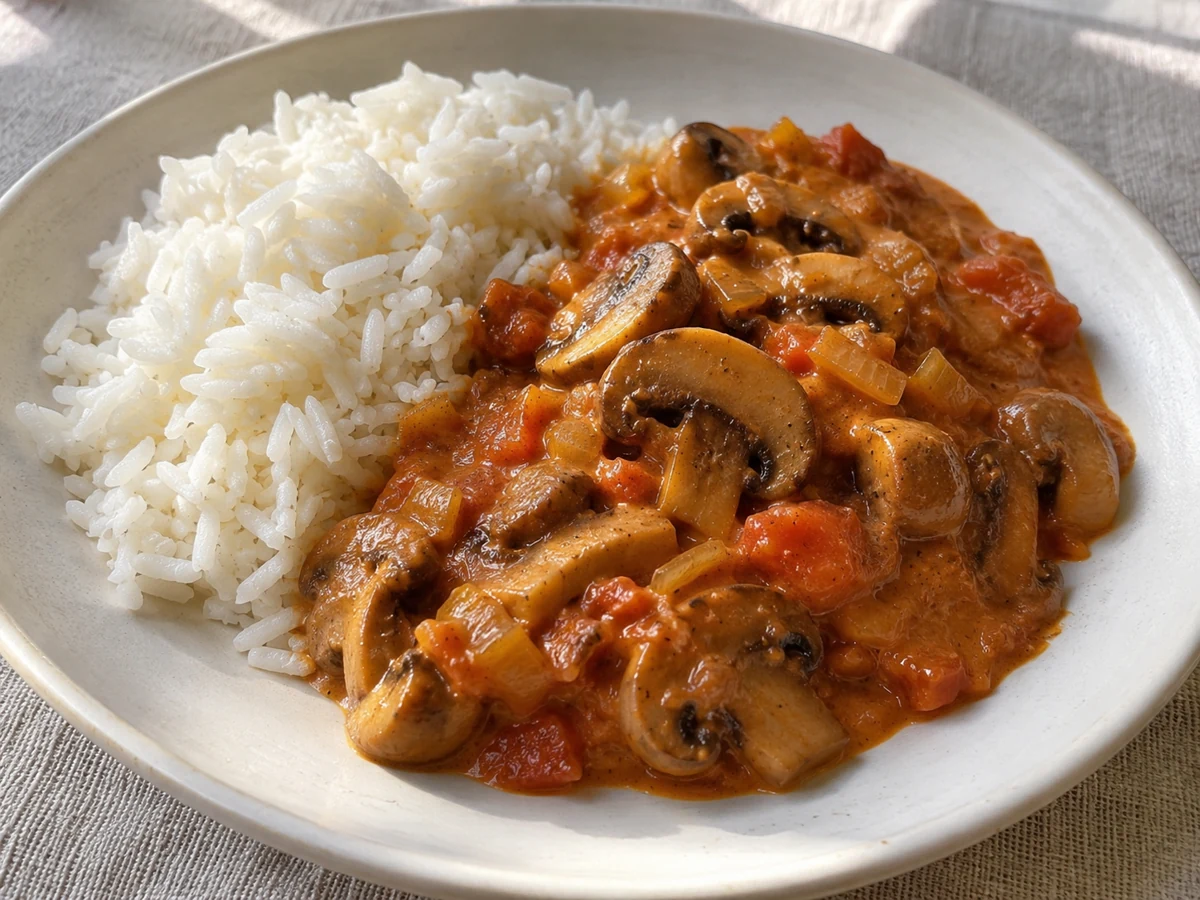
White rice with browned mushrooms in a tomato and peanut sauce. Separate cooking and gradual dilution keep the grains distinct and the sauce smooth.
Ingredients
- 250 g uncooked rice
- 400 g mushrooms
- 50 g unsweetened peanut paste
- 200 g tomatoes
- 120 g onion
- 2 garlic cloves
- 20 ml oil
- 850 ml water, including 500 ml for the rice, adjusted to its packet instructions
- 4 g salt
- 1 g black pepper
Preparation
Cook the rice according to its packet instructions, using five hundred millilitres of water for the stated two hundred and fifty grams as a guide. Adjust if the manufacturer specifies a different ratio. Once the grains are cooked, turn off the heat and rest, covered, for around five minutes before fluffing with a fork. This rest is part of the recipe organisation. Keep the rice hot for an imminent serving; do not leave it waiting for a long time at room temperature.
Clean and slice the mushrooms, then heat ten millilitres of oil in a large frying pan. Brown for around eight minutes, in batches if the cooking surface is insufficient. Wait for initial browning before stirring. Their water should evaporate rather than remain trapped under a lid. Transfer the browned pieces to a clean plate. They will return to the sauce later and do not need to undergo the entire cooking period for the tomatoes and peanuts.
Finely chop the onion and garlic. Pour the remaining ten millilitres of oil into the pan, then soften the onion over medium heat for around five minutes. Add the garlic towards the end to avoid burning it. Stir in the chopped tomatoes and cook for about eight minutes, stirring. They should begin to break down. Lift the brown mushroom cooking juices with a spatula, but do not incorporate black, burnt residue, which would taste bitter.
Dilute the peanut paste with some of the three hundred and fifty millilitres of water reserved for the sauce. Begin with a little liquid, then gradually add the rest until smooth. Pour into the tomatoes and stir across the bottom. Add salt and pepper, then gently simmer for about twelve minutes. The sauce thickens as it heats; vigorous boiling would cause splashes and could quickly make it catch on the bottom.
Return the mushrooms and warm them in the sauce for around three minutes. Check the consistency with a spoon: it should coat without setting solid. Add a little hot water if needed, stirring before deciding to add more. Taste with some rice, since sauce on its own often seems more concentrated. Do not reduce it excessively in an attempt to strengthen the flavour; the peanut mixture must remain fluid enough to accompany the grains.
Fluff the rice again and divide between four plates. Spoon the sauce and mushrooms alongside and serve hot. Distribute the pieces evenly so that everyone receives a similar share. A slight sheen from the peanut paste's natural oil may appear on the sauce; stir before serving instead of adding more oil. Plating the components separately preserves the rice grains and lets diners enjoy the sauce without completely masking each grain's texture.
Introduction
Plain white rice accompanies a mushroom and peanut sauce in this dish. Brown the mushrooms before adding them to the sauce so that they retain a recognisable texture and a stronger flavour than they would after simply boiling. Peanut paste thickens the tomatoes without milk or cream. Aim for a loose sauce that coats the pieces and can be spooned beside the rice, rather than a compact paste. The rice is not stirred extensively into the sauce; everyone can combine the components on their plate. This contemporary proposal uses ingredients found across West African and other cuisines. It claims neither a traditional name nor an exclusive regional origin for this precise combination.
Use unsweetened peanut paste with clearly listed ingredients. A sweet sandwich spread will not give the same balance. If the oil has naturally separated, stir the jar before weighing fifty grams. Choose firm mushrooms, remove damaged parts, clean without prolonged soaking and cut into fairly thick slices. Select a rice suitable for your usual cooking method and follow the packet. Of the eight hundred and fifty millilitres of water, five hundred are intended for the rice, adjusted to the product, and three hundred and fifty for the sauce. Use separate cooking vessels to distinguish these quantities. A large frying pan helps the mushrooms brown. Keep a small cup ready to dilute the peanut paste: dropping a large spoonful directly into the tomatoes makes even mixing harder and encourages lumps.
Cultural context
Contemporary creation using ingredients from the West African repertoire, proposed for this volume devoted to Côte d’Ivoire. No exclusive regional origin or particular tradition is attributed to this formulation.
Institutional references FAO INFOODS : https://www.fao.org/infoods/infoods/tables-and-databases/faoinfoods-databases/en/ — Food composition tables for Western Africa; general context, without a nutritional calculation for this recipe. World Health Organization : https://www.who.int/teams/nutrition-and-food-safety/multisectoral-actions-in-food-systems/five-keys-to-safer-food-poster — Principles of cleanliness, food separation, cooking and temperature control.
Tips
The mushrooms' cooking surface affects the result. In an overcrowded small pan, they release water and steam more than they brown. Two short batches often give a more even result than one large mass stirred for a long time. Wait for one side to colour before turning, maintaining sufficient heat without allowing the oil to smoke heavily.
Diluting peanut paste can take several strokes of the spoon, especially when it is dense. Start with a small amount of water to form a smooth cream. Adding all the water immediately can leave blocks that are hard to dissolve. This technique controls sauce texture without changing the actual quantity of peanuts used.
If the paste is already salted, adjust the planned four grams of salt. Read the ingredients before starting and taste after the tomatoes have cooked. Adding a little near the end is easier than correcting an overly salty sauce. Do not mistake tomato acidity for a lack of salt.
For reheating, keep the rice and sauce separately refrigerated after rapid cooling. Reheat only the portion needed and add a little water if the sauce has thickened. The rice must also be reheated thoroughly; a closed container does not replace proper storage conditions.
Nutrition notes
Rice provides the cereal base. Mushrooms and tomatoes supply vegetable volume, while peanut paste contributes fat and plant protein to the sauce. Peanut is a major allergen and remains present even in a strongly diluted sauce. Check other package warnings, including possible traces. No calorie or nutrient calculation per plate has been made. The amount of sauce, the rice actually served and the peanut paste's composition can alter the composition of the portion eaten.
Conclusion
The sauce is ready when the tomatoes are cooked, the peanut paste is dispersed and the mushrooms are thoroughly hot while retaining some firmness. Keeping rice and sauce separate simplifies serving and storage of possible leftovers. Rapidly cool, cover and refrigerate anything not served. Avoid leaving a pan of rice slowly cooling on the worktop. For the next meal, reheat thoroughly and adjust the texture sparingly. Two actions guide this dish: brown the mushrooms first, then let the sauce simmer gently.
Enjoy your meal
Enjoy your meal!