Roasted peppers stuffed with yam and cowpeas
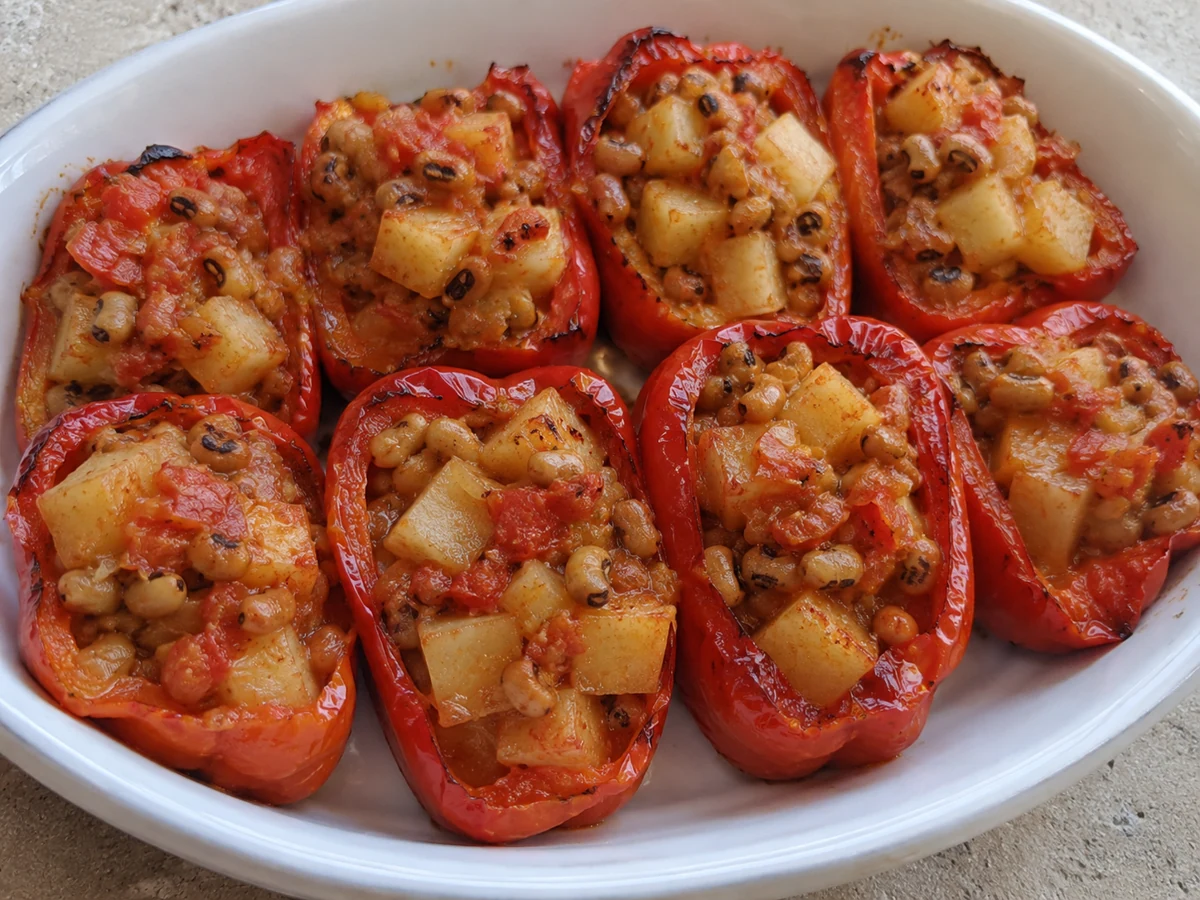
Red peppers filled with diced yam, cooked cowpeas and a reduced tomato sauce, with separate cooking stages to keep the filling moist and distinct.
Ingredients
- 4 large red peppers
- 500 g peeled yam
- 350 g cooked cowpeas, drained
- 300 g tomatoes
- 120 g onion
- 2 garlic cloves
- 25 ml oil
- 150 ml water
- 4 g salt
- 1 g black pepper
Preparation
Cut the peeled yam into cubes of about one and a half centimetres. Put them in a saucepan of simmering water and cook for around fifteen to twenty minutes, depending on the variety and actual size. A knife tip should enter easily while the pieces still hold their shape. Drain carefully and set aside without crushing. Yam cooked until it falls apart would make the filling denser and conceal its textural difference from the cowpeas.
Preheat the oven to 190 °C. Wash the peppers, halve them lengthways and remove the seeds and thick membranes. Arrange the halves in the dish with the cavities facing up. Brush with ten millilitres of oil, then precook for about fifteen minutes. They should begin to soften without collapsing. This prepares the shells: since the filling ingredients are already cooked or nearly so, they will not have to wait long for a raw pepper to become tender.
Finely chop the onion and garlic. Heat the remaining fifteen millilitres of oil in the frying pan and soften the onion for five minutes, then add the garlic. Stir in the diced tomatoes and the hundred and fifty millilitres of water. Season with salt and pepper and simmer for about ten minutes, stirring. The sauce should concentrate and no longer contain a large quantity of free liquid. Watch the bottom so that reduction does not end in burning.
Add the drained cowpeas and diced yam to the sauce. Lift gently with a spatula to distribute the tomato without mashing the ingredients. Taste a small portion before adjusting the salt. If the mixture looks very dry, a small spoonful of hot water may be enough; see how the filling holds together before adding more. It should be possible to spoon it into the peppers without it immediately flowing into the dish.
Take out the precooked peppers and divide the filling among the eight cavities. Fill to the rim without making a very tall mound that would be difficult to heat evenly. Return to the oven for around twenty-five minutes. Check that the centre of the filling reaches 74 °C and that the peppers are tender. If an edge colours quickly, shield it lightly. Timing may vary with the thickness of the pepper flesh and the filling’s starting temperature.
Rest for a few minutes out of the oven, then lift the peppers with a wide spatula to preserve their shape. Serve two halves per person and spoon over any juices from the dish. Do not pour on extra oil for shine: the recipe’s oil has already been divided between the shells and sauce. The peppers should remain supple, with a hot filling whose pieces are distinct under the fork, rather than a dry crust.
Introduction
These stuffed peppers contain diced yam, cowpeas and a short tomato sauce. The filling retains pieces rather than being mashed before it goes into the pepper halves. Precooking the shells and cooking the yam separately produce tender components without leaving the cowpeas in the oven too long. The eight halves are shared between four people. The red pepper and tomato contrast with the pale yam and marked cowpea grains. This contemporary combination uses a fairly simple plant-based filling without cheese or an egg mixture. It holds together mainly through reducing the sauce and arranging the pieces inside the cavities.
Choose four large peppers of similar size, wide enough to hold the filling after being cut lengthways. Check that they can rest without tipping; a slight adjustment to their underside may help, but do not pierce the flesh. The yam is weighed peeled and should be cut into small, even cubes. The cowpeas are already cooked and drained: the same dry weight would not match this recipe’s quantities. Prepare a saucepan, frying pan and oven dish that can hold the eight halves in a single layer. Divide the oil: ten millilitres for the peppers and fifteen for the sauce. Keep the measured hundred and fifty millilitres of water for this sauce, adjusting only if it reduces too quickly. An excessively wet filling would spill out of the peppers, while a dry filling would be less pleasant after its second spell in the oven.
Cultural context
Contemporary creation using ingredients from the West African repertoire, proposed for this volume devoted to Côte d’Ivoire. No exclusive regional origin or particular tradition is attributed to this formulation.
Institutional references FAO INFOODS : https://www.fao.org/infoods/infoods/tables-and-databases/faoinfoods-databases/en/ — Food composition tables for Western Africa; general context, without a nutritional calculation for this recipe. World Health Organization : https://www.who.int/teams/nutrition-and-food-safety/multisectoral-actions-in-food-systems/five-keys-to-safer-food-poster — Principles of cleanliness, food separation, cooking and temperature control. FoodSafety.gov : https://www.foodsafety.gov/food-safety-charts/safe-minimum-internal-temperatures — Core cooking temperature guidance; timings depend on the ingredients and equipment.
Tips
A surplus of filling does not necessarily require another pepper. Put it in a small ovenproof container and heat alongside, watching that it does not dry out. Share this extra filling when serving. Avoid overfilling the cavities: a very thick layer heats less evenly at the centre and makes moving the pepper halves more difficult.
Cut the yam smaller than you would for simply boiling it. Compact cubes fit better into the filling and combine with the cowpeas. Cut before cooking to maintain even dimensions. Trying to reduce large, already very tender pieces afterwards easily produces an unintended mash.
Peppers may release water during precooking. If a significant amount collects, remove some before filling, handling the hot dish carefully. Do not confuse this liquid with the tomato sauce prepared separately. The aim is a tender shell and moist filling without turning the bottom of the dish into a pool.
If preparing components ahead, cool the filling quickly and refrigerate it separately from the precooked peppers. Assemble before the final oven stage. A cold filling may take longer to reach 74 °C; check its centre rather than automatically reusing the timing intended for components that are still hot.
Nutrition notes
Yam provides starch, while cowpeas contribute carbohydrates, fibre and plant protein. Pepper and tomato make up most of the vegetables. The oil is divided between two stages and should not be added again without changing the quantities. The basic list contains neither milk nor egg, but freedom from allergens cannot be guaranteed without examining products and cross-contamination. No numerical nutritional calculation has been made for these four portions. Drained weights, cooking losses and pepper size influence the portion actually served.
Conclusion
These stuffed peppers make a substantial dish to share, with components cooked separately for better control of texture. Tender yam that holds its shape and a sufficiently reduced sauce give a filling that is easy to serve. Cool leftovers promptly and refrigerate in a closed container. To reheat, use a suitable dish and check the heat at the centre of the filling, not just the pepper’s surface temperature. This recipe describes a contemporary variation using West African ingredients; it makes no claim to a particular local tradition for this combination.
Enjoy your meal
Enjoy your meal!