Stir-fried beef with green beans and sesame
Beef stir-fried with green beans, ginger and sesame, finished with lime. Separate cooking helps keep the meat tender and the vegetables distinct.
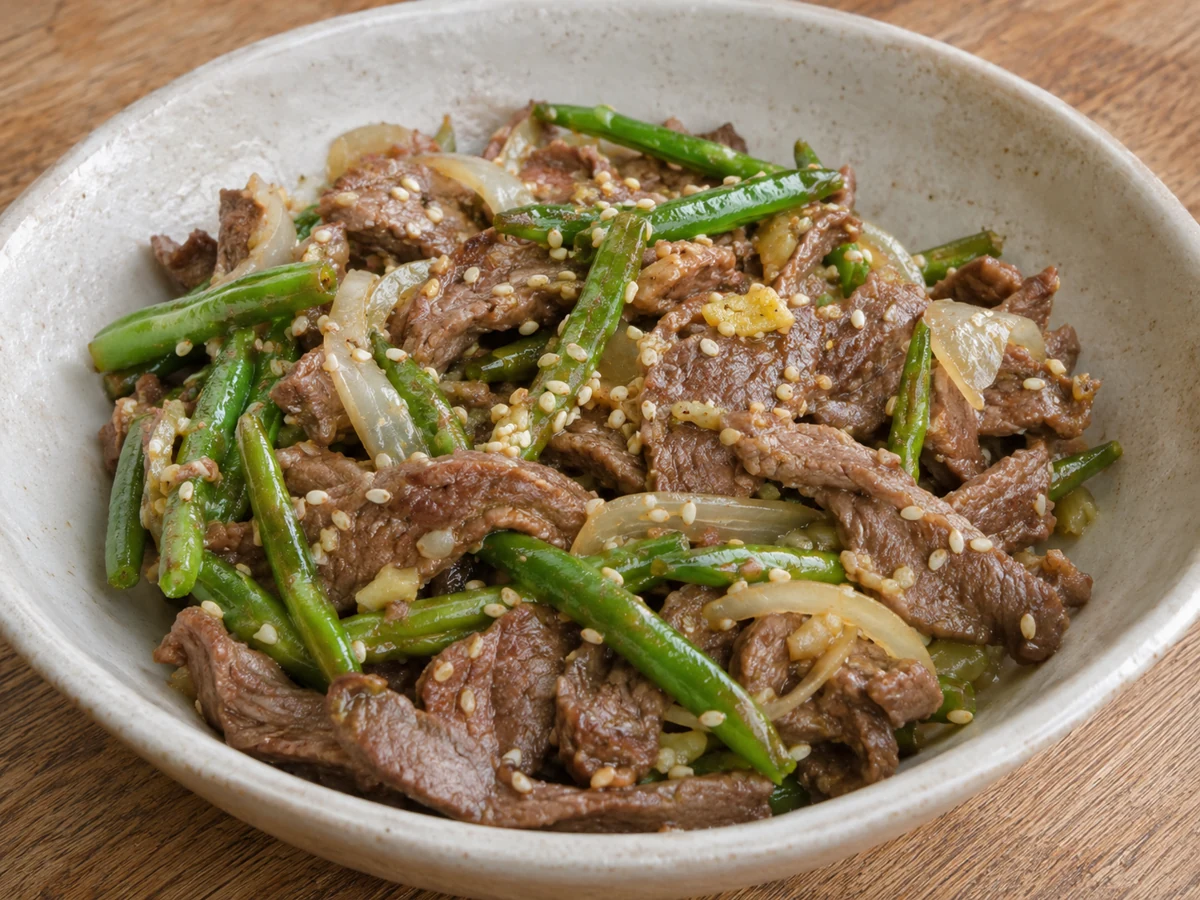
Ingredients
- 600 g quick-cooking beef, thinly sliced into strips
- 500 g green beans
- 150 g onion
- 15 g ginger
- 2 garlic cloves
- 25 g sesame seeds
- 25 ml oil
- 100 ml water
- 1 lime
- 4 g salt
- 1 g black pepper
Preparation
Bring a saucepan of water to the boil and cook the green beans for about eight to ten minutes, depending on their size. Taste a bean: it should be tender while retaining a little resistance. Drain thoroughly and reserve. Separate cooking avoids prolonging the stir-fry while meat waits. If the beans are very long, halve them after preparation to make tossing and distribution among four plates easier.
Put sesame in a small dry frying pan and heat for around two minutes, stirring. As soon as the seeds turn lightly golden and smell toasted, transfer to a plate. They would continue browning if left in the hot pan off the heat. Slice the onion, chop garlic and grate ginger if not already prepared. Pat the beef strips dry to reduce water released during searing.
Heat the large pan and use fifteen millilitres of oil to sear the beef in several small batches. Spread strips out instead of piling them up. Stir or turn after some initial browning, then continue briefly, around two to three minutes depending on thinness. Check sufficient cooking, using 63 °C for the meat followed by three minutes' resting as a guide. Transfer to a clean plate without immediately enclosing in a deep container.
Lower the heat a little and add the remaining ten millilitres of oil for the aromatics as needed. Soften the onion for about five minutes, then add garlic and ginger without burning. Gently loosen browned juices with a spatula. If the bottom contains distinctly black, bitter residues, do not incorporate them into the sauce. Browned juices can be recovered with liquid; burning cannot be corrected simply with more water.
Add the drained green beans and the hundred millilitres of water. Toss for three minutes to warm the vegetables and form a short sauce. Return the beef with any juices collected on its plate, then combine quickly. Do not begin a long covered cooking stage. The components are already cooked and only need to share the seasoning. Add salt and pepper, tasting the juices before deciding whether all the planned salt is necessary.
Off the heat, add lime juice and scatter over toasted sesame. Lift everything once more to coat beans and meat, then serve immediately on four plates. Distribute beef pieces and vegetables evenly. Spoon over the small amount of liquid remaining at the bottom. Do not wait for it to reduce completely: the beef would keep cooking and risk becoming firmer.
Introduction
This beef and green bean stir-fry depends on separate cooking and brief final assembly. The beans are tenderised in water, beef is seared in small batches and sesame is toasted dry. Onion, garlic and ginger then form a light base, loosened with a little water to recover the browned juices. Lime finishes the seasoning. This version needs no soy sauce. Beef strips should retain their juices and beans remain recognisable without becoming soft and shapeless. It is a contemporary creation using ingredients found in many cuisines. Preparing the cuts before heating the pan is especially helpful because the final stages follow quickly, leaving no time to peel an onion between batches.
Choose beef suited to quick cooking rather than a stewing cut that would remain tough after a few minutes. Ask for advice on thin strips cut across the grain. Take out only what is needed during preparation and keep the remainder chilled. Trim the green beans and select fairly similar sizes. Prepare a saucepan, colander, large frying pan or stable wok, tongs and a clean plate for cooked beef. A plate that held raw meat must not receive seared pieces without washing. Divide the oil between beef and aromatics. Measure the water ahead; it will go into a hot pan, so take care with the steam. Also prepare lime juice and sesame to avoid interrupting the final cooking.
Cultural context
Contemporary creation using ingredients from the West African repertoire, proposed for this volume devoted to Côte d’Ivoire. No exclusive regional origin or particular tradition is attributed to this formulation.
Institutional references FAO INFOODS : https://www.fao.org/infoods/infoods/tables-and-databases/faoinfoods-databases/en/ — Food composition tables for Western Africa; general context, without a nutritional calculation for this recipe. World Health Organization : https://www.who.int/teams/nutrition-and-food-safety/multisectoral-actions-in-food-systems/five-keys-to-safer-food-poster — Principles of cleanliness, food separation, cooking and temperature control. FoodSafety.gov : https://www.foodsafety.gov/food-safety-charts/safe-minimum-internal-temperatures — Core cooking temperature guidance; timings depend on the ingredients and equipment.
Tips
An overcrowded pan cools down and boils the beef in its own water. Cook in batches even if it appears to take longer. Regular searing of small amounts is easier to control than continuously stirring one large heap. Adapt the batch number to the actual cooking surface instead of trying to fill every available space.
Cutting across the grain shortens the long muscle fibres felt when chewing. Strips sliced along those fibres can seem tougher despite correct cooking. For even cuts, ask the butcher to slice the meat or work with well-chilled beef and a sufficiently sharp knife.
Save sesame for the end. Added early with water and covered for a long time, it would lose some toasted contrast. Crush lightly if you prefer it to cling more closely to the juices. Do not automatically grind into a paste: that texture would transform the sauce and require a different consistency adjustment.
Have containers ready before searing: raw beef on one side, a clean receiving plate on the other, prepared aromatics and drained vegetables. This reduces moving around while the pan is very hot. It also avoids putting contaminated tongs on the toasted seeds or lime intended for serving.
Nutrition notes
Beef provides most of the protein, with fat depending on the cut. Green beans make up most vegetables, while sesame adds fat and a small amount of plant protein. Sesame is a major allergen that must be identified. The recipe contains no soy sauce or cereal, but labels and cross-contact still need checking for particular dietary requirements. No precise nutritional calculation has been made for these four portions. Any starchy accompaniment is not included in this recipe's quantities.
Conclusion
Serve immediately after final assembly. Beef has already been seared and rested, green beans cooked separately and aromatics have flavoured the juices; extending the last stage does not automatically improve the result. Cool any portion to be saved promptly and refrigerate in a closed container. Reheating may produce less tender beef than the first serving, so take only the portion needed. The defining technique remains separate cooking followed by a short toss that preserves each ingredient's own texture.
Enjoy your meal
Enjoy your meal!