Crab and zucchini attiéké bake
Attiéké baked with crab and zucchini, bound with eggs and milk. Detailed preparation helps control moisture and produces soft, sliceable portions.
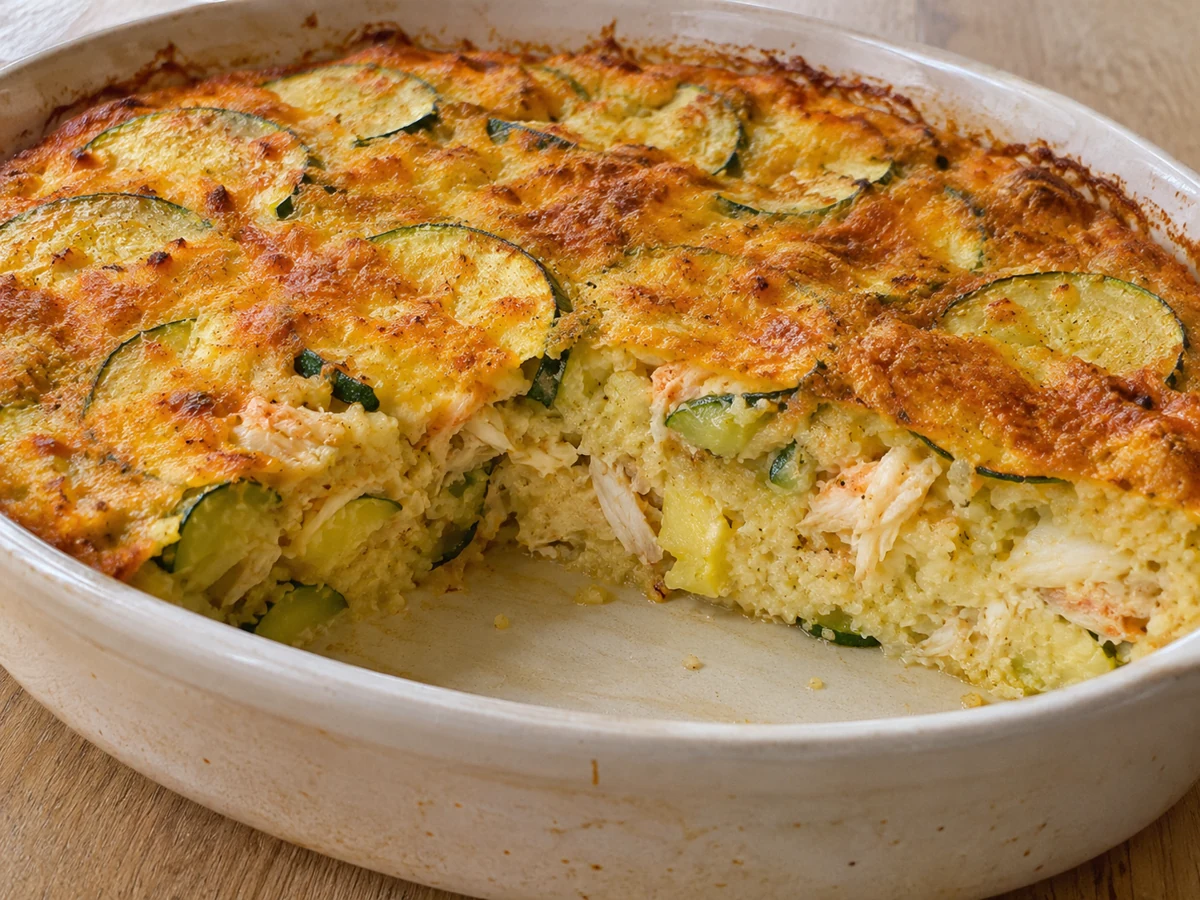
Ingredients
- 400 g already cooked attiéké, ready to reheat
- 300 g cooked shelled crab meat
- 500 g zucchini
- 3 eggs
- 150 ml pasteurised milk
- 120 g onion
- 20 ml oil
- 3 g salt
- 1 g black pepper
Preparation
Preheat the oven to 180 °C. Wash the zucchini, trim the ends and coarsely grate. Squeeze small handfuls to remove some water without trying to make them completely dry. Finely chop the onion. Keep zucchini and onion separate so cooking can begin in the correct order. A fine grater would produce a more uniform, less interesting texture in this bake, where the vegetables should remain visible.
Heat ten millilitres of oil in the frying pan. Soften the onion for five minutes over medium heat, then add the grated zucchini. Spread out and continue for about ten minutes, stirring regularly. Water should evaporate and the vegetables soften without forming a brown crust. Transfer to a plate to cool slightly. Do not pour a large pool of liquid into the mixing bowl: it would make the egg mixture's setting less predictable and the bake more fragile.
Put the attiéké in a bowl and separate the grains with a fork or clean fingers. Break up clumps without crushing the couscous into a paste. Inspect the crab carefully and remove any hard fragments. Leave pieces large enough to remain recognisable after baking. If packed crab comes with liquid, drain according to its instructions first. Do not treat that liquid as a quantity planned for the egg mixture.
Beat the three eggs with the hundred and fifty millilitres of milk, salt and pepper. Mix until even without creating a thick foam. Fold in the attiéké, cooled zucchini and crab, lifting gently with a spatula. Reach the bottom of the bowl to distribute grains that settle there. Everything should look moist and bound, but the ingredients do not need to float in abundant liquid before baking.
Oil the dish with the remaining ten millilitres, paying attention to corners. Pour in the mixture and level without pressing hard. Bake for about thirty to thirty-five minutes. The centre must reach 74 °C and the mixture should be set with a lightly golden surface. If the top colours too fast, loosely protect with a suitable sheet. A deeper dish may need more time: check its centre rather than only the edges.
Remove the bake and let it rest for about five minutes so portions hold together better. Cut four portions with a wide spatula and support their bases when lifting. Serve hot. A portion may remain soft: without cheese and with cassava couscous, its structure differs from a very firm custard. Do not dry it out for a long time merely to obtain perfectly geometric slices, as this risks toughening the crab pieces.
Introduction
Attiéké can be baked without completely losing its individual grains. This version combines already cooked cassava couscous, crab and zucchini softened in a frying pan. Eggs and milk set the mixture in the oven without adding cheese. The aim is a soft portion that can be cut after a short rest, with zucchini distributed evenly and small pieces of crab still noticeable. Moisture control is essential: raw grated zucchini would release too much water directly into the mixture. Fluff the attiéké before combining. This contemporary dish uses a baked-gratin technique without claiming that the combination is a traditional Ivorian speciality. A fairly shallow dish serves four people.
Buy attiéké already cooked and ready to reheat, not a product whose instructions require a different cooking method. Follow the pack's storage directions. Crab meat must be cooked, shelled and kept chilled; inspect it despite any shell-free claim, as small fragments may remain. Choose a dish wide enough for an even layer rather than a thick mass. Prepare a grater, frying pan, colander, bowl and whisk. Reserve ten millilitres of oil for the dish and ten for the vegetables. Take out milk and eggs only when needed. Keep crab refrigerated while cooking the zucchini, adding it once the vegetables have cooled slightly. Excessive heat during assembly could start setting the eggs before the mixture is evenly distributed.
Cultural context
Contemporary creation using ingredients from the West African repertoire, proposed for this volume devoted to Côte d’Ivoire. No exclusive regional origin or particular tradition is attributed to this formulation.
Institutional references FAO INFOODS : https://www.fao.org/infoods/infoods/tables-and-databases/faoinfoods-databases/en/ — Food composition tables for Western Africa; general context, without a nutritional calculation for this recipe. World Health Organization : https://www.who.int/teams/nutrition-and-food-safety/multisectoral-actions-in-food-systems/five-keys-to-safer-food-poster — Principles of cleanliness, food separation, cooking and temperature control. FoodSafety.gov : https://www.foodsafety.gov/food-safety-charts/safe-minimum-internal-temperatures — Core cooking temperature guidance; timings depend on the ingredients and equipment.
Tips
Dish choice affects cooking. A fairly thin layer heats more evenly and allows moisture to escape at the surface. To double the recipe, use two similar dishes rather than one twice as deep. Cooking checks will remain closer to those given and the mixture's setting at the centre will be easier to assess.
Crab is delicate during mixing. Add after distributing the zucchini and avoid working the mixture for too long. A flexible spatula lifts without crushing. This recipe requires already cooked meat: substituting a whole raw crab directly would need different preparation, timings and a separate cooking check not described here.
If cold attiéké forms blocks, loosen them gradually rather than immediately adding milk. Extra liquid would change the egg ratio and could prevent the desired firmness. Also check that the attiéké is already cooked. Dehydrated products or cassava meals sold under different names are not always interchangeable.
Prepare zucchini ahead if this helps organise the meal, then cool promptly and refrigerate. Assemble with crab and eggs on the serving day. Avoid leaving the raw mixture containing these ingredients on the table for a long time even if the oven is not yet available.
Nutrition notes
Attiéké forms the starchy base; crab and eggs provide protein. Milk contributes to the setting mixture, while zucchini increases the vegetable content. Crab is an allergenic crustacean; egg and milk must also be identified. Check the ingredients of packaged crab meat and purchased attiéké. No nutritional calculation per portion has been made for this formulation. The four portions assume sharing the whole dish; a larger helping or an accompaniment would necessarily change the composition of the meal actually eaten.
Conclusion
The bake brings separately prepared components together for final cooking: vegetables lose excess water, couscous is fluffed and crab is inspected. This advance work gives more reliable firmness than quickly mixing all the ingredients cold. Promptly refrigerate leftovers in a suitable container and thoroughly reheat the portion required. Do not leave the dish waiting in a lukewarm oven for hours. A short rest after baking is sufficient for serving; it is not a storage method. Success particularly lies in the balance between grains, vegetables and crab meat.
Enjoy your meal
Enjoy your meal!