Lime sardines with sweet potato mash
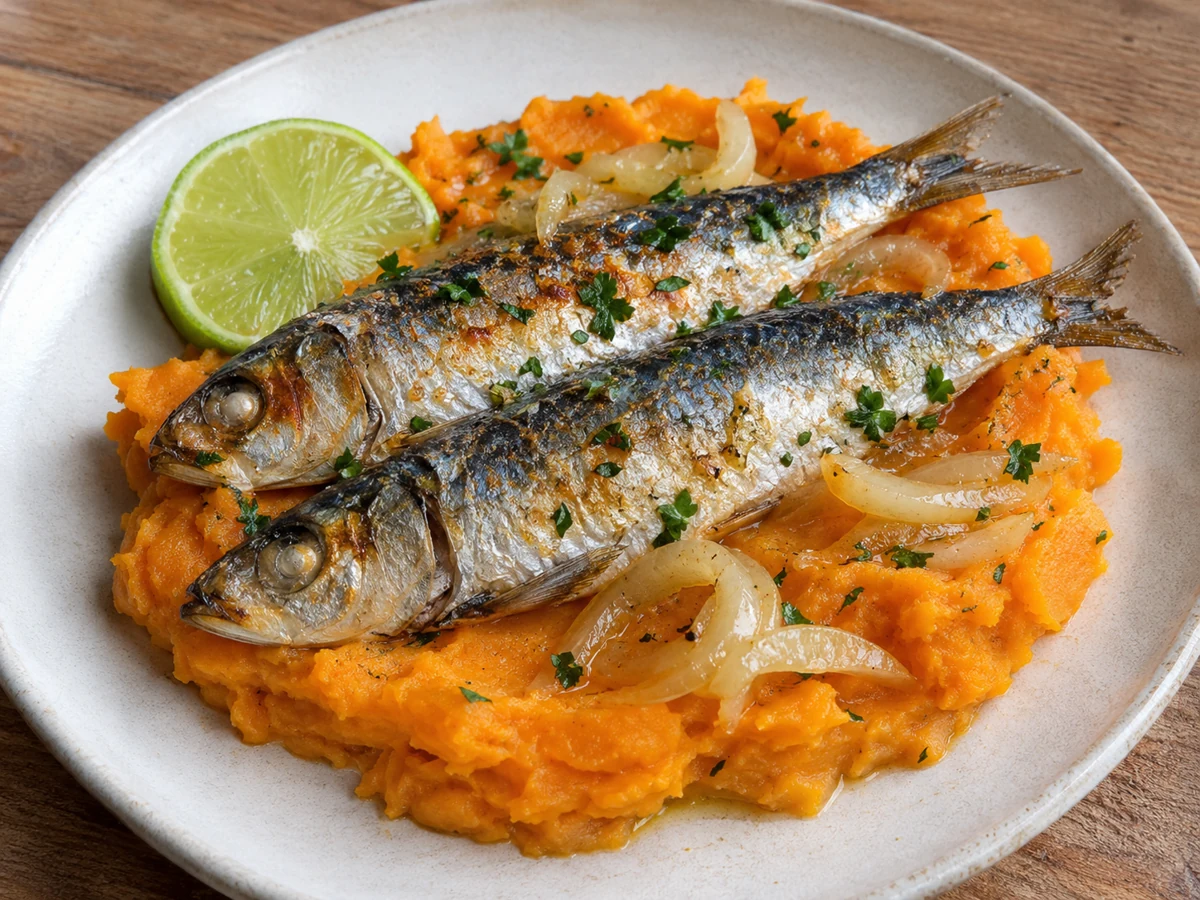
Oven-roasted sardines on sweet potato mash with soft onions, finished with lime and parsley. A detailed recipe for four people.
Ingredients
- 8 fresh sardines, gutted and scaled, about 800 g
- 800 g peeled sweet potatoes
- 150 g onion
- 1 lime
- 20 ml oil
- 120 ml hot water for the mash
- 10 g parsley
- 4 g salt
- 1 g black pepper
Preparation
Put the sweet potato cubes in a saucepan and cover with water. Bring to a simmer and cook for about twenty minutes, until tender in the centre. A knife tip should enter without marked resistance. Drain without saving this water for the fish, then briefly return the cubes to the hot saucepan off the heat to let some steam escape. This reduces the risk of watery mash.
While the sweet potatoes cook, peel and slice the onion. Soften it with ten millilitres of oil in a frying pan over medium, then low heat, for around ten minutes. Stir regularly and reduce the heat if the edges brown too quickly. The slices should soften and become lightly golden without drying out. Reserve in the pan off the heat with a lid resting on it, keeping them warm without continuing to cook strongly.
Preheat the oven to 200 °C. Check the prepared sardines, then pat their surfaces dry with kitchen paper. Arrange in one layer on a baking-paper-lined tray. Distribute the remaining ten millilitres of oil and some salt over the fish. Avoid crowding them: heat needs to circulate and the skin should roast rather than cook inside a mass of steam and liquid.
Bake the sardines for about twelve to fifteen minutes, depending on their thickness. Check the flesh near the thickest part: it should reach 63 °C, or become opaque and separate easily. Do not necessarily wait for very dark skin. Prolonged cooking can quickly dry a small fish. Keep the tray steady when removing it because the juices and oil are still very hot despite their small volume.
Mash the sweet potatoes with the masher. Add hot water in stages and mix to the desired consistency, using only what is needed from the hundred and twenty millilitres provided. Add the remaining salt and pepper after tasting with a little onion. Avoid a stick blender if you want a straightforward, controlled texture. The mash should spread across the plate yet remain firm enough to support the sardines.
Divide the mash among four warm plates, add the softened onions and place two sardines on each portion using a wide spatula. Chop the clean, dry parsley and distribute it with the lime juice at serving. Warn diners about bones. Serve immediately to keep the fish moist and the mash warm. Do not stir the sardines into the mash in small pieces before carefully checking for and removing their bones.
Introduction
Roasted sardines sit on sweet potato mash loosened with hot water and accompanied by softened onions. The fish's flesh and lightly coloured skin contrast with a smooth, sweeter base. Lime is added at serving; it brightens the fish but does not replace cooking. Allow two sardines per person, although sizes vary: choose eight similarly sized fish to avoid very different cooking needs on the same tray. This contemporary dish does not aim for a mash rich in butter or cream. A soft texture is enough to catch the juices and onions. Bones must still be considered, even when the fishmonger has carefully prepared the sardines.
Ask for gutted and scaled sardines if you want less preparation at home. They must have been kept chilled and should be cooked without excessive delay. Check each fish and remove any remaining scales. The sweet potatoes are weighed after peeling. Cut them evenly so their centres and edges soften at similar rates. Prepare a saucepan, colander, potato masher, small frying pan for the onion and a baking tray. The hundred and twenty millilitres of hot water are solely for adjusting the mash; add gradually, as some sweet potatoes retain more moisture than others. Divide the oil between fish and onions. Also provide a plate for bones and suitable utensils for serving whole fish. This organisation makes eating the dish easier as well as simplifying its cooking.
Cultural context
Contemporary creation using ingredients from the West African repertoire, proposed for this volume devoted to Côte d’Ivoire. No exclusive regional origin or particular tradition is attributed to this formulation.
Institutional references FAO INFOODS : https://www.fao.org/infoods/infoods/tables-and-databases/faoinfoods-databases/en/ — Food composition tables for Western Africa; general context, without a nutritional calculation for this recipe. World Health Organization : https://www.who.int/teams/nutrition-and-food-safety/multisectoral-actions-in-food-systems/five-keys-to-safer-food-poster — Principles of cleanliness, food separation, cooking and temperature control. FoodSafety.gov : https://www.foodsafety.gov/food-safety-charts/safe-minimum-internal-temperatures — Core cooking temperature guidance; timings depend on the ingredients and equipment.
Tips
Sardine size matters more than number alone. If one is notably smaller, watch it separately and remove it once cooked. A tray of fish with similar dimensions is easier to manage. Ask the fishmonger for a fairly uniform batch rather than compensating later by cooking all the fish for longer.
Thick mash can be loosened with a small amount of reserved hot water. Mash that is already too runny needs brief drying over low heat while stirring. Do not add flour as a quick fix: it would change the ingredient list, texture and time required to obtain an enjoyable preparation.
Lime juice is easier to distribute if squeezed into a small bowl before serving, with the seeds removed. Then spoon it in small amounts over the sardines. This avoids soaking just one area of mash or generously dressing the first fish while leaving the others without lime.
The onions can be prepared ahead of the remaining dish and gently reheated. They should not become a dry, crunchy garnish in this version. If the pan catches, reduce the heat and stir; a spoonful of the water intended for the mash can help, provided it is deducted from that amount afterwards.
Nutrition notes
Sardines provide protein and fat, in quantities that vary between fish. Sweet potato forms the starchy base, with onions and parsley completing the preparation. Total oil remains the stated amount, divided between two uses. Fish is the main allergen that must be identified. Cooking and removing bones do not eliminate this allergen. No numerical calculation of calories, salt or nutrients has been made for these four plates. The amount eaten depends particularly on sardine size and the inedible parts removed during the meal.
Conclusion
A useful sequence is to start the sweet potatoes, soften the onion, then bake the sardines while finishing the mash. This coordination reduces the fish's waiting time and avoids having cold mash to reheat. To save a portion, separate fish from mash as much as possible after the meal, cool promptly and refrigerate in a closed container. Gentle reheating better preserves texture while still heating the food thoroughly in the centre. Always serve with particular attention to bones.
Enjoy your meal
Enjoy your meal!