Roasted sweet potatoes and lime black-eyed pea cream
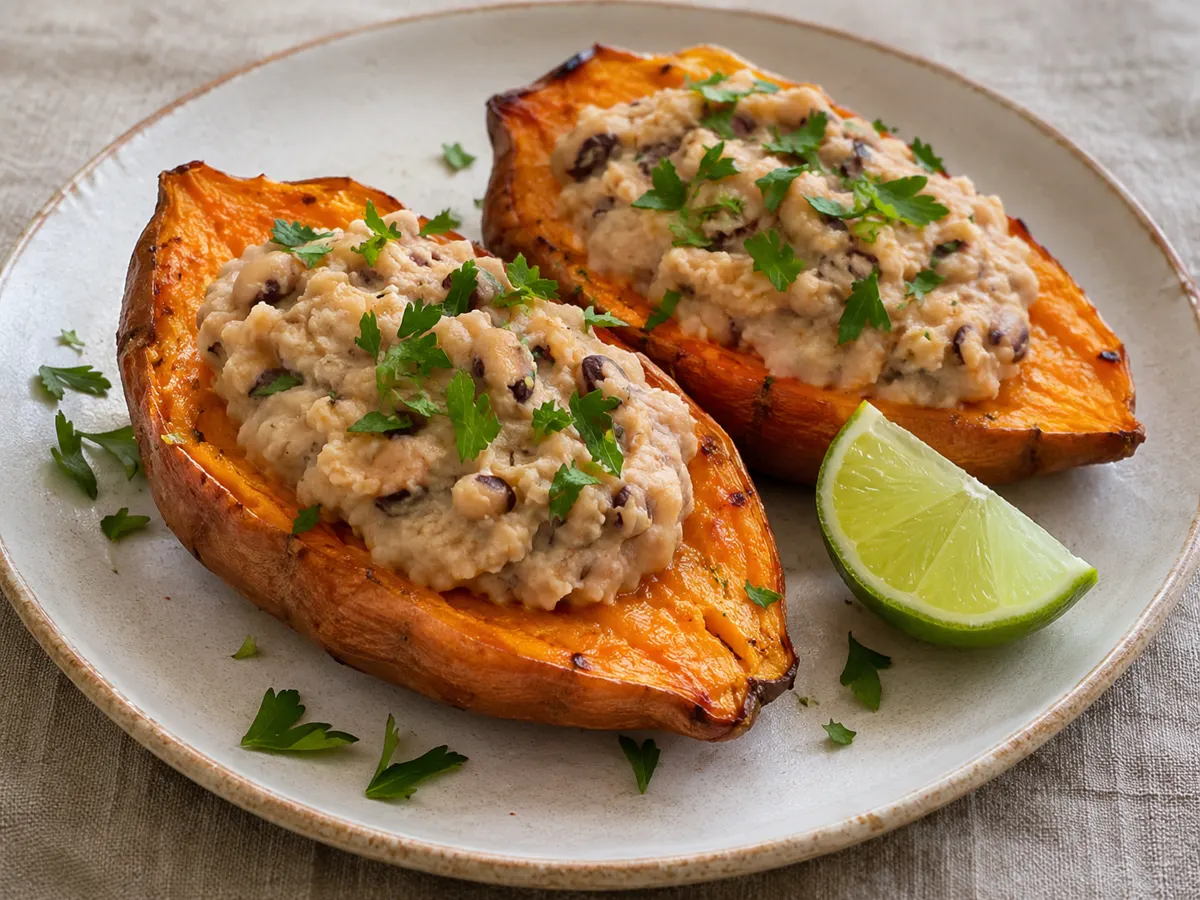
A comforting and flavorful dish, where the sweetness of roasted sweet potatoes meets the creaminess of a black-eyed pea cream brightened with a hint of lime.
Ingredients
- 4 sweet potatoes, about 200g each
- 450g cooked and drained black-eyed peas
- 1 lime
- 1 small garlic clove
- 2 tablespoons oil
- About 100ml hot water
- 10g parsley
- Maximum 3g salt
- Black pepper to taste
Preparation
Preheat your oven to 200°C. Wash and thoroughly brush the sweet potatoes to remove any traces of soil. Cut each sweet potato in half lengthwise. Brush the flesh and skin with one tablespoon of oil, then arrange them on a baking sheet, flesh side up. Bake for 40 to 55 minutes. Cooking is perfect when the flesh is very tender and slightly caramelized on the edges; check by piercing with the tip of a knife.
While the sweet potatoes are roasting, prepare the black-eyed pea cream. In a small saucepan or frying pan, pour the second tablespoon of oil. Finely grate the small garlic clove and sauté it gently for 2 minutes over low heat, without letting it brown, to soften its taste.
Add the cooked and drained black-eyed peas to the saucepan with the garlic and oil. Stir well to coat the black-eyed peas. Let warm for a few moments, then transfer everything to a blender. Begin blending, gradually adding the hot water, about 50ml to start, until you obtain a thick and homogeneous purée. The texture should be smooth and creamy; adjust the amount of water if necessary.
Squeeze half of the lime and add one tablespoon of juice to the black-eyed pea cream. Season with 2g of salt and pepper to your taste. Blend again to thoroughly incorporate the flavors. Taste and adjust the seasoning: if the cream lacks zest, add a little more lime juice, a pinch of salt, or pepper. The balance between acidity and sweetness is the key to this cream.
Finely chop the fresh parsley. Once the sweet potatoes are cooked, remove them from the oven. Check that the flesh is tender to the center with the tip of a knife; it should enter without resistance. Let them cool for a few moments to facilitate handling. The skin, if well washed, can be eaten and provides additional fiber and nutrients.
To serve, slightly open each roasted sweet potato half by scooping out a little of the flesh with a fork. Generously spoon a dollop of warm black-eyed pea cream onto the flesh of each sweet potato. Sprinkle with chopped parsley and grated lime zest for a fragrant and visually appealing final touch. Serve immediately to enjoy the warmth and freshness of the flavors.
Introduction
This contemporary dish is a celebration of Ivorian flavors, revisiting familiar ingredients to create a new and refined culinary experience. The idea is to marry the soft texture and natural sweetness of roasted sweet potato with the protein richness and velvety texture of black-eyed peas (niébé), a legume much appreciated in West Africa. The subtle addition of lime brings a touch of freshness and acidity that perfectly balances the whole, preventing any heaviness and enhancing the aromas. This proposal is part of a modern culinary approach, where the simplicity of ingredients is highlighted by careful preparation techniques and bold flavor combinations. The absence of tahini or dairy products is a deliberate choice to allow the black-eyed peas to fully express their unique flavor and natural texture. The sweet potatoes, meanwhile, are simply roasted to concentrate their sugars and achieve a melting flesh, offering a pleasant contrast with the cream. This dish is an invitation to rediscover local products in a new light, proving that Ivorian cuisine is constantly evolving, capable of innovating while remaining true to its taste roots.
Cultural context
A contemporary creation based on West African ingredients, presented for this volume dedicated to Côte d’Ivoire. No exclusive regional origin or particular tradition is attributed to this formulation.
Institutional References FAO INFOODS: https://www.fao.org/infoods/infoods/tables-and-databases/faoinfoods-databases/en/ — Food composition and table for West Africa; no nutritional calculation of this formulation is announced. World Health Organization: https://www.who.int/teams/nutrition-and-food-safety/multisectoral-actions-in-food-systems/five-keys-to-safer-food-poster — Principles of cleanliness, food separation, cooking, and temperature control.
Tips
For a perfectly roasted sweet potato, the key is patience and good heat management. If you notice the skin starting to blacken too quickly before the flesh is tender, you can cover the baking sheet with aluminum foil for the last few minutes. This will allow the flesh to cook through without burning the outside. Another tip is to flip the sweet potatoes halfway through cooking, flesh side down, to achieve uniform caramelization and prevent them from drying out. Don't hesitate to check the cooking regularly, as the size of the potatoes and the efficiency of your oven can significantly vary the cooking time. The flesh should be melt-in-your-mouth under a fork, with no resistance.
The consistency of the black-eyed pea cream is essential for this dish. If, after adding hot water, the cream seems too thick, don't hesitate to add very small amounts of additional hot water, one tablespoon at a time, blending well after each addition. The goal is to obtain a smooth and creamy texture that holds well on the sweet potato without being liquid. Conversely, if it is too liquid, this may indicate an excess of water. In this case, you can return it to a saucepan over low heat and reduce it very slightly, stirring constantly, until it thickens. Another solution is to add a small amount of unblended cooked black-eyed peas to give it more body.
The balance of flavors in the black-eyed pea cream is crucial. Lime brings a refreshing acidity that cuts through the richness of the black-eyed peas. Don't hesitate to taste the cream several times during seasoning. If you find it lacks zest, add a little more lime juice in small touches. If, on the contrary, it is too acidic, a pinch of sugar or a very small amount of additional black-eyed peas can help rebalance. Salt and pepper are also important flavor enhancers. Remember that flavors develop as they cool, so it's best to season slightly stronger than what you would judge perfect when hot, for an optimal result at serving time.
For storage, if you have leftovers, separate the sweet potatoes and the black-eyed pea cream. The black-eyed pea cream can be stored in an airtight container in the refrigerator for 2 to 3 days. Roasted sweet potatoes, once cooled quickly (within two hours of cooking), can also be stored in the refrigerator in a sealed container for 2 to 3 days. To reheat, the black-eyed pea cream can be gently reheated in a saucepan with a tablespoon of water if it has thickened. Sweet potatoes can be reheated in the oven at 180°C for 10-15 minutes to regain their soft texture. Avoid freezing this dish, as the texture of the sweet potatoes and cream could be altered.
Planning
The success of this dish relies on the quality of the ingredients and precise execution. For the sweet potatoes, choose ones of similar size for even cooking. Once brushed and cut in half lengthwise, light oiling is essential to promote beautiful surface caramelization and a tender, melt-in-your-mouth interior. An oven at 200°C is ideal for this cooking, allowing natural sugars to develop without burning. Monitor cooking by piercing the flesh with the tip of a knife: it should be tender but not mushy. The indicated time is an average and may vary depending on the size of the potatoes and your oven's performance. Feel free to extend by a few minutes if necessary; the goal is perfect cooking. Regarding the black-eyed pea cream, using pre-cooked and drained black-eyed peas greatly simplifies preparation. If starting with dry black-eyed peas, plan for an overnight soak and cooking for about 45 to 60 minutes until very tender. Incorporating garlic is a delicate point: a small grated clove briefly cooked in oil helps soften its pungency and develop its aromas. Hot water is added gradually to achieve the desired smooth and creamy consistency. Lime juice is the key element that brings the necessary vibrancy to the cream, so it's important to add it in small quantities and taste to adjust the balance of flavors. Fresh parsley, chopped just before serving, will add an herbaceous touch and vibrant color.
Nutrition notes
This dish is an excellent source of energy and essential nutrients. Sweet potatoes are renowned for their richness in dietary fiber, promoting good digestion and contributing to a feeling of fullness. They also provide vitamins, particularly vitamin A in the form of beta-carotene, beneficial for vision and skin. Black-eyed peas, meanwhile, are a valuable legume, offering a significant amount of plant-based protein, making them an excellent meat substitute and an asset for maintaining muscle mass. The combination of these two ingredients creates a balanced, nourishing, and easy-to-digest dish.
Conclusion
A modern and flavorful dish, where sweet potato and black-eyed peas harmonize beautifully. This recipe is a wonderful demonstration of the richness and diversity of contemporary Ivorian cuisine, both simple and refined.
Enjoy your meal
Enjoy your meal!