Baked fish and green papaya compote
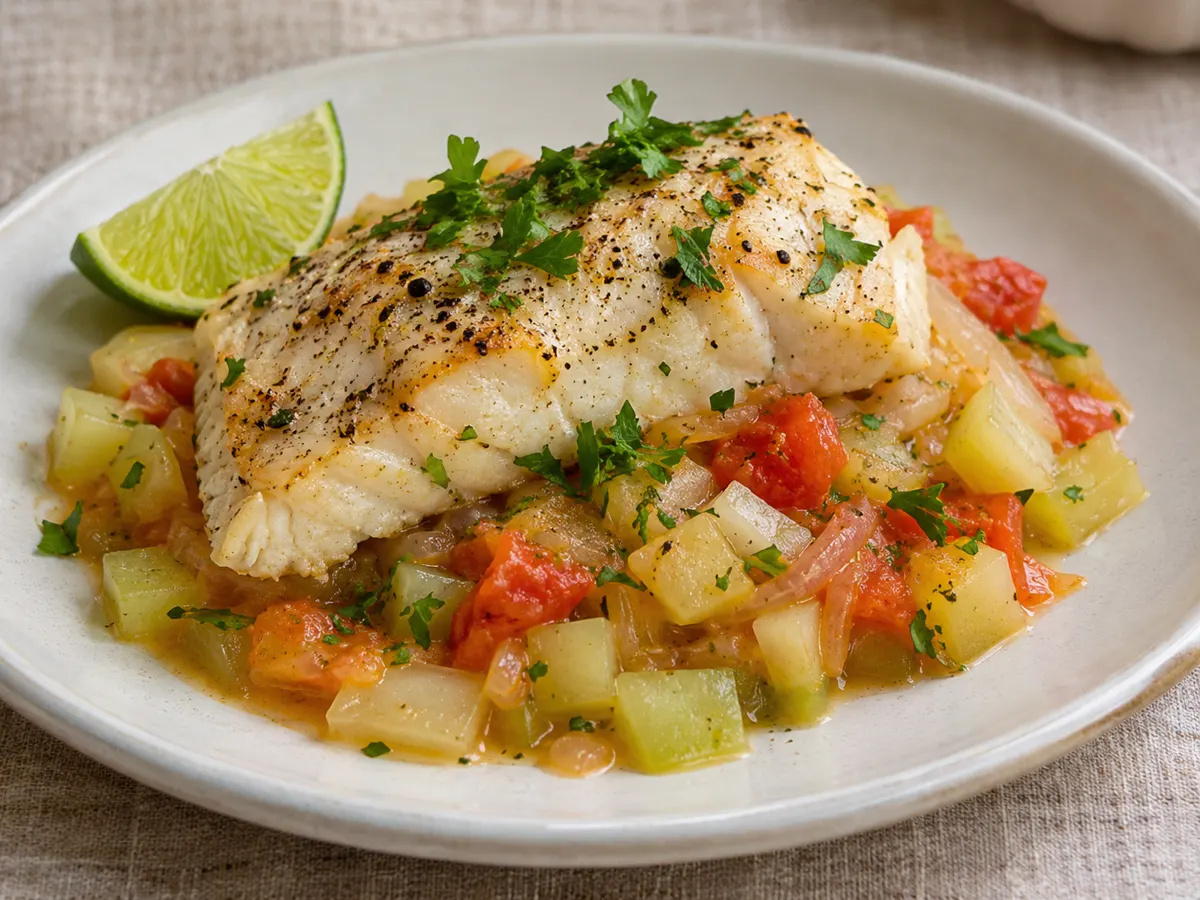
Baked white fish and melting green papaya with tomato and ginger: a detailed contemporary preparation, with separate cooking methods.
Ingredients
- 4 white fish fillets, 150 g each
- 500 g peeled and deseeded green papaya
- 2 tomatoes
- 1 onion
- 15 g fresh ginger
- 1 lime
- 2 tablespoons oil
- 150 ml water
- 10 g parsley
- 3 g salt maximum
- Black pepper to taste
Preparation
Peel and thinly slice the onion. Grate the ginger after peeling it. Wash the tomatoes, remove the hard parts around the stem, and cut the flesh into small dice. Prepare the green papaya by removing the skin and seeds, then cut it into regular cubes. Place the fish fillets in a separate container in the refrigerator while you start the garnish. Clean any equipment that has touched raw fish before any other use.
Heat one tablespoon of oil in a large saucepan. Sauté the onion for five minutes over medium-low heat, until it softens. Add the ginger and tomatoes. Continue for eight minutes, stirring regularly so that the tomato begins to reduce. If the bottom sticks before the tomatoes have released their juice, lower the heat and pour in a small spoonful of the reserved water.
Add the papaya cubes and about one hundred milliliters of water. Season with some of the salt and black pepper. Cover partially and let simmer for twenty-five to thirty minutes, stirring carefully from time to time. The papaya should become tender to the center. Add the rest of the water gradually if the bottom dries out while the pieces are still firm; the final result should remain a compote rather than a soup.
When the papaya begins to tenderize, preheat the oven to 190 °C. Brush a small dish with the second tablespoon of oil and place the patted-dry fish fillets. Sprinkle a little salt and pepper on their surface. Bake for fifteen to twenty-five minutes depending on their thickness. Check for doneness with a clean thermometer: the flesh should reach at least 63 °C at the core, with no translucent central area.
Taste a cooked piece of papaya and a small spoonful of sauce. Adjust the salt within the planned limit and extend cooking for a few minutes uncovered if the garnish remains too liquid. Wash, dry, and chop the parsley. Cut the lime into wedges. Once the fish is cooked, remove its dish from the oven; do not let it wait long in a hot enclosure while you adjust the compote.
Distribute the papaya and tomatoes into four plates, then place a fish fillet on each portion with a wide spatula. Add the parsley and a few drops of lime juice. Offer the remaining lime separately. Serve immediately, preserving the clear fish juices if they are not burnt. Both cooking methods should remain perceptible: a melting garnish and a fillet still easy to separate with a fork.
Introduction
Green papaya changes its role when cooked with onion, tomato, and ginger. Its still firm flesh becomes a melting vegetable, whose small pieces absorb the juice of the aromatics. The fish is prepared separately in the oven to ensure cooking adapted to its thickness. This separation avoids leaving a delicate fillet waiting in a compote that would still need twenty minutes to tenderize. Lime is added at serving, when both elements are ready.
This proposal is a contemporary creation around products found in West African kitchens. It is not attributed to a region nor presented as a reproduction of a traditional Ivorian recipe. Its practical interest lies in the contrast between a soft garnish and fish flesh that still flakes apart. Choose a white fish offered in comparable fillet sizes. A ripe orange-fleshed papaya will not yield the same garnish: it breaks down quickly and adds more sweetness.
Cultural context
Contemporary creation around products from the West African repertoire, proposed for this volume dedicated to Côte d'Ivoire. No exclusive regional origin or particular tradition is attributed to this formulation.
Institutional references FAO INFOODS: https://www.fao.org/infoods/infoods/tables-and-databases/faoinfoods-databases/en/ — Food composition and table for West Africa; no nutritional calculation for this formulation is announced. World Health Organization: https://www.who.int/teams/nutrition-and-food-safety/multisectoral-actions-in-food-systems/five-keys-to-safer-food-poster — Principles of cleanliness, food separation, cooking, and temperature control. FoodSafety.gov: https://www.foodsafety.gov/food-safety-charts/safe-minimum-internal-temperatures — Institutional cooking temperature guidelines; durations depend on products and equipment.
Tips
If the papaya is still firm, continue cooking it with a little water and a partially closed lid. Lemon does not replace this cooking. The time varies with the ripeness of the fruit and the size of the cubes: check several pieces, especially the largest ones. If the garnish is ready before the fish, keep it warm over very low heat, then readjust its consistency with a small amount of water if it thickens.
A thin fillet can cook significantly faster than a thick fish loin. Use comparable portions or remove the thinner ones when they have reached their correct doneness. Surface browning is not a sufficient indicator of the internal temperature. Insert the clean probe into the thickest part, then clean it before checking another food. Avoid excessive handling that would break the fillets in the dish.
To prepare part of the meal in advance, cook only the compote, then cool it quickly and refrigerate it within two hours. Reheat it completely before starting the fish. This method keeps the fillet's finish close to serving time. Leftovers of fish and vegetables should be quickly refrigerated and consumed within twenty-four hours after complete reheating. The presence of lime does not allow for prolonged storage on the table.
Ripe papaya can be cooked in another dessert or garnish, but it does not exactly replace the green fruit in this recipe. Its juice, sweetness, and texture change the balance. If you haven't found green papaya, choose another recipe rather than keeping the same cooking time with a very soft fruit. Similarly, do not replace fillets with a whole fish without reviewing the duration and bone control.
Planning
Green papaya must be a clearly identified food fruit, purchased from a reliable supplier. Wash its skin before peeling, then remove the seeds and fibrous parts near the cavity. Work on a stable board with a clean knife. The weight of five hundred grams corresponds to the usable flesh, after this preparation. Cut it into small, regular cubes, about one and a half centimeters, so that the center softens without unnecessarily prolonging the simmering.
Fillets are checked before cooking, even when sold boneless. If frozen, thaw them in the refrigerator in a container that retains their liquid, then pat them dry. The oven time mainly depends on their thickness. Keep them cold during the initial cooking of the papaya and prepare the baking dish in advance. This organization allows you to start the fish when the garnish truly begins to tenderize, rather than following an arbitrary start time.
Nutrition notes
White fish contributes to protein intake, while papaya and tomatoes diversify the vegetables consumed. The amount of lipids depends on the fish and the oil actually used. This recipe does not present papaya as a treatment or as a food with particular effects on digestion. Portions and any starchy side dish should be considered as part of the overall meal. No precise caloric figures are announced without calculation based on actual ingredients.
Conclusion
Enjoy your meal: savor the fish straight from the oven, on tender papaya well coated with tomato. The acidity of the lime can be adjusted on the plate to allow the sweetness of the garnish and the taste of the fish to remain distinct.
Enjoy your meal
Enjoy your meal!