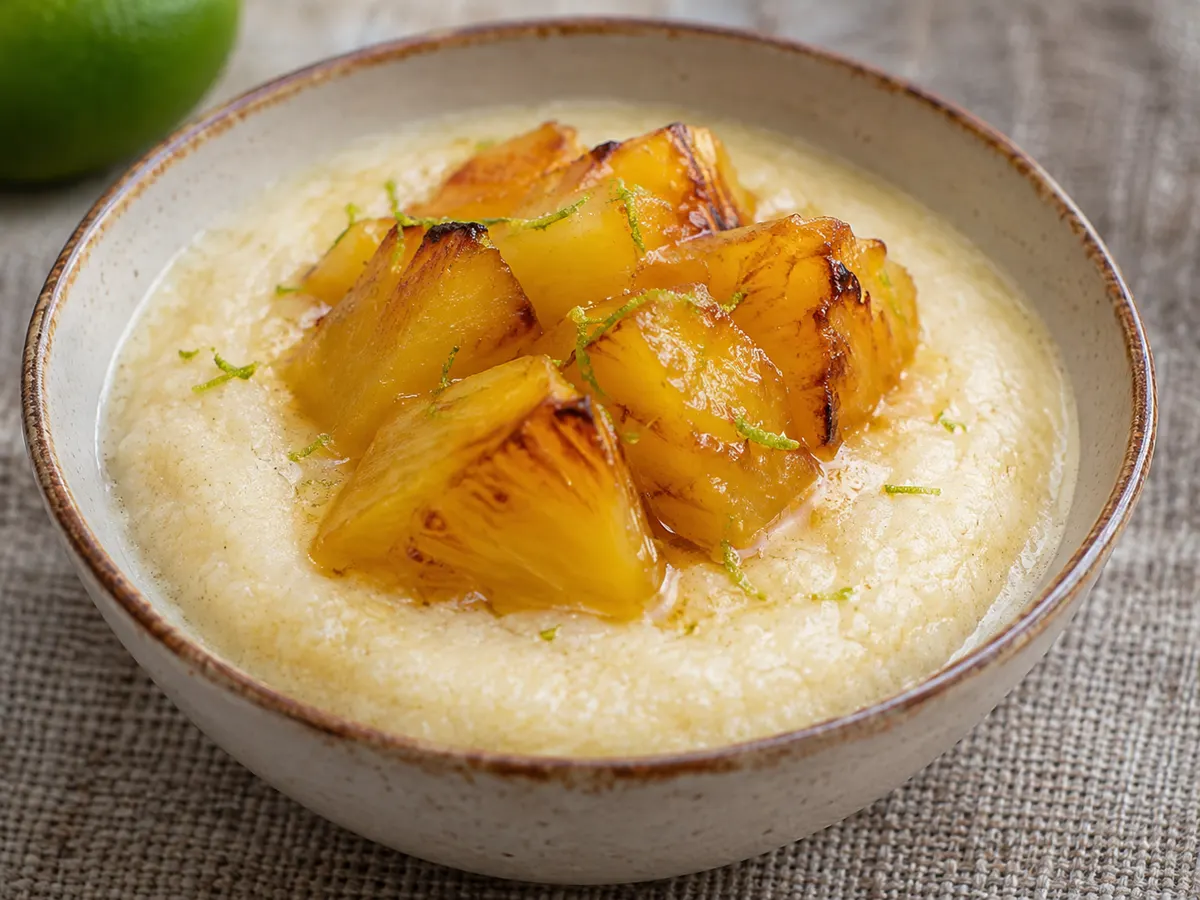
Corn cream with coconut milk and roasted pineapple
Corn semolina cream with coconut milk and roasted pineapple: a contemporary vanilla dessert, with cooking and cooling guidelines.
Ingredients
- 100 g fine food-grade corn semolina
- 400 ml coconut milk
- 400 ml water
- 500 g fresh pineapple flesh
- 30 g sugar
- 1 lime
- 1 small vanilla bean
- 1 teaspoon neutral oil
- 1 small pinch of salt
Preparation
Preheat the oven to 200°C. Cut the pineapple flesh into pieces two to three centimeters in size. Arrange them in a small oven-safe dish, add the teaspoon of oil and ten grams of the sugar. Mix to coat the pieces without leaving a thick layer of sugar at the bottom. Spread the pieces out so they can lose some of their water during cooking.
Bake the pineapple for twenty-five to thirty-five minutes, turning it once. It should become tender and have some slightly colored edges. Monitor the bottom of the dish: if the juice reduces too quickly, add a tablespoon of water to prevent it from burning. Remove the fruit from the oven and keep the juice. Let cool separately while you finish the corn cream.
In a thick-bottomed saucepan, cold-mix the cornmeal with water and coconut milk. Split the vanilla bean and scrape out its seeds, then add both seeds and pod to the mixture. Incorporate the remaining twenty grams of sugar and the small pinch of salt. Whisk to disperse the grains before turning on the heat, to limit lump formation.
Heat gently, stirring constantly with a spatula that reaches the bottom. As soon as it begins to simmer, lower the heat and continue according to the cornmeal's instructions, usually fifteen to twenty minutes for a fine, uncooked grind. The grains should become tender. If the mixture thickens too quickly before they are fully cooked, add a little hot water and continue stirring without abruptly increasing the heat.
Remove the vanilla bean. Taste a small cooled spoonful to check for any hard grains. Wash the lime, zest a little fine peel without the white part, and add it to the cream. Divide into four shallow containers. Let only the strongest steam dissipate, then place in the refrigerator, protecting the containers without enclosing a large, still-burning mass.
Once the cream is cooled, distribute the pineapple and its juice over the four portions. If you prefer a warm and cool contrast, only reheat the fruit just before placing it on the cold cream. Serve with a spoon. The base should remain pleasant to scoop, not firm enough to be cut like a dough; the fruit should be tender, and the juices should not taste of burnt sugar.
Introduction
Fine corn semolina makes it possible to prepare a cream whose texture gently firms up as it cools. Coconut milk softens it and provides a fragrance that complements the roasted pineapple. Separate cooking of the fruit concentrates its flavor without caramelizing the entire cream. When served, the pineapple pieces remain visible and their juice forms a small surface seasoning. The dessert is eaten with a spoon, with a soft base and tender fruit that retains its shape.
This proposal is a contemporary creation around corn, coconut, and pineapple. It does not claim to reproduce a traditional Ivorian dessert under an invented name. Its success relies mainly on identifying the grind: a fine food-grade semolina, distinct from starch and corn flour intended for other uses. The indicated time includes one hour of cooling, but a cream placed in large containers may require more time to become cool to the center.
Cultural context
A contemporary variation around West African ingredients, proposed for this volume dedicated to Côte d’Ivoire. No exclusive regional origin or particular tradition is attributed to this formulation.
Institutional references FAO INFOODS: https://www.fao.org/infoods/infoods/tables-and-databases/faoinfoods-databases/en/ — Food composition benchmarks; no nutritional calculation of this formulation is announced. World Health Organization: https://www.who.int/teams/nutrition-and-food-safety/multisectoral-actions-in-food-systems/five-keys-to-safer-food-poster — General principles of cleanliness, food separation, cooking, and temperature control.
Tips
The final consistency is judged after cooling, as the corn continues to bind the liquid. A cream that appears soft when removed from the heat can become significantly firmer in the refrigerator. For a next, more fluid preparation, keep the same semolina and note the amount of water actually used. Changing both the grind and the liquid simultaneously would make the comparison less useful.
Small lumps are primarily prevented by cold dispersion and regular stirring of the bottom. If some clumps appear, crush them with the spatula against the side while the cream remains soft. Prolonged mixing does not replace sufficient cooking of the grains. Also, check that the semolina is suitable for this preparation and that it is not coarse grains requiring another method.
Keep the cream and pineapple in the refrigerator if serving is delayed. Refrigerate within two hours after cooking and consume within twenty-four to forty-eight hours. For a transported dessert, use a refrigerated insulated container. Coconut milk and cooked fruit do not make the preparation stable outside of cold. Add the topping at the last moment if you want to maintain a clear separation between the cream and the pineapple juice.
Vanilla should remain discreet to allow the corn and pineapple to be perceived. Be sure to retrieve the pod before distributing the cream. For a neat presentation, wipe the edge of the small bowls after filling, then add the cooled fruit only when the base is no longer likely to engulf them.
Planning
Coconut milk can separate in its packaging. Mix it thoroughly before measuring the quantity. The recipe uses an unsweetened food product; a very diluted drink or an already sweetened preparation would alter the consistency and seasoning. Water is used to hydrate the corn, while coconut milk contributes to the texture. The amount of sugar remains moderate and can be adjusted according to the actual ripeness of the pineapple.
Choose a healthy and fragrant pineapple, then remove the skin, eyes, and hard core. The indicated weight is that of the usable flesh. Cut pieces of regular size so that they roast at the same rate. Prepare four small, heat-resistant, clean containers, wide enough to cool without retaining a compact hot mass. Cooling begins quickly after cooking, without letting the dessert wait long on the countertop.
Nutrition notes
Corn provides carbohydrates and coconut milk provides lipids, including a proportion of saturated fatty acids that depends on the product. The added sugar should be considered with that naturally present in pineapple. This dessert is not presented as a therapeutic food or as automatically light. Portions, the brand of coconut milk, and the ripeness of the fruit influence its composition; no precise figures are given without appropriate calculation. Check labels if dietary restrictions are necessary. Enjoy your meal, with a cream whose grains are well cooked and roasted pineapple without bitterness.
Conclusion
Serve at the indicated texture and adjust seasoning after tasting the cooked foods.
Enjoy your meal
Enjoy your meal!