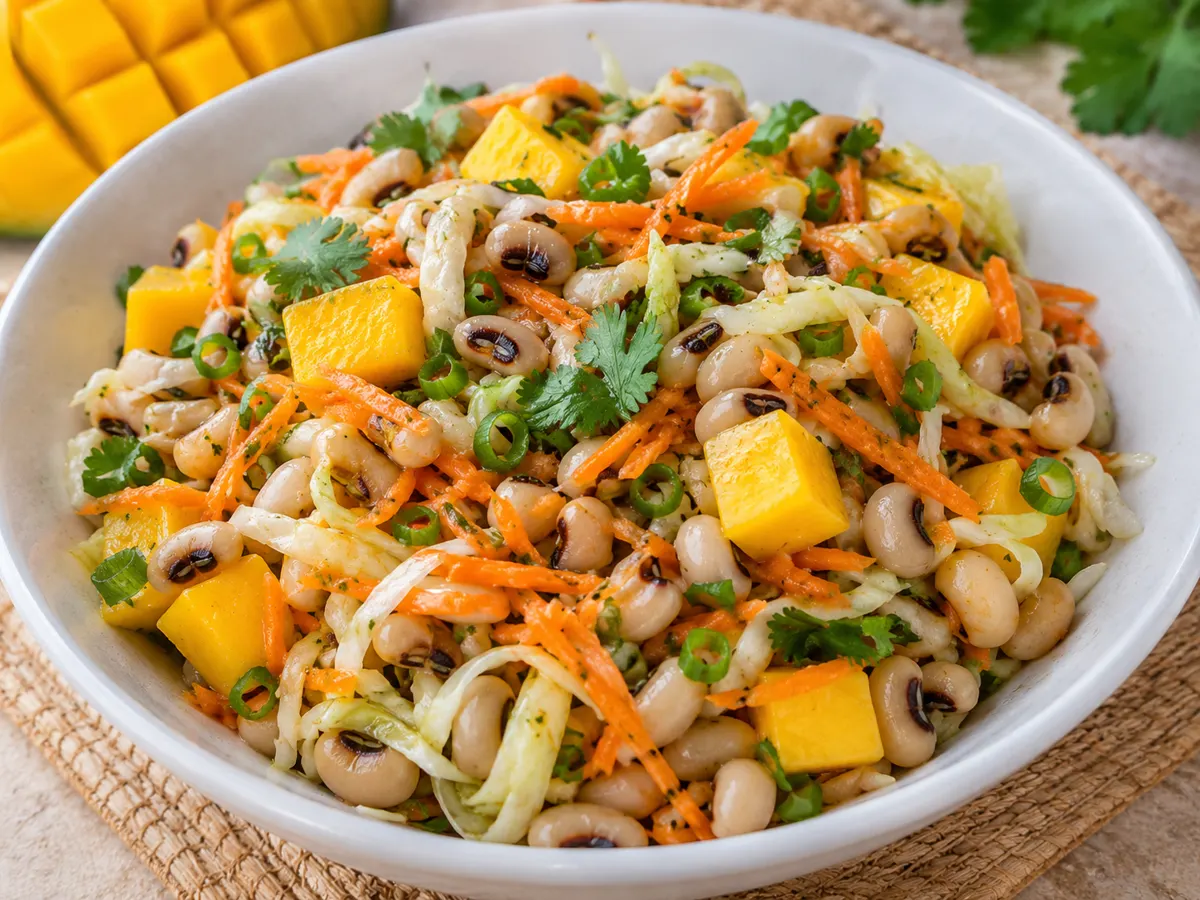
Black-eyed pea salad with firm mango and crunchy cabbage
Tender black-eyed peas, firm mango, crunchy cabbage and carrot: a contemporary lime salad, explained with preparation and storage tips.
Ingredients
- 500 g cooked and drained black-eyed peas
- 1 firm mango, about 350 g
- 250 g white cabbage
- 1 small carrot
- 2 spring onions
- 1 lime
- 2 tablespoons oil
- 10 g fresh coriander
- 1 teaspoon grated ginger
- 2 g salt maximum
- Black pepper to taste
Preparation
Check that the black-eyed peas are fully cooked and cold. Drain them in a colander for a few minutes. If using canned, rinse the beans with potable water then let them drain. Remove any crushed beans or skin fragments that bother you, without trying to strip the entire preparation. Then place the black-eyed peas in a large clean salad bowl.
Remove the core from the cabbage and finely shred the leaves. Peel the carrot, rinse it, and grate it with a fairly coarse grater. Wash the spring onions and chop them finely, keeping their healthy green parts. Combine these vegetables in a second container. This separation allows them to be seasoned without crushing the black-eyed peas from the start.
Wash the mango before peeling it. Place it on a stable cutting board and remove the two cheeks from either side of the pit. Cut the flesh into small, regular cubes. Also retrieve the edible parts around the pit, then taste a piece. Reserve the cubes in the refrigerator; do not mix them with the vegetables yet, as they do not tolerate repeated handling as well.
Squeeze the lime and measure one tablespoon of juice. Mix this juice with the oil, finely grated ginger, some of the salt, and black pepper. Whisk briefly with a fork to disperse the ginger. Taste a small drop, then optionally add a second spoon of juice if the mango is rather sweet and you want more acidity.
Pour half of the sauce over the cabbage, carrot, and spring onions. Mix with clean hands or two spoons to distribute the seasoning well. Add these vegetables to the black-eyed peas and gently lift the mixture. Then incorporate the mango cubes and the washed, dried, and chopped coriander. Pour the remaining sauce gradually, depending on the moisture already present in the salad bowl.
Taste a bite containing black-eyed peas, cabbage, and mango. Adjust the salt within the planned limit, then serve immediately or refrigerate until serving. Distribute with a large spoon, reaching for the beans at the bottom of the salad bowl. The salad should remain colorful and crunchy, with a sauce that coats the ingredients without forming a layer of liquid at the bottom of the plates.
Introduction
This salad combines already cooked black-eyed peas, a still firm mango, and finely shredded cabbage. The sweetness of the fruit complements the legumes, while the cabbage and carrot provide a distinct crunch. Lime and ginger form a light dressing, without a thick sauce. Preparation remains pleasant when two conditions are met: thoroughly drain the black-eyed peas and choose a mango that can be neatly cut into small cubes.
This is a contemporary creation, designed for a generous starter or a light meal supplemented as needed. It is not presented as a historical recipe from a particular Ivorian region. The mango can be slightly tart or simply underripe, but it should not be so hard as to be impossible to chew. This difference influences the balance of the sauce: taste the fruit before using all the lime juice, then adjust the acidity sparingly.
Cultural context
Contemporary variation on West African ingredients, offered for this volume dedicated to Côte d’Ivoire. No exclusive regional origin or particular tradition is attributed to this formulation.
Institutional references FAO INFOODS: https://www.fao.org/infoods/infoods/tables-and-databases/faoinfoods-databases/en/ — Food composition data; no nutritional calculation for this formulation is announced. World Health Organization: https://www.who.int/teams/nutrition-and-food-safety/multisectoral-actions-in-food-systems/five-keys-to-safer-food-poster — General principles of cleanliness, food separation, cooking, and temperature control.
Tips
If the cabbage seems too firm for your taste, massage it for one minute with a small portion of the dressing before adding the other ingredients. This action softens it slightly without turning it into a cooked vegetable. Long maceration changes the texture more and releases water: reserve it for a different result rather than letting this salad sit for several hours at room temperature.
A very ripe mango may be suitable for a sauce or a dessert, but it easily falls apart in this mixture. If you only have this fruit, cut larger pieces and place them directly on the plates after serving the black-eyed peas with cabbage. You will maintain a neat presentation and avoid turning the entire sauce into mango pulp. Do not compensate for very soft flesh by stirring more.
For transport, keep the salad bowl closed in an insulated container with cooling elements, then refrigerate it immediately upon arrival. The presence of lemon does not make the salad stable at room temperature. Leftovers should be quickly refrigerated and consumed within twenty-four hours. It is better to prepare a quantity suitable for the meal: the cabbage softens and the mango loses its firmness over time.
For individual presentation, first distribute the beans and vegetables, then add the last mango cubes on top. This arrangement allows you to visually check that the fruits are distributed among the four portions. Keep a clean spoon for serving; the one used for tasting does not go back into the salad bowl. A large serving plate also makes it easier to scoop without crushing the cubes.
Planning
The five hundred grams of black-eyed peas correspond to the cooked and drained weight. To use dry beans, plan to soak and cook them beforehand according to product instructions; these additional steps are not included in the thirty minutes of preparation for this recipe. The beans should be tender to the center, then cooled quickly before mixing. Rinsed and thoroughly drained canned beans are another option.
The cabbage should be washed after removing damaged leaves, then dried to avoid a watery salad. Shred it as finely as possible with a stable knife. The carrot should be coarsely grated, without being pureed. Keep the black-eyed peas, vegetables, and herbs chilled until assembly. The salad contains ready-to-eat foods and will not be cooked after combining them.
Nutrition notes
Black-eyed peas provide plant proteins and fiber, while mango, cabbage, and carrot diversify the vegetables consumed. Oil contributes to seasoning and lipid intake; it should be measured rather than poured without reference. This recipe does not claim any therapeutic properties or precise caloric value. The composition depends on the quantity served and the black-eyed peas used, particularly the possible presence of salt in canned goods. People who have difficulty digesting legumes can adjust their portion and choose well-cooked beans. Enjoy this fresh salad, where each bite maintains the contrast between tender beans and crunchy vegetables.
Conclusion
Serve at the indicated texture and adjust the seasoning after tasting the cooked ingredients.
Enjoy your meal
Enjoy your meal!