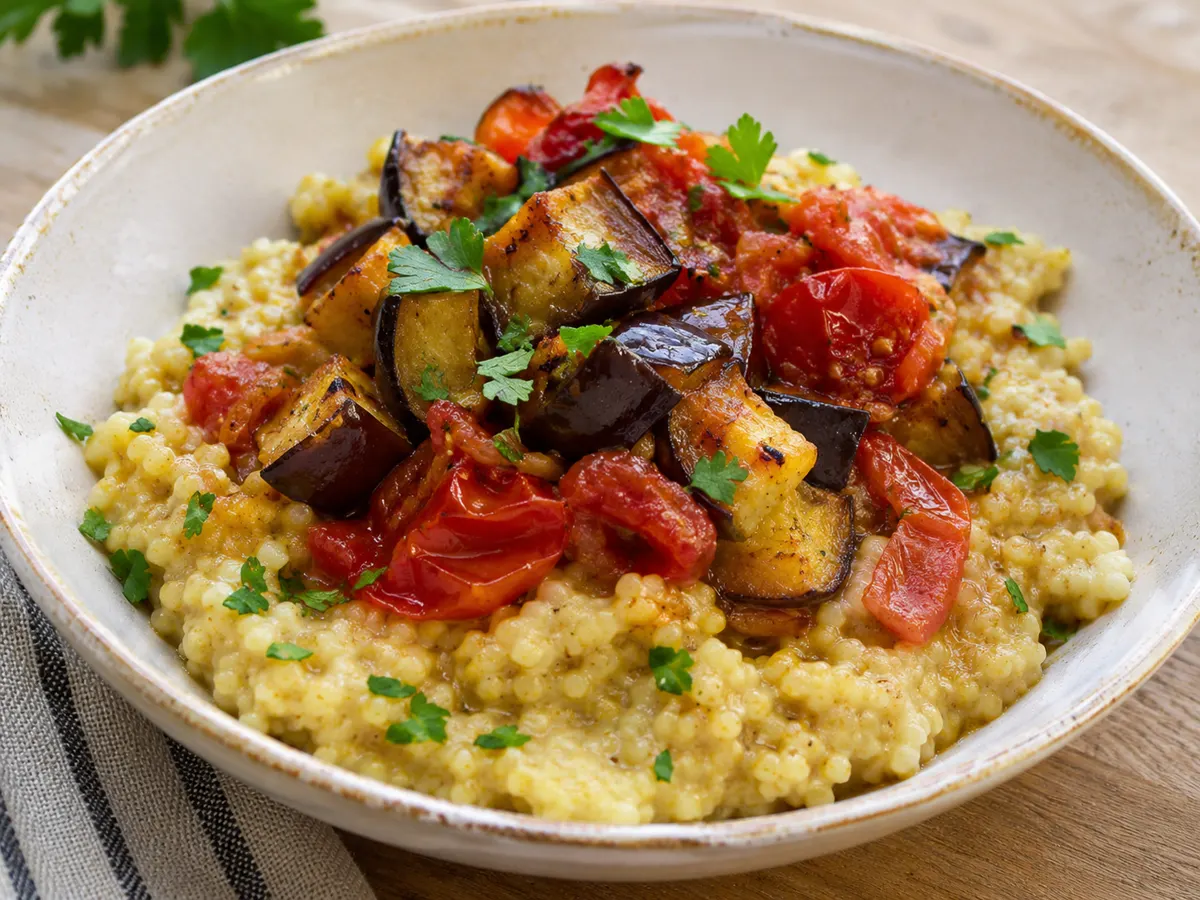
Creamy millet with roasted eggplant and tomatoes
Supple millet with roasted eggplant and tomatoes: a creamy preparation without cream, with cooking and grain texture guidelines.
Ingredients
- 250 g hulled millet
- 2 medium eggplants
- 500 g tomatoes
- 1 onion
- 2 cloves garlic
- 3 tablespoons oil
- About 900 ml hot water
- 1 teaspoon thyme
- 10 g parsley
- 3 g salt maximum
- Black pepper to taste
Preparation
Preheat the oven to 200 °C. Wash the eggplants and tomatoes. Cut the eggplants into two-centimeter cubes, then the tomatoes into quarters. Spread them on a large baking sheet, add two tablespoons of oil and the thyme. Mix directly on the sheet, then spread without overcrowding. Tomatoes can be placed on one half to collect their juice more easily.
Bake for thirty to forty minutes, turning the eggplants halfway through cooking. The pieces should be tender to the center, with some colored sides. If the tomatoes release a lot of juice, let it reduce without letting it blacken. If, on the contrary, the sheet dries too quickly, add two or three spoonfuls of water to the exposed areas to protect the juices.
Rinse the millet and drain it. Peel and chop the onion and garlic. In a heavy-bottomed saucepan, heat the remaining tablespoon of oil. Sauté the onion for five minutes over medium-low heat, add the garlic and stir for another minute. Add the drained millet and mix for one minute, without aiming for a brown coloration of the grains.
Pour in about seven hundred milliliters of hot water. Bring to a simmer, add some of the salt, and lower the heat. Cook for about twenty to twenty-five minutes, stirring regularly and checking the package cooking time. Gradually add some of the remaining water if the grains are still firm while the saucepan becomes dry. A small boil is sufficient.
When the grains are tender, take half of the roasted tomatoes and eggplants. Incorporate them into the millet with the cooking juices collected from the baking sheet. Crush a few tomato pieces against the side to distribute their juice. Continue for two to three minutes over low heat, adding a little hot water if necessary to regain a supple consistency.
Turn off the heat and taste a small portion. Adjust salt and black pepper, then add the washed, dried, and chopped parsley. Divide the creamy millet into four deep plates. Place the reserved vegetables on top, making sure to distribute eggplants and tomatoes to everyone. Serve immediately: millet continues to thicken as it cools and should be enjoyed without a long wait.
Introduction
Hulled millet can become a creamy side dish without added cream. Gentle cooking with a gradually adjusted amount of liquid allows the grains to soften and lightly bind their water. Oven-roasted eggplants and tomatoes provide a more concentrated garnish, part of which is mixed with the cereal while the rest remains visible when served. This arrangement results in a supple plate, with vegetable pieces that retain their identity.
This recipe is a contemporary creation based on a cereal and vegetables used in West African cuisines. It does not attribute an exclusive origin of millet to Côte d'Ivoire, nor a specific tradition for this method. The culinary interest lies in the meeting of textures: a warm, almost unctuous base, tender eggplants, and tomatoes whose juice becomes a seasoning. The millet grains must be clearly identified on the package; flour and pre-cooked semolina do not behave in the same way.
Cultural context
Contemporary variation on West African ingredients, proposed for this volume dedicated to Côte d'Ivoire. No exclusive regional origin or particular tradition is attributed to this formulation.
Institutional references FAO INFOODS: https://www.fao.org/infoods/infoods/tables-and-databases/faoinfoods-databases/en/ — Food composition benchmarks; no nutritional calculation of this formulation is announced. World Health Organization: https://www.who.int/teams/nutrition-and-food-safety/multisectoral-actions-in-food-systems/five-keys-to-safer-food-poster — General principles of cleanliness, food separation, cooking, and temperature control.
Tips
Millet whose grains remain hard first requires more time and liquid. Adding oil at this stage does not replace the water needed for hydration. Pour a small volume of hot water, mix, and continue over low heat. Taste again after a few minutes. The grains should be pleasant to chew, without a dry core that resists under the tooth.
The creamy texture does not mean a perfectly smooth puree. Some of the grains remain perceptible and give texture to the preparation. If you want a more bound version, take two spoonfuls of cooked millet, crush them in a small plate, then return them to the saucepan. This action allows you to slightly modify the binding without blending the entire preparation or removing the texture of the vegetables.
Vegetables can be roasted a few hours in advance, cooled quickly, and refrigerated. Reheat them completely before combining them with the millet. For leftovers, divide the preparation into shallow containers and refrigerate within two hours. Consume within twenty-four to forty-eight hours. When reheating, add water and stir often, as cooled millet absorbs liquid and can stick to the bottom.
The tomato juice collected on the baking sheet can be loosened with a spoonful of hot water when the dish is no longer scorching. Pour it into the saucepan, scraping only the soft, colored juices. Black, dry, or bitter traces should not be incorporated. This recovery allows you to rediscover the taste of roasted vegetables without adding broth or industrial seasoning to the millet preparation.
Planning
Hulled grains require rinsing in a fine enough sieve to avoid losing them. Consult package directions, as cooking times may vary by product. The water indicated is a reserve and not necessarily a quantity to be poured in entirely. The dish should remain easy to scoop with a spoon; complete absorption followed by a long wait would result in a firmer mass.
Choose shiny, firm eggplants and cut them into regular-sized cubes. Tomatoes can be of different varieties if they are ripe and healthy. Cut large ones into quarters and leave small ones in halves. Their water content varies: monitor the baking sheet in the oven rather than aiming for total desiccation. The juices are interesting for flavoring the millet, provided they don't burn on the edges.
Nutrition notes
Millet is the main source of carbohydrates here. Eggplants and tomatoes contribute to the vegetable variety of the meal, while oil provides lipids and helps distribute flavors. To compose a meal with more protein, accompany this preparation with black-eyed peas, eggs, or another food suitable for the guests. No numerical nutritional values are given without calculation on actual products and portions. If strict gluten avoidance is necessary, also check the labeling and any potential contamination of the packaged cereal. Enjoy your meal: serve the millet very supple, with visible vegetables and fully tender grains.
Conclusion
Serve at the indicated texture and adjust seasoning after tasting the cooked food.
Enjoy your meal
Enjoy your meal!