Yam soup with chicken and ginger
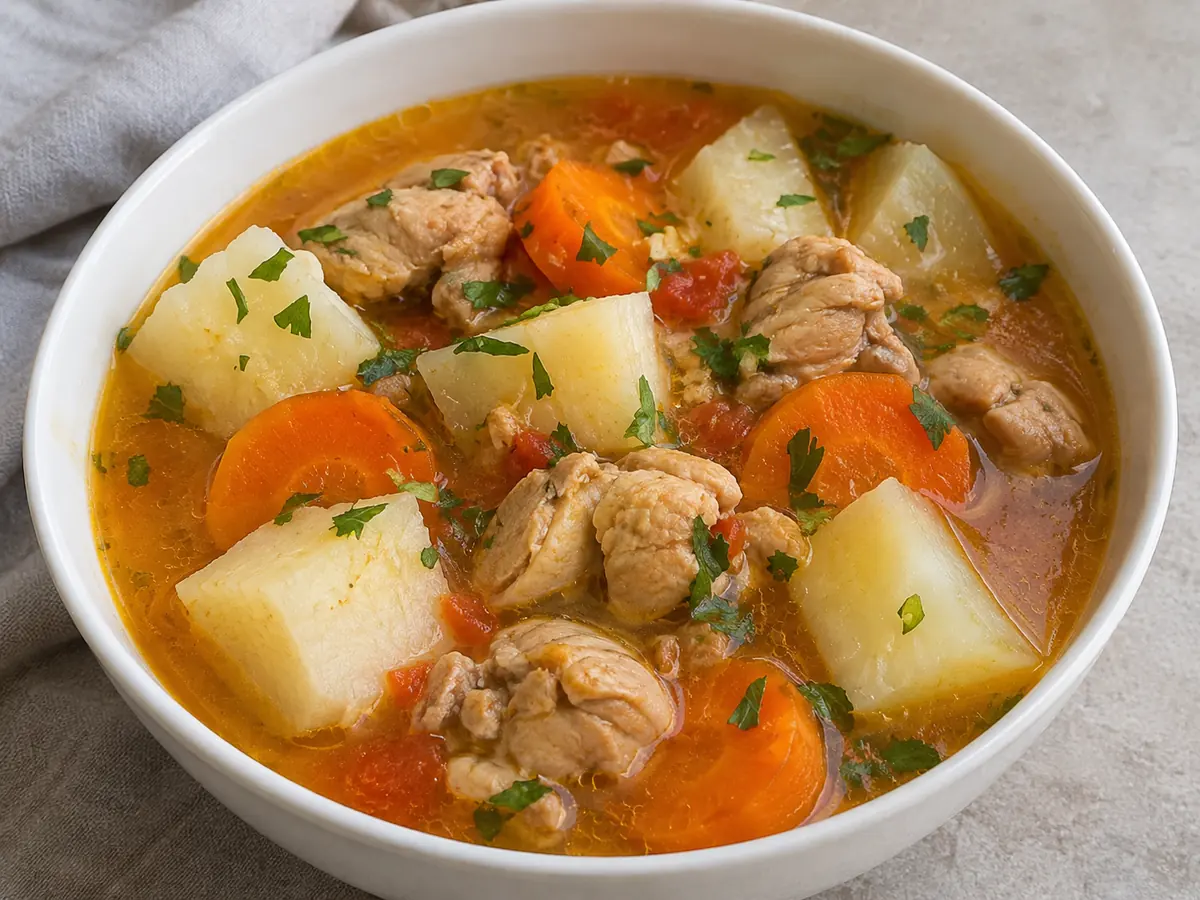
Prepare a yam soup with chicken and ginger, featuring a fragrant broth, tender pieces, and a liaison achieved without flour or cream.
Ingredients
- 600 g boneless chicken thighs
- 800 g peeled food-grade yam
- 250 g carrots
- 180 g onion
- 200 g tomatoes
- 20 g fresh ginger
- 10 g garlic
- 15 ml sunflower oil
- 1.4 liters potable water
- 15 ml lime juice
- 10 g parsley
- 3 g salt maximum
- 1 g pepper
Preparation
Chop the onion and garlic, grate the ginger, and dice the tomatoes. Heat the oil in the pot and sweat the onion for five to six minutes. Add the garlic and ginger, stir for one minute, then incorporate the tomatoes. Let it stew for five minutes, without aiming for a very thick reduction. Add a small spoonful of water if the bottom sticks: this mixture should flavor the broth, not form a browned base.
Add the chicken pieces and mix for three minutes to coat them with aromatics. Pour in the 1.4 liters of water, then bring to a simmer. Skim if necessary and add about half of the salt. Let it cook gently for fifteen minutes, with the lid ajar. Avoid a strong boil which greatly clouds the liquid and unnecessarily toughens the meat fibers. The chicken will continue to cook with the vegetables.
Incorporate the yam cubes and carrots. Bring back to a simmer, then continue for twenty to twenty-five minutes. Stir gently from time to time, passing the spatula near the bottom, without crushing all the pieces. Pierce several yam cubes with a blade: they should be tender to the center. Depending on the variety, a few extra minutes may be needed. If the liquid level becomes insufficient, add a little hot water.
Check that the chicken is completely cooked in its thickest pieces. Then take about a ladleful of yam, with very little broth, and mash it on a clean plate. Return this purée to the pot, mixing gently. Let it simmer for three to five minutes. This liaison should give a little body while keeping a fluid soup; do not turn half of the tuber into a purée without re-evaluating the consistency.
Add the pepper, then taste the broth and adjust the salt with the reserved amount. Turn off the heat and first pour in 10 ml of lime juice. Mix, taste, and add more if necessary. Wash and chop the parsley, then incorporate some of it off the heat. If the soup has thickened too much, thin it with a little hot water before definitively adjusting its seasoning.
Distribute the chicken, yam, and carrots into four deep plates, then add the broth. Sprinkle with the remaining parsley and serve immediately. A small cup of chili can be offered on the side for those who wish. Check the temperature of the portions before giving them to children, as the yam cubes can remain very hot in the center. The broth should surround the pieces, without covering them with too dense a mass.
Introduction
A nourishing soup with pieces
This yam soup with chicken and ginger maintains a visible broth around the pieces of tuber and poultry. A small part of the yam is mashed at the end of cooking to thicken the liquid without flour or cream. The result is eaten with a spoon and should not become a compact purée. Carrots provide another texture and a measured sweetness, while ginger flavors the whole without requiring a strong dose of chili.
The recipe is a contemporary creation for volume two. It uses yam in a way other than boiled, fried, or pounded, without attributing this combination to a specific regional tradition. The word “soup” describes the desired consistency and does not claim a local appellation. For four people, it can form the main dish of a simple meal. Yam already represents a significant portion of the starch; therefore, bread or rice are not automatic side dishes.
Cultural context
Contemporary creation based on products from the Ivorian repertoire. The proportions are not attributed to a regional tradition nor certified by the cited institutions.
Institutional References FAO INFOODS: https://www.fao.org/infoods/infoods/tables-and-databases/faoinfoods-databases/en/ — Food composition reference for subsequent nutritional calculation. No nutritional calculation of these recipes is claimed to have been performed. UNESCO: https://ich.unesco.org/fr/RL/les-savoir-faire-lies-a-la-fabrication-de-l-attieke-en-cote-d-ivoire-02086 — Context of the know-how for making attiéké, inscribed in 2024. Does not validate the combinations or proportions of the recipes. World Health Organization: https://www.who.int/teams/nutrition-and-food-safety/multisectoral-actions-in-food-systems/five-keys-to-safer-food-poster — General principles of cleanliness, food separation, cooking, and temperature control. The proposed storage durations remain cautious household advice.
Tips
Adjusting a soup that thickens while waiting Yam releases starch and can continue to thicken the liquid after the heat is turned off. A soup prepared in advance will therefore often be thicker when served. Keep hot water available to gently thin it. Add it in small quantities, mix, and taste again. Salt and ginger are perceived differently after dilution; a measured final correction is better than excessive seasoning at the beginning of cooking. If the yam falls apart very quickly, reduce mixing and omit the mashed ladle step: the broth may already have enough liaison. If it remains firm, extend cooking before mashing a few cubes. A purée obtained with a still-hard tuber would result in unpleasant small grains. The recipe requires observing and tasting the cooked elements, rather than applying the same durations to all varieties.
Preparing in advance and modifying the poultry The aromatic base can be made a few hours before the meal and kept in the refrigerator. Raw chicken remains separate until the start of its cooking. If you use bone-in pieces, increase the weight to obtain a comparable amount of flesh and adjust the cooking time. Bones also complicate serving with a spoon; carefully remove them before distributing portions if you wish to maintain the spirit of this soup. Leftover cooked chicken can be used in an adaptation, but it must be stored correctly and added late enough to reheat completely without crumbling. Do not automatically keep the same cooking time or the same volume of broth. Ginger can be reduced for a milder flavor, but lemon is always added after tasting. These adjustments must be clearly noted if you make this version a new published recipe.
Planning
Choose the tuber and prepare the cuts
The weight of yam is indicated after peeling and removing damaged parts. Buy a firm food-grade tuber, without wet areas or an abnormal smell. Peel on a stable board and use food-grade gloves if the raw flesh irritates your skin. Rinse with potable water, then cut into cubes of about three centimeters. The variety influences the cooking time and the amount of starch released into the broth; therefore, the final adjustment of the liquid is important.
Cut the carrots into thick slices and the chicken into pieces of four to five centimeters. Prepare the vegetables before the poultry, then use separate equipment or clean thoroughly between uses. Do not wash raw chicken, to avoid splashing onto kitchen surfaces. Keep the meat in the refrigerator until incorporated. A large, heavy-bottomed pot is useful for maintaining a steady simmer without the yam cubes sticking quickly.
Nutrition notes
Storage and nutritional benchmarks Quickly cool leftovers in small, shallow portions and store them in the refrigerator. When reheating, add a little water if necessary and heat until the center of the pieces. Avoid warming then cooling the entire pot multiple times. Chicken contributes to protein intake and yam mainly provides carbohydrates; carrots and tomato complete the vegetable portion. No calorie figures are invented without detailed calculation. Enjoy your meal! Serve this soup very hot, with pieces still distinct and a flexible broth.
Conclusion
Serve at the indicated texture and adapt the seasoning to the products used.
Enjoy your meal
Enjoy your meal!