Stewed eggplants with cowpeas and soumbala
Prepare stewed eggplants with cowpeas and soumbala, with separate cooking for the beans and a gradual dosage of the fermented condiment.
Ingredients
- 300 g dried cowpeas
- 700 g edible eggplants
- 350 g tomatoes
- 180 g onion
- 10 g garlic
- 10 g fresh ginger
- 8 g plain food-grade soumbala
- 25 ml sunflower oil
- 1.5 liters water for cowpeas plus 350 ml for the sauce
- 2 g salt maximum
- 1 g pepper
- 1 whole chili pepper (optional)
Preparation
Place the drained cowpeas in a saucepan with one and a half liters of fresh water. Bring to a boil, then simmer for forty to sixty minutes, or longer depending on the grains. Add hot water if the level becomes insufficient. Take several beans and crush them between a fork and a plate: they should be tender to the center, without any hard, floury parts. Drain, keeping a little cooking liquid available for the sauce.
Wash the eggplants and remove the stems. Cut them into cubes of about three centimeters. Large purple eggplants yield a mild flesh; small African eggplants may have a more pronounced bitterness. If you change varieties, taste and adjust the overall dish without expecting to obtain exactly the same result. Chop the onion and garlic, grate the ginger, and crush the tomatoes. Crumble the soumbala into a small bowl with two tablespoons of hot water.
Heat the oil in a Dutch oven. Sweat the onion for six minutes over medium heat, then add the garlic and ginger for one minute. Incorporate the tomatoes and reduce for eight to ten minutes. Stir to prevent the aromatics from sticking. The base should be smooth and well-cooked before adding the condiment, so that its flavor blends with an already established vegetable base rather than with still-raw tomatoes.
Add the eggplant cubes and about 350 ml of water, or a comparable amount of cowpea cooking liquid. First, incorporate half of the diluted soumbala, then the whole chili pepper if you are using it. Cover partially and simmer for twenty minutes. Stir gently halfway through cooking. The eggplants should begin to break down at the edges while still retaining some pieces. Check with the tip of a knife and extend cooking if their center remains firm.
Add the cooked cowpeas, pepper, and a small portion of the salt. Mix by lifting to avoid mashing all the beans. Simmer for ten minutes over low heat. Then taste a spoonful containing sauce, eggplant, and cowpeas. Gradually add the rest of the soumbala if its aroma seems insufficient; depending on the product, you may not need all eight grams planned. Adjust the salt only after this tasting.
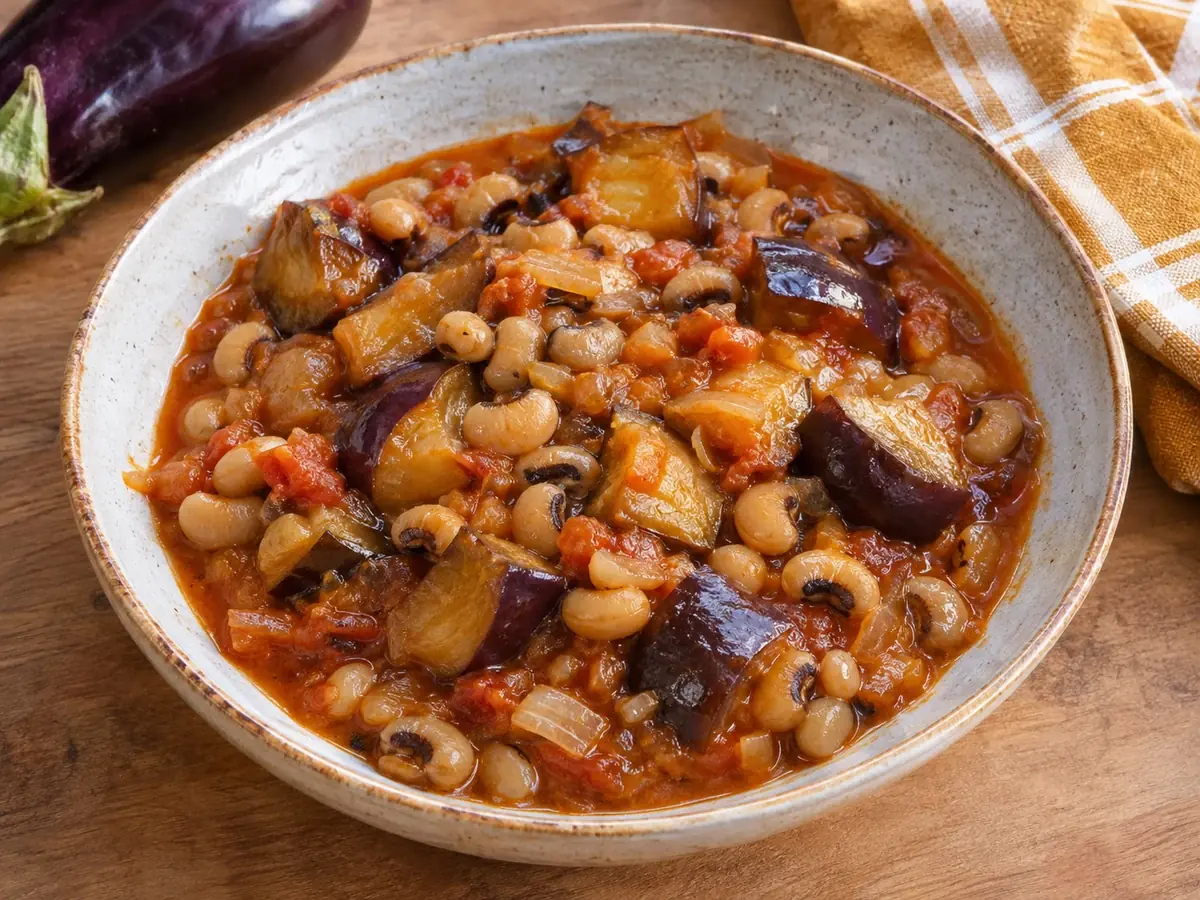
Remove the whole chili pepper before serving or clearly indicate its presence. If the sauce is too liquid, let it reduce for a few minutes uncovered. If it is too thick, add a little hot water and mix. Divide into four portions, with the beans and eggplant pieces visible. Serve the spicy condiment separately if you wish to allow for different intensities according to guests. The dish should remain tender, without being submerged in excess liquid.
Introduction
A stew where the condiment remains measured
Stewed eggplants with cowpeas and soumbala combine tender vegetables, whole beans, and a small amount of fermented condiment. Soumbala brings an aromatic depth that spreads throughout the sauce, without having to mask the taste of the eggplants. The dish is served with a short sauce, flexible enough to coat the grains but without a large volume of broth. It can be accompanied by a little rice or eaten alone in a deep plate depending on appetite.
The preparation is a contemporary creation within a repertoire of West African products. It does not claim the origin of a traditional sauce or belonging to a specific community in Côte d’Ivoire. Soumbala is named as a condiment, and not as proof of general authenticity. The proposed proportions are specific to this recipe; an institutional source on foods or legumes does not automatically certify the formulation of a particular recipe.
Cultural context
Contemporary creation based on products from the Ivorian repertoire. The proportions are not attributed to a regional tradition nor certified by the cited institutions.
Institutional References FAO INFOODS: https://www.fao.org/infoods/infoods/tables-and-databases/faoinfoods-databases/en/ — Food composition reference for subsequent nutritional calculation. No nutritional calculation for these recipes is claimed to have been performed. UNESCO: https://ich.unesco.org/fr/RL/les-savoir-faire-lies-a-la-fabrication-de-l-attieke-en-cote-d-ivoire-02086 — Context of the know-how related to the production of attiéké, inscribed in 2024. Does not validate the combinations or proportions of the recipes. World Health Organization: https://www.who.int/teams/nutrition-and-food-safety/multisectoral-actions-in-food-systems/five-keys-to-safer-food-poster — General principles of cleanliness, food separation, cooking, and temperature control. The proposed shelf lives remain cautious household advice.
Tips
Why add soumbala in two stages The potency of the condiment varies with its origin, preparation, and preservation. A fractional addition prevents a single measurement from making the sauce too strong for your table. The first half cooks with the eggplants and distributes itself in the liquid; the second is used to adjust after the beans are added, which dilute the aromatic perception. This adjustment is better than adding a large amount of oil or tomato afterwards to mitigate an excess that is difficult to control. Salt should also be evaluated at the end. Even when soumbala is sold as plain, practices and mixtures can vary; check the composition. An additional bouillon cube is not necessary for the method and can overpower the seasoning. The goal is to understand what the condiment yields in a simple sauce. A future adaptation can explore other additions, provided they are precisely noted in the ingredients.
Preserving eggplants without leaving them hard Eggplant cubes can absorb some of the oil before releasing their water and softening. It is not necessary to immediately add more oil. The simmering liquid and partial covering allow for gentle cooking to the core. A persistent spongy texture generally indicates that cooking should continue. Conversely, vigorous boiling and stirring quickly turn the sauce into a purée and break the beans. You can cook the cowpeas in advance, cool them quickly, then keep them in the refrigerator with a small amount of their liquid. The eggplant base can also be prepared separately. Combine and reheat the elements completely before the meal, adjusting the water if the mixture has thickened. This organization facilitates serving without altering the cooking logic. Do not use still-firm grains hoping they will finish cooking quickly in an already reduced sauce.
Planning
Prepare the beans and identify the soumbala
Sort the cowpea grains, rinse them, then soak them for about eight hours in the refrigerator in a generous volume of water. Soaking facilitates organization, but cooking time still depends on the age and variety of the grains. Then drain and discard the soaking water. Cowpeas must be cooked completely before joining a sauce containing tomatoes; you will better control their tenderness and that of the eggplants with two separate cooking processes.
Choose food-grade soumbala from a reliable supplier, with a clearly known composition. Some mixtures contain salt or other ingredients: their dosage does not automatically translate to a plain product. The fermented condiment has a distinct odor, but this alone does not allow judging the quality of a poorly preserved product. Follow its packaging instructions and discard any product showing abnormal moisture or mold.
Nutrition notes
Storage and nutritional benchmarks Quickly divide leftovers into small containers and store them in the refrigerator. The mixture also freezes, with eggplants becoming softer after thawing in the cold and complete reheating. Cowpeas provide vegetable proteins and carbohydrates; vegetables diversify the plate. Check the soumbala ingredients for allergies and potential mixtures. No nutritional figures are invented without calculation based on the actual formulation. Enjoy your meal! Serve with a simple side dish to keep the condiment's aroma perceptible.
Conclusion
Serve at the indicated texture and adapt the seasoning to the products used.
Enjoy your meal
Enjoy your meal!