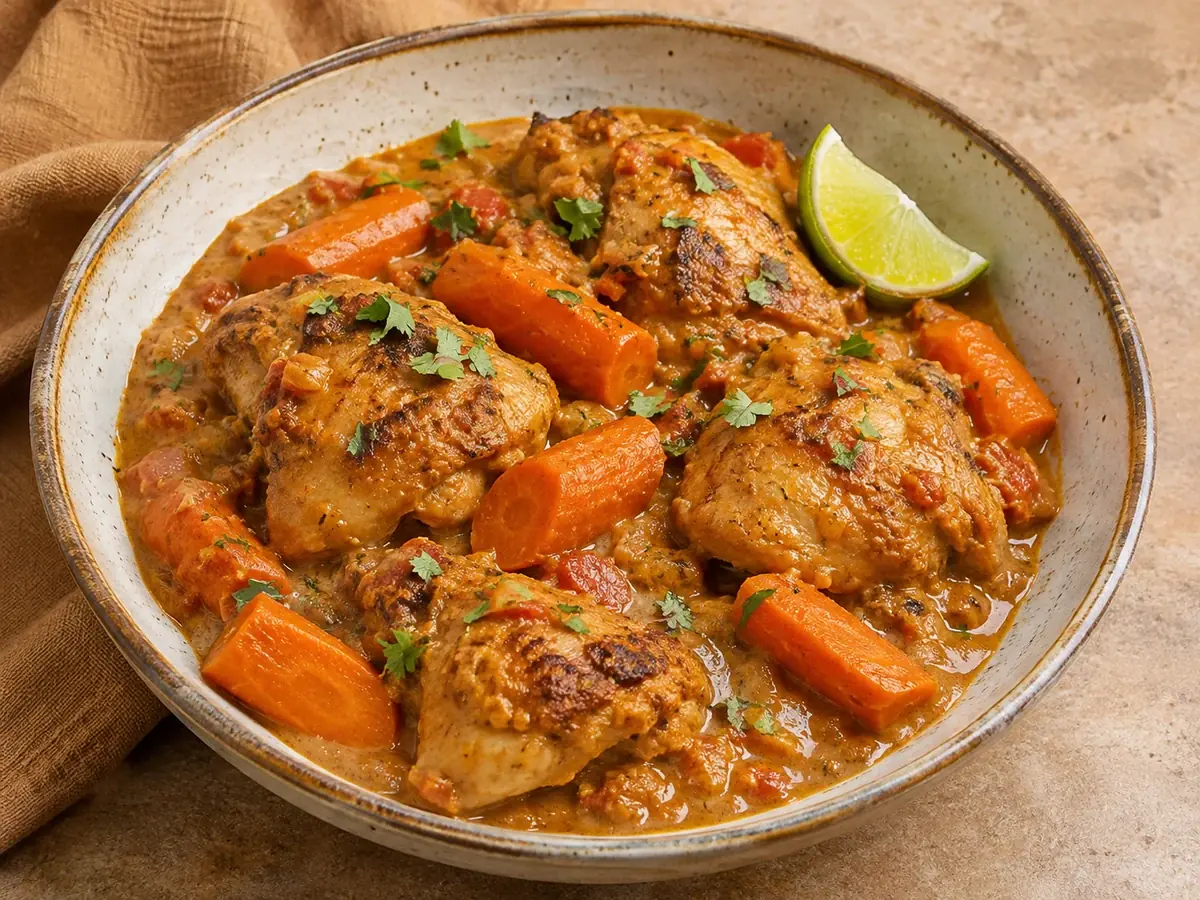
Chicken stew with carrots and lime peanut sauce
Prepare a chicken with carrots and lemony peanut sauce, with a short sauce and tips for diluting the peanut butter without it sticking.
Ingredients
- 800 g boneless chicken thighs
- 600 g carrots
- 100 g pure unsweetened peanut butter
- 250 g tomatoes
- 180 g onion
- 10 g garlic
- 15 g fresh ginger
- 15 ml sunflower oil
- 650 ml drinking water
- 25 ml lime juice
- 3 g salt maximum
- 1 g pepper
- 1 whole chili pepper (optional)
Preparation
Cut the chicken thighs into regular pieces. Heat the oil in the Dutch oven and brown the chicken in two batches if necessary, about three minutes per side. Set aside without trying to cook the meat completely at this stage. Sauté the chopped onion in the same pot for five minutes. Add the garlic and ginger, stir for one minute, then incorporate the crushed tomatoes and let reduce for eight minutes.
Return the chicken with the collected juices to the reserve container. Add the carrots and about 500 ml of water from the total quantity. Bring to a simmer, cover partially, and cook for twenty minutes over low heat. Add the whole chili pepper if you want to flavor the sauce without releasing many pieces. The liquid should allow for regular simmering, without excessively covering all the ingredients.
Meanwhile, place the peanut butter in a bowl. Gradually add the remaining 150 ml of water, mixing first with a small amount to form a smooth cream. Continue to thin until you get a pourable preparation without large lumps. This step prevents a mass of paste from settling at the bottom of the Dutch oven, where it might stick before dispersing. The water can be lukewarm to facilitate mixing.
Pour the diluted peanut butter into the Dutch oven, stirring gently between the chicken pieces. Add half of the salt and the pepper. Let simmer for fifteen to twenty minutes uncovered or partially covered, regularly scraping the bottom with a spatula. The sauce should lose its raw paste taste and become homogeneous. If it thickens too quickly, add a little hot water, in small quantities, without waiting for it to stick.
Check the doneness of the chicken in its thickest part: the meat should be fully cooked in the center. Also test the carrots, which should be tender while retaining their shape. Remove the whole chili pepper if you used it. Turn off the heat, pour in half of the lime juice, and mix. Taste a spoonful of sauce with a piece of carrot before adding the remaining lime and salt.
Let rest for five minutes off the heat, then gently stir the sauce. Divide the chicken and carrots into four plates, adding a measured amount of sauce. Serve the side dish separately or in a small portion alongside. Inform all guests about the peanuts before serving. Any leftover sauce can accompany another preparation, but it must be cooled and stored correctly, like the rest of the dish, rather than left in the lukewarm Dutch oven.
Introduction
A short sauce that keeps the carrots visible
This chicken with carrots and lemony peanut sauce offers a thick but flexible sauce, with carrot pieces that remain visible alongside the poultry. The peanut binds the juice without forming a compact layer, and the lime adds a lively note as a finish. The recipe does not seek to rename the peanut sauce from the first volume. It develops a particular combination, centered on the sweetness of the carrots, a moderate amount of paste, and a final adjustment of acidity.
This version is a contemporary creation of family cooking, without attribution to a specific regional tradition. It can be served with a separately chosen side dish, for example, plain rice or a small portion of boiled plantain. The weight of boneless chicken allows for easy portioning; a whole chicken with bones would require different quantities and an adapted cooking time. Keeping a well-defined cut makes the recipe more useful than a general indication of “chicken pieces.”
Cultural context
Contemporary creation based on products from the Ivorian repertoire. The proportions are not attributed to a regional tradition nor certified by the institutions cited.
Institutional References FAO INFOODS: https://www.fao.org/infoods/infoods/tables-and-databases/faoinfoods-databases/en/ — Food composition reference for subsequent nutritional calculation. No nutritional calculation of these recipes is claimed to have been performed. UNESCO: https://ich.unesco.org/fr/RL/les-savoir-faire-lies-a-la-fabrication-de-l-attieke-en-cote-d-ivoire-02086 — Context of the know-how for making attiéké, inscribed in 2024. Does not validate the combinations or proportions of the recipes. World Health Organization: https://www.who.int/teams/nutrition-and-food-safety/multisectoral-actions-in-food-systems/five-keys-to-safer-food-poster — General principles of cleanliness, food separation, cooking, and temperature control. The proposed shelf lives remain cautious household advice.
Tips
Preventing a sauce from sticking or separating Peanut paste increases the density of the liquid and makes the bottom more susceptible to heat. A gentle simmer and regular stirring with a spatula are more effective than a high flame intended to cook faster. If the bottom starts to stick, immediately lower the heat and transfer the healthy part to another container without scraping a burnt layer. A burnt taste diffused throughout the sauce will not disappear with more lemon or tomato. A small amount of oil may rise to the surface during cooking. Stir gently and assess the overall consistency: it is not necessary to add flour to force a perfect emulsion. A sauce that has become very oily can result from a particularly oily paste or excessive reduction. Add a little hot water and stir to restore a coating texture. Do not then significantly prolong the reduction, as you would return to the same problem.
Adjusting acidity and organizing your work Lime juice should be adjusted at the end of cooking to preserve its aroma and avoid an excessively acidic sauce. Tomatoes already provide a base acidity, and carrots modify the perception of sweetness. It is therefore preferable to keep some for the table. The juice does not replace any hygiene rules and does not allow storage at room temperature. Its role is gustatory; it should not be presented as a food safety treatment. You can prepare the vegetables and dilute the peanuts a few hours beforehand, then store them separately in the refrigerator. The sauce thickens as it rests: when reheating, add water gradually and check the temperature in the center of the chicken pieces. For six people, increase the quantities proportionally but especially use a sufficiently large container. Cooking time depends on the size of the meat, not directly on the number of portions.
Planning
Choose a suitable peanut butter
Use a peanut butter made only from peanuts, with no added sugar and preferably no salt. Some spreads intended for toast contain other ingredients that change the consistency and seasoning. Stir the jar before taking out the 100 grams if the oil has separated on the surface. Natural separation is not, in itself, a defect; however, a rancid smell or a damp, moldy product should lead to discarding it.
Choose firm carrots and cut them into slanted pieces about two centimeters thick. Slices that are too thin would fall apart before the chicken is ready. Also prepare the onion, garlic, ginger, and tomatoes before handling the poultry. Do not wash raw chicken; pat it dry if necessary and use separate equipment to limit cross-contamination. A Dutch oven or a deep, heavy-bottomed sauté pan is better than a small, narrow saucepan.
Nutrition notes
Storage and nutritional benchmarks Quickly cool remaining portions in shallow containers and store them in the refrigerator. Reheat only the necessary quantities until they are hot throughout. Peanuts are a major allergen and cannot simply be removed from an allergic person's plate: they are dispersed throughout the sauce. Poultry provides protein, while peanut butter and oil contribute to fats. No precise figures are announced without calculation. Enjoy your meal!
Conclusion
Serve at the indicated texture and adjust seasoning to the products used.
Enjoy your meal
Enjoy your meal!