Small Corn and Coconut Milk Flans with Mango
Make small corn and coconut milk flans with mango: gentle cooking, soft texture, and tips to avoid a grainy cream.
Ingredients
- 60 g cornstarch
- 400 ml unsweetened coconut milk
- 300 ml drinking water
- 45 g sugar
- 1 ripe mango yielding about 300 g of flesh
- 15 ml lime juice
- 1 g ground vanilla or half a vanilla bean
- 1 small pinch of salt less than 0.5 g
- 10 g optional grated coconut
Preparation
Take 150 ml from the 300 ml of water and pour it into a bowl. Add the cornstarch and whisk until no dry lumps remain. The suspension should be fluid and uniform. Prepare it just before cooking, or stir it again before pouring: starch naturally settles to the bottom when left to sit. Do not dilute it in hot liquid, which would immediately form difficult-to-disperse lumps.
Pour the coconut milk and the remaining 150 ml of water into the saucepan. Add the sugar, vanilla, and the very small pinch of salt. If using half a vanilla bean, split it, scrape out the seeds, and put both seeds and pod into the liquid. Heat gently, stirring until the sugar is dissolved and the mixture is very hot. Avoid a strong boil before adding the starch.
Remove the vanilla bean, if you used one. Stir the diluted starch one last time, then pour it in a thin stream into the hot coconut milk while whisking. Continue to heat over medium-low heat. The cream thickens gradually then more distinctly; scrape the bottom and sides to prevent a stuck layer. As soon as small bubbles appear, continue for about two minutes at a low boil, stirring constantly.
Turn off the heat when the cream is smooth and thick yet still pourable. Immediately divide it among the six ramekins, without waiting for it to set in the saucepan. Gently tap each ramekin very softly on a cloth placed on the work surface to release large air bubbles. Let the strongest heat dissipate briefly, then quickly place the portions in the refrigerator, without leaving them at room temperature for several hours.
Chill for at least two hours, until the creams are set and cold in the center. During this time or just before serving, wash and peel the mango and cut its flesh into small cubes. First add 10 ml of lime juice, mix and taste before using the rest. The lemon should highlight the fruit, not make it disappear. Store this garnish in the refrigerator in a separate container if it needs to wait.
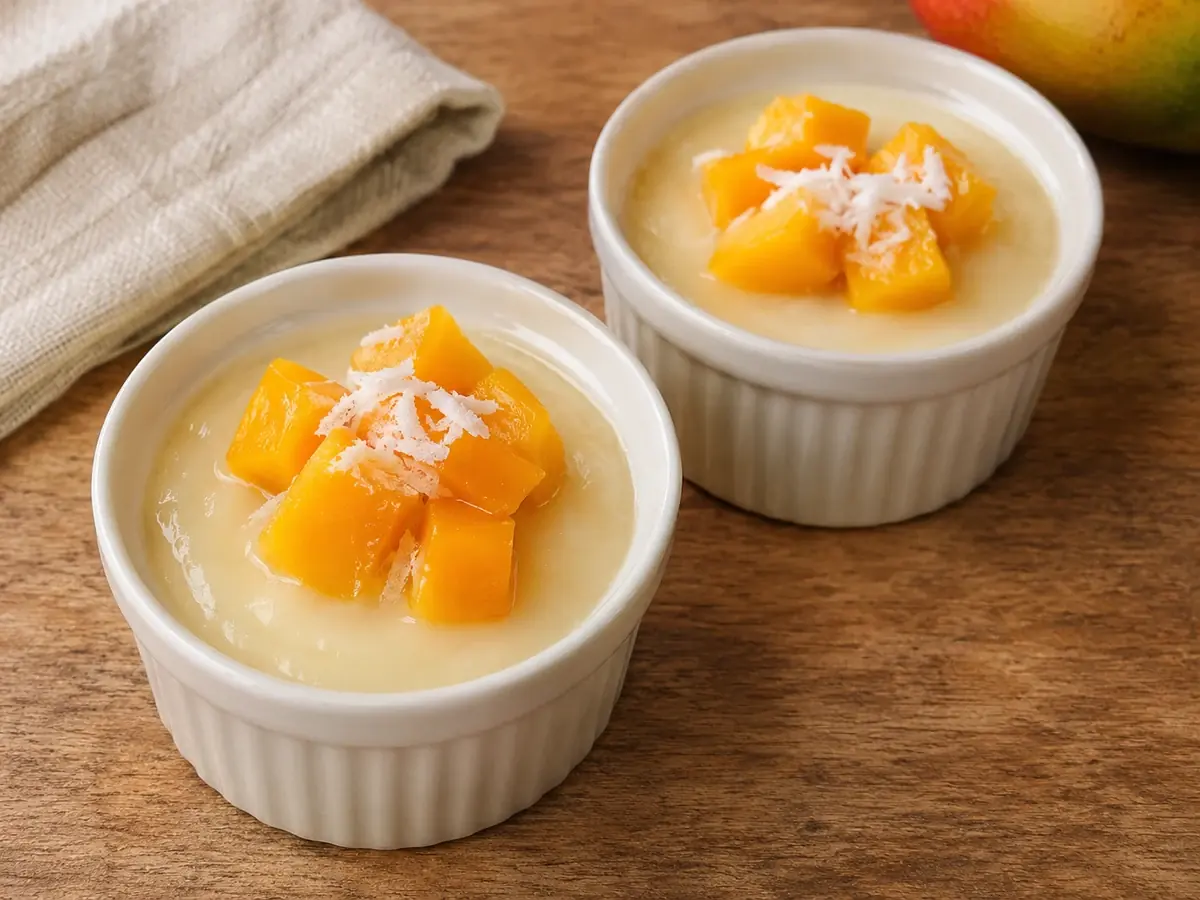
Distribute the mango cubes over the cold flans at the last moment. Optionally add a little grated coconut for texture, being light on the quantity. Serve the ramekins as they are: the formulation is not designed to guarantee a clean unmolding. If you want unmolded desserts, you will need to develop another starch proportion and test it, rather than turning out these creams at the risk of them collapsing.
Introduction
A fresh dessert with a soft texture
These small corn and coconut milk flans with mango are thickened in a saucepan, then cooled in ramekins. The word “flan” here describes a starch-set cream, without eggs, eaten with a spoon. The desired texture is smooth and supple, firm enough to hold mango cubes but without rubbery firmness. The fruit is added at serving time to preserve its fresh flavor and prevent it from releasing water into the cream during resting.
The preparation is a contemporary creation for volume two, with no claim to ancient Ivorian tradition. Corn, coconut, and mango offer a culinary canvas suitable for a family dessert, but their precise combination here is an editorial formulation. This distinction avoids transforming a dessert idea into an undocumented cultural affirmation. The starch used must be clearly identified: a whole corn flour will not give the same fineness or setting.
Cultural context
Contemporary creation based on products from the Ivorian repertoire. The proportions are not attributed to a regional tradition nor certified by the cited institutions.
Institutional References FAO INFOODS: https://www.fao.org/infoods/infoods/tables-and-databases/faoinfoods-databases/en/ — Food composition reference for subsequent nutritional calculation. No nutritional calculation of these recipes is claimed to have been performed. UNESCO: https://ich.unesco.org/fr/RL/les-savoir-faire-lies-a-la-fabrication-de-l-attieke-en-cote-d-ivoire-02086 — Context of attiéké manufacturing know-how, inscribed in 2024. Does not validate the combinations or proportions of the recipes. World Health Organization: https://www.who.int/teams/nutrition-and-food-safety/multisectoral-actions-in-food-systems/five-keys-to-safer-food-poster — General principles of cleanliness, food separation, cooking, and temperature control. The proposed shelf lives remain cautious domestic advice.
Tips
Correcting texture problems A grainy cream often results from poor starch dispersion or pouring too quickly without mixing. If small lumps appear before the cream is completely set, whisk vigorously and, if necessary, pass it through a fine sieve. Do not try to mask them with more grated coconut. A smooth texture primarily depends on the cold preparation of the suspension and regular mixing during heating. A cream that is too liquid may have been undercooked after initial thickening. A low boil must be reached and continued briefly, while respecting the indications for the starch used. Very prolonged cooking over high heat does not necessarily improve setting and can cause the bottom to stick. If the cream seems too firm once cooled, keep the initial measurement in your notes and slightly reduce the starch in the next attempt, without modifying several ingredients at once.
Adjusting sugar and choosing fruit 45 grams of sugar corresponds to six small desserts. Sweet perception also depends on the mango and coconut milk. A very ripe mango gives a sweeter impression; an acidic fruit sometimes calls for less lemon rather than more sugar. Taste the fruit before seasoning the garnish. Sugar is not used to correct fruit that is starting to ferment or whose preservation is doubtful: always choose healthy raw material. Pineapple can replace mango in an announced adaptation, provided it is finely cut and its juice is controlled. Ripe papaya gives a softer garnish, which sometimes requires a little more lemon. Do not mix a large volume of fruit juice with the hot cream: acidity and the addition of liquid would change the formulation. This recipe intentionally keeps the cream and fruit separate until serving to preserve a reproducible texture.
Planning
Choose coconut milk and prepare equipment
Use unsweetened coconut milk and homogenize it before measuring, as its fat can separate in the can. A very diluted plant-based drink does not directly correspond to the product indicated and would result in a less creamy dessert. Mixing with water reduces richness while retaining flavor. If you change brands, the texture may vary; note the result before adjusting the amount of starch in a future preparation.
Prepare six small ramekins of about 120 to 150 ml and a thick-bottomed saucepan. A whisk helps disperse the starch, then a flexible spatula helps scrape the corners during cooking. Measure all ingredients before heating: a starch-based cream can thicken quickly and requires continuous attention. Choose a ripe but still firm enough mango to form cubes, with a clear fragrance and no fermented or heavily damaged areas.
Nutrition notes
Storage and nutritional information Keep the ramekins in the refrigerator, covered after cooling, and preferably consume them within two days. Mango cubes are ideally prepared as close to serving time as possible and kept cold while waiting. The recipe contains carbohydrates provided notably by starch, sugar, and fruit, as well as fats from coconut milk. It does not automatically become light because it is egg-free. Check for any traces on packaged products. Bon appétit! Serve in small, very fresh portions, with a generous mango garnish and little juice at the bottom.
Conclusion
Serve with the indicated texture and adapt the seasoning to the products used.
Enjoy your meal
Bon appétit!