Sweet potato leaf and sesame rice
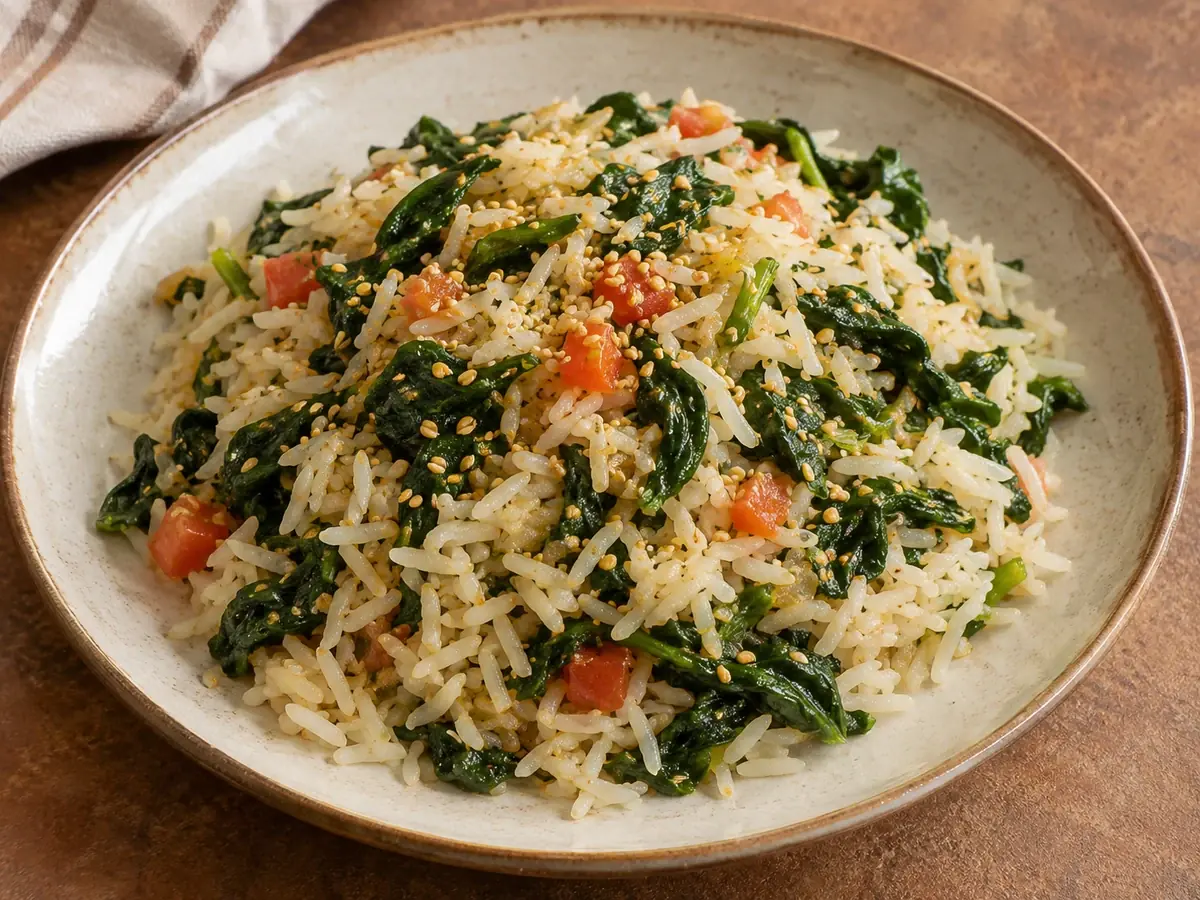
Prepare a sweet potato leaf and sesame rice, with careful washing of the leaves, separate cooking, and grains that remain detached.
Ingredients
- 300 g long-grain rice
- 400 g identified young edible sweet potato leaves
- 180 g onion
- 250 g tomatoes
- 10 g garlic
- 10 g fresh ginger
- 30 g sesame seeds
- 25 ml sunflower oil
- 600 ml water for rice, to be adjusted according to package
- 100 ml water for vegetables
- 15 ml lime juice
- 3 g salt maximum
- 1 g pepper
Preparation
Rinse the rice with potable water until the water is less cloudy, then drain it. Place it in the pot with 600 ml of water, or the volume recommended by its manufacturer, and about one gram of salt. Bring to a simmer, cover, and reduce heat. Cook for twelve to eighteen minutes depending on the variety, without constant stirring or frequent lid lifting. The grains should have absorbed the water and no longer have a hard core.
Turn off the heat and let the rice rest for ten minutes, covered. Meanwhile, heat a small dry pan and add the sesame. Toast it for two to three minutes over medium heat, stirring constantly. As soon as its aroma develops and a few seeds color, pour it onto a cold plate. It would continue to brown in the hot pan and could become bitter if left there.
Chop the onion, garlic, and ginger. Dice the tomatoes finely and cut the drained leaves into fairly wide strips. Heat the oil in the sauté pan. Sweat the onion for five to six minutes, then add the garlic and ginger for one minute. Incorporate the tomatoes and let them stew for eight to ten minutes, until their juice reduces and the pieces begin to break down under the spatula.
Add the leaves in several batches, allowing them to reduce in volume between each addition. Pour in the 100 ml of water, cover, and cook gently for ten to fifteen minutes, or longer if their texture requires it. Stir halfway through cooking. The leaves should be fully cooked and tender, without fibrous stems. Then uncover and evaporate any excess liquid. The bottom should remain moist, but no significant puddle should appear when you tilt the sauté pan.
Fluff the rested rice with a fork. Gradually incorporate it into the leaves, lifting with a large spatula, over very low heat. Do not crush the mixture against the bottom. Add half of the toasted sesame, pepper, and about 10 ml of lime juice. Taste a full spoonful, then adjust the salt and acidity with the reserved quantities. The sesame should remain distributed in the dish, without forming a paste.
Heat for another two to three minutes if necessary, just to homogenize the temperature. Divide into four bowls or deep plates and sprinkle the remaining sesame at the last moment. Serve immediately, either alone as a vegetable plate or with an accompaniment chosen according to the menu. If you add fish or an egg, present it separately and adapt the corresponding recipe card: the ingredients, allergens, and storage conditions of the meal will then be different.
Introduction
Rice mixed with well-prepared leaves
This sweet potato leaf and sesame rice is prepared in two parts: the rice cooked by absorption, while the leaves are softened in an onion and tomato base. The two are only combined at the end. This way, the grains keep their shape and the leaves are distributed without forming large clumps. A small amount of toasted sesame provides a punctual texture and a fragrance that complements the ginger, without overpowering the vegetal taste.
This is a contemporary creation. It differs from rice served with a separate leaf sauce by its assembly and by the clearly defined use of sweet potato leaves. No ancient origin or community attribution is claimed for this formulation. The name of the leaf remains essential: one should not use a plant simply because it resembles the product described. Buy identified edible leaves from a supplier who knows their culinary use.
Cultural context
Contemporary creation based on products from the Ivorian repertoire. The proportions are not attributed to a regional tradition nor certified by the cited institutions.
Institutional references FAO INFOODS: https://www.fao.org/infoods/infoods/tables-and-databases/faoinfoods-databases/en/ — Food composition reference for subsequent nutritional calculation. No nutritional calculation of these recipes is claimed to have been performed. UNESCO: https://ich.unesco.org/fr/RL/les-savoir-faire-lies-a-la-fabrication-de-l-attieke-en-cote-d-ivoire-02086 — Context of attiéké manufacturing know-how, inscribed in 2024. Does not validate the assemblies or proportions of the recipes. World Health Organization: https://www.who.int/teams/nutrition-and-food-safety/multisectoral-actions-in-food-systems/five-keys-to-safer-food-poster — General principles of cleanliness, food separation, cooking, and temperature control. The proposed shelf lives remain cautious domestic advice.
Tips
Achieving detached grains The resting of the rice after cooking is as useful as the cooking itself. It allows moisture to distribute and facilitates fluffing. Rice that is still very wet should not be immediately transferred to the leaves. First, check if its water can finish absorbing for a few minutes covered, then let it rest. Vigorous mixing with a spoon breaks the grains and releases starch; a wide spatula used for lifting better preserves their shape. If you use already cooked rice, it must have been cooled quickly and stored in the refrigerator, without a long wait on the countertop. Reheat it completely in contact with the vegetables, with a very small amount of water if needed. Do not consider day-old rice safe simply because it will be pan-fried. Control of storage before reheating remains crucial; smells and appearance are not sufficient to judge all risks.
Firmer leaves and substitutions Older leaves may remain fibrous despite prolonged cooking. It is better to sort them strictly before starting rather than trying to soften them in already prepared rice. Separate pre-cooking allows you to observe their texture if you are new to the product, but does not replace its correct food identification. In any case, do not serve the leaves raw in this recipe: the method describes their cooking before assembly with the rice. Plain frozen spinach can be used in an adapted version: thaw it according to package directions and remove excess water before incorporating. Sesame can be omitted in case of allergy, but the name of the dish must then be modified. A substitution with chopped pumpkin seeds would give a different flavor and texture. Keep quantities modest to preserve the place of the leaves and avoid an overly dominant seed garnish.
Planning
Sort the leaves and adjust the rice
Choose young, fresh leaves without signs of mold. Remove thick stems and damaged parts, then weigh 400 grams of usable leaves. Rinse in several changes of potable water if necessary to remove soil, then drain. Do not substitute these leaves with cassava or taro leaves using the same method. If you cannot find the product correctly identified, spinach is a simpler adaptation, to be announced in the title of your version.
The 600 ml water volume is suitable for many long-grain rices, but package instructions take precedence: some varieties absorb less, others more. Use a pot with a tight-fitting lid and a sauté pan wide enough for the leaves. The goal is to obtain cooked rice and low-water vegetables before mixing them. If both elements are wet, the mixture becomes pasty, even when each cooking time seems to have been respected.
Nutrition notes
Storage and nutritional benchmarks Quickly divide leftovers into shallow portions and place them in the refrigerator. Reheat only what will be eaten and avoid keeping a large lukewarm dish for several hours. Rice provides the main carbohydrates, leaves contribute to vegetable diversity, and sesame adds fats, among other things. No nutritional figures are attributed to the recipe without detailed calculation. Clearly indicate sesame as an allergen. Enjoy your meal! Serve the dish with a few seeds added at the last second to preserve their toasted aroma.
Conclusion
Serve at the indicated texture and adapt the seasoning to the products used.
Enjoy your meal
Enjoy your meal!