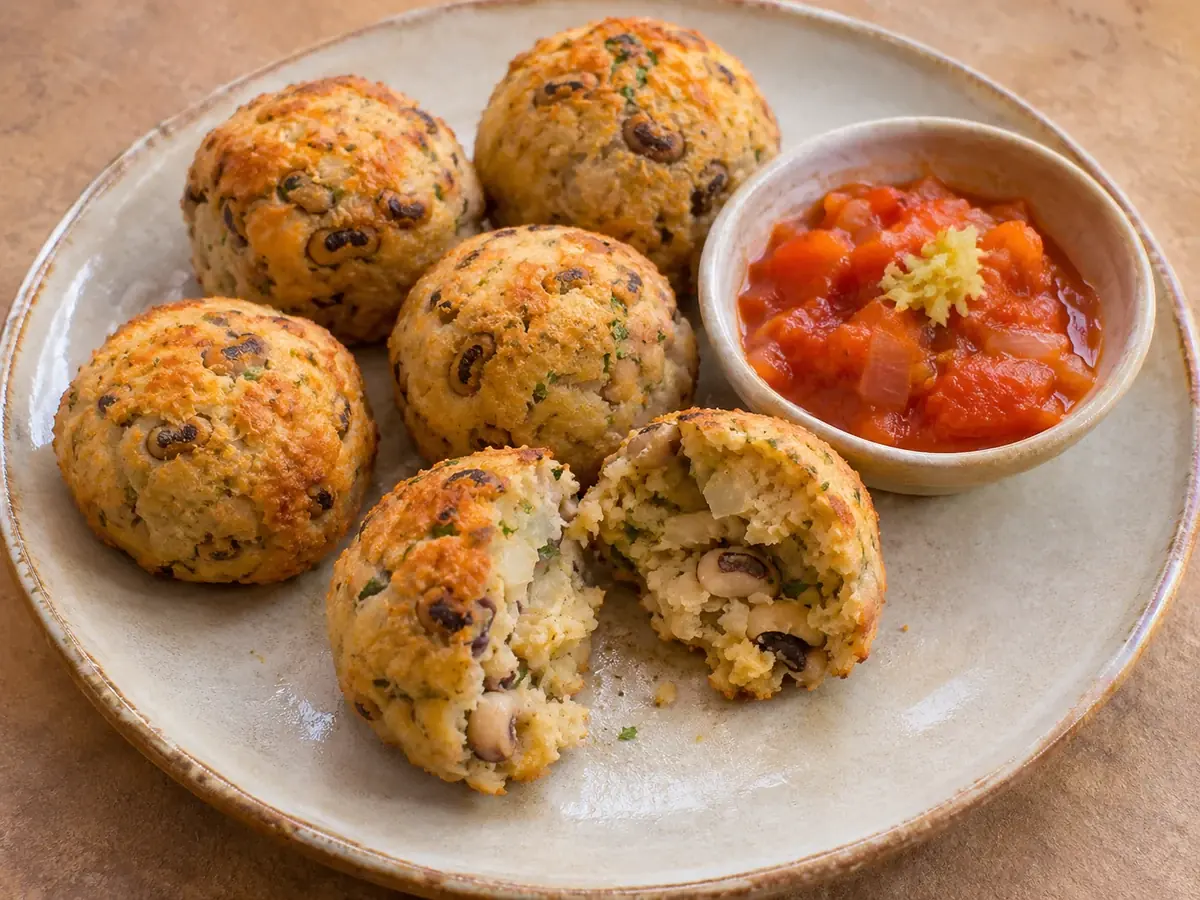
Baked black-eyed pea dumplings with ginger tomato sauce
Make baked black-eyed pea dumplings, accompanied by a ginger tomato sauce, with guidelines for a dough that holds together without being dry.
Ingredients
- 600 g cooked and drained black-eyed peas
- 60 g fine corn flour
- 120 g onion for the dumplings
- 100 g onion for the sauce
- 15 g parsley
- 10 g garlic
- 20 g fresh ginger
- 500 g tomatoes
- 30 ml sunflower oil
- 150 ml drinking water for the sauce
- 15 ml lime juice
- 3 g salt maximum
- 1 g pepper
Preparation
Preheat the oven to 200 °C (static heat). Finely chop the 120 g of onion for the dumplings. Sauté them in 5 ml of oil for five to six minutes, then let them cool. This pre-cooking softens the onion and prevents crunchy pieces in the center. Wash and chop the parsley. Grate the ginger, then set aside about one-third for the dumplings and the remaining two-thirds for the sauce.
Mash the black-eyed peas with a potato masher or fork in a mixing bowl. Keep a few small fragments of grains for texture, but remove large whole beans that hinder shaping. Add the cooled onion, parsley, reserved ginger, half of the pepper, and about one gram of salt. Incorporate 50 g of corn flour and mix with a spatula, without kneading for a long time like bread dough.
Let rest for ten to fifteen minutes. Then take a spoonful of dough and press it in your palm: it should form a ball that holds its shape without collapsing. If it remains very sticky and soft, add the remaining 10 g of flour, then wait another five minutes. If it crumbles, add a spoonful of drinking water and mix. Adjust in small quantities to avoid exceeding the correct texture.
Shape about sixteen regular-sized dumplings, or four per person. Lightly oil your hands if necessary and place them on a baking sheet covered with parchment paper. Brush their surface with 10 ml of oil, rolling them gently if that is more practical. Bake for twenty-five to thirty minutes. Carefully turn them halfway through cooking. The surface should be firm and golden, and the inside hot, without becoming dry or crumbly.
Meanwhile, thinly slice the 100 g of onion for the sauce. Sauté them in the remaining 15 ml of oil for five minutes. Add the chopped garlic and reserved ginger, then the crushed tomatoes. Cook for ten minutes before pouring in the 150 ml of water. Simmer uncovered for another ten to fifteen minutes, until a coating sauce is obtained. Add the rest of the pepper and salt gradually to taste.
Finish the sauce with the lime juice, starting with half. Taste, then adjust. Remove the dumplings and let them rest for three minutes to firm up. Place a little sauce on each plate, then place the dumplings on top or next to it, just before serving. Do not let them wait long in the sauce: they would absorb the liquid and lose some of their firmness.
Introduction
Dumplings made from cooked beans
Baked black-eyed pea dumplings are prepared with already cooked beans, mashed and then bound with a measured amount of corn flour. They differ from akara, whose traditional method generally relies on a bean paste worked differently and deep-frying. Here, the surface firms up in the oven while the center remains tender. The ginger tomato sauce is served on the side to preserve this contrast when eating.
The recipe is a contemporary creation, designed as a bean dish to share. It does not claim a precise local origin or a new traditional name. Its practical interest is to transform cooked black-eyed peas into an easy-to-portion preparation, without trying to imitate meat. The dumplings can be offered with vegetables and a small portion of a side dish depending on the menu, but they are already more substantial than a simple condiment.
Cultural context
Contemporary creation based on products from the Ivorian repertoire. The proportions are not attributed to a regional tradition nor certified by the cited institutions.
Institutional references FAO INFOODS: https://www.fao.org/infoods/infoods/tables-and-databases/faoinfoods-databases/en/ — Food composition reference for subsequent nutritional calculation. No nutritional calculation of these recipes is claimed to have been performed. UNESCO: https://ich.unesco.org/fr/RL/les-savoir-faire-lies-a-la-fabrication-de-l-attieke-en-cote-d-ivoire-02086 — Context of the know-how related to the production of attiéké, inscribed in 2024. Does not validate the combinations or proportions of the recipes. World Health Organization: https://www.who.int/teams/nutrition-and-food-safety/multisectoral-actions-in-food-systems/five-keys-to-safer-food-poster — General principles of cleanliness, food separation, cooking, and temperature control. The proposed shelf lives remain cautious household advice.
Tips
Diagnosing a crumbling dough A dumpling that cracks as soon as it is rolled often lacks binding or contains too many large fragments. Mash the dough a little more finely and add very little water, then wait before trying again. A dough that sticks strongly to the fingers, on the other hand, may be too wet. Do not correct it with a large handful of flour poured all at once: the beans must remain the main ingredient, with a soft center after cooking. A lightly browned surface does not necessarily mean the dumplings are raw: the beans are already cooked to begin with. The cooking time primarily allows the flour to cook and the structure to stabilize. Prolonging cooking for a very long time to achieve a brown color results in a dry interior. If your oven browns lightly, slightly increase the temperature during the last few minutes while monitoring, or accept a lighter shade with a pleasant texture.
Sauces and advance preparation The sauce can be prepared the day before, cooled quickly, and then kept in the refrigerator. Reheat it in a saucepan before serving, adding a little water if it has thickened. The dumplings can be shaped a few hours in advance and kept cold on a covered baking sheet. Then bake them without a long wait at room temperature. Cold dough may require a few extra minutes of cooking; especially check the center and the firmness of the surface. For an appetizer service, form smaller pieces and reduce the cooking time, monitoring them from fifteen minutes. The number of portions then changes: do not keep the indication of four dumplings per person if their size is halved. Present the sauce in a separate bowl and provide small spoons or appropriate picks. This presentation does not transform the recipe into food that can remain all evening without temperature control.
Planning
Control moisture before shaping
600 grams refers to the weight of cooked and well-drained beans. If you are starting with dry black-eyed peas, plan for a separate cooking until each grain crushes easily; yield varies with the beans and their hydration. Then spread the cooked grains for a few minutes in a colander or on a clean plate to allow excess steam to escape. A dough that is too wet requires more flour and ultimately results in heavy dumplings.
Corn flour should be fine, not a coarse semolina intended for long cooking. Its role is to retain some moisture and help the dough firm up. Resting before shaping allows it time to act. Chop the onion very finely so that large pieces do not create cracks in the dumplings. You will need a baking sheet, a potato masher, and a sauté pan to prepare the sauce in parallel.
Nutrition notes
Storage and nutritional guidelines Refrigerate leftovers quickly in a shallow container. Reheat the dumplings in the oven to firm up their surface and the sauce separately, avoiding repeated cooling and reheating cycles. Black-eyed peas contribute vegetable proteins and carbohydrates to the preparation; the flour mainly completes its structure. Check for any traces on packaged flour and adapt ingredients to known allergies. No numerical caloric estimate is presented without calculation. Enjoy your meal! A crisp salad or roasted vegetables pair well with these tender dumplings.
Conclusion
Serve at the indicated texture and adjust seasoning to the products used.
Enjoy your meal
Enjoy your meal!