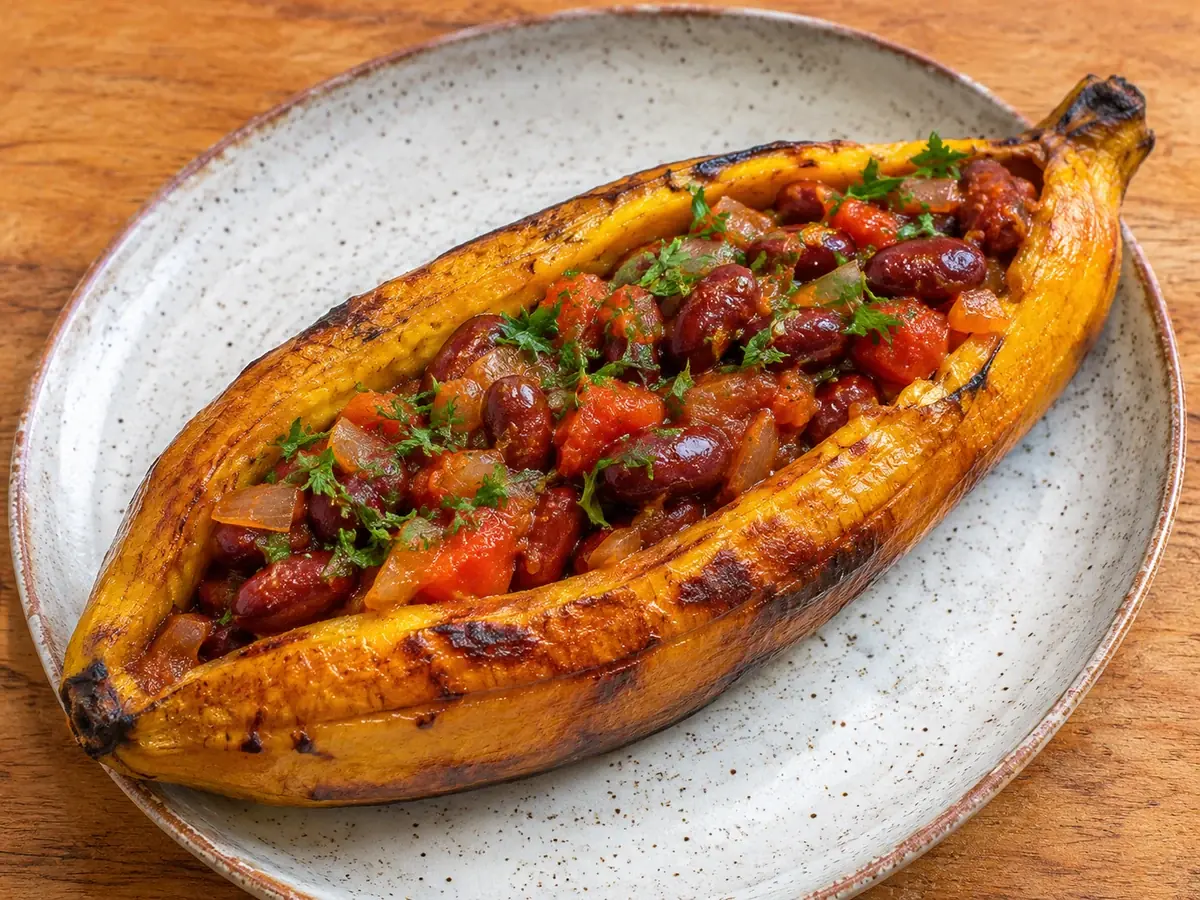
Stuffed plantains with red beans and tomato
Prepare stuffed plantains with red beans and tomato, baked in the oven, with tips for choosing the right ripeness of the bananas.
Ingredients
- 4 large yellow plantains with a few black spots
- 500 g canned cooked and drained red beans
- 350 g tomatoes
- 150 g onion
- 10 g garlic
- 10 g fresh ginger
- 25 ml sunflower oil
- 15 ml lime juice
- 100 ml drinking water
- 2 g salt maximum
- 1 g pepper
- 10 g parsley
- 1 small chili (optional)
Preparation
Preheat the oven to 200 °C (static heat). Wash and dry the plantains before peeling them. Score the skin lengthwise with a small knife, avoiding deep cuts into the flesh, then remove it. Brush the plantains with 10 ml of oil from the total amount. Place them in a dish or on a baking sheet lined with parchment paper, leaving space between them.
Bake the plantains for 25 to 35 minutes, depending on their diameter and ripeness. Gently turn them over after fifteen minutes. They are ready for stuffing when the flesh softens and a knife can be inserted without significant resistance, but the plantains still hold their shape. A slight browning is sufficient. If the surface browns before the center is tender, loosely cover with parchment paper and continue baking at a moderate temperature.
Meanwhile, chop the onion, garlic, and ginger. Dice the tomatoes into small pieces. Heat the remaining 15 ml of oil in a sauté pan and sweat the onion for six minutes. Add the garlic and ginger, stir for one minute, then incorporate the tomatoes. Cook for about ten minutes over medium heat, until their juice begins to thicken and the onion is very tender.
Add the cooked beans and 100 ml of water. Mix gently, then let simmer uncovered for ten minutes. Mash two spoonfuls of beans against the side of the sauté pan to give body to the stuffing. Season lightly with salt and pepper. The filling should be spoonable without being as runny as soup. If it is still liquid, continue for a few more minutes; if it sticks, add only a small spoonful of water.
Remove the plantains and let them rest for two minutes. Incise each plantain lengthwise without cutting through its base or ends. Gently spread the edges with two spoons to form a pocket. Distribute the hot stuffing among the four plantains, reserving a little filling for serving if necessary. Do not force the opening: an overstuffed plantain can split and lose stability during transfer.
Return to the oven for five to eight minutes to equalize temperatures. Remove the dish, add the lime juice and chopped parsley over the stuffing. Serve one plantain per person with the remaining beans and, if desired, a separately prepared raw vegetable salad. Offer chili at the table. Use a large spatula to move the plantains: the hot flesh becomes more fragile, especially when the plantains were very ripe.
Introduction
A whole plantain becomes the dish
These stuffed plantains with red beans and tomato are served sliced lengthwise, with a thick filling placed in the center. The fruit remains firm enough to be lifted with a spatula, while its flesh becomes tender and slightly sweet. The stuffing provides whole beans and a well-reduced tomato sauce. This presentation differs from alloco and turnovers: it preserves the shape of the plantain and requires neither frying nor dough preparation.
This is a contemporary creation inspired by familiar products from Côte d'Ivoire's kitchens, and not a traditional dish with an attested origin. The culinary interest lies in the balance between the sweetness of the ripe plantain, the acidity of the tomato, and the consistency of the beans. The filling remains intentionally simple so that these three elements are recognizable. Chili is optional and can be offered separately, especially when the dish is shared with family.
Cultural context
Contemporary creation based on products from the Ivorian repertoire. The proportions are not attributed to a regional tradition nor certified by the institutions cited.
Institutional references FAO INFOODS: https://www.fao.org/infoods/infoods/tables-and-databases/faoinfoods-databases/en/ — Food composition reference for subsequent nutritional calculation. No nutritional calculation of these recipes is claimed to have been performed. UNESCO: https://ich.unesco.org/fr/RL/les-savoir-faire-lies-a-la-fabrication-de-l-attieke-en-cote-d-ivoire-02086 — Context of attiéké manufacturing know-how, inscribed in 2024. Does not validate recipe combinations or proportions. World Health Organization: https://www.who.int/teams/nutrition-and-food-safety/multisectoral-actions-in-food-systems/five-keys-to-safer-food-poster — General principles of cleanliness, food separation, cooking, and temperature control. The proposed shelf lives remain cautious domestic advice.
Tips
Adjust the filling before stuffing A filling that is too wet softens the plantain and spills onto the plate. The reduction of the tomatoes must therefore precede the addition of the beans, and the water only serves to allow them to simmer together. Fresh tomatoes vary greatly; the time indicated is a guide, not an obligation to stop when the timer rings. Run a spoon across the bottom: a slowly closing furrow indicates a consistency suitable for stuffing. If using canned tomatoes, choose plain ones and crush them before cooking. Adjust the salt after reduction, as some products already contain it. Lime juice is added at the end to preserve its bright note. It is not essential if the tomato is already very acidic: first taste a spoonful of filling with a small piece of plantain. Seasoning is judged on the whole, not on the filling alone.
Adapt presentation for a large table For eight people, use two baking sheets and a sauté pan large enough for the tomatoes to reduce easily. The plantains can be cooked before guests arrive, then stuffed with the hot filling and returned to the oven at mealtime. However, keep the preparation under temperature control and avoid letting cooked fruits wait several hours on the countertop. Serving in two batches is preferable to prolonged waiting in a lukewarm oven. You can also cut the cooked plantains in half lengthwise and present them open in a large dish. This version facilitates sharing between children and adults, but does not change the proportions. A layer of cheese is not necessary for a pleasant finish and would introduce another flavor profile as well as an allergen. First preserve the sweetness of the fruit and the flavor of the filling before adding ingredients that would dominate the preparation.
Planning
The ripeness of the plantain determines the success of the recipe.
Choose large yellow plantains with a few dark spots on the skin. They should yield slightly to the touch without being soft. An entirely green plantain will require a different preparation and result in a more floury flesh, while an almost black fruit risks collapsing upon opening. For four regular portions, take four fruits of similar size; this will prevent a small plantain from being overcooked while the larger one remains firm.
Red beans indicated are canned and pre-cooked. Drain and rinse them if their liquid is very salty. The recipe is not suitable for dry red beans that have only been soaked: these require appropriate pre-cooking and should not be cooked directly in the stuffing. This precision ensures a reproducible method and prevents an apparently simple substitution from changing the preparation conditions. Prepare a baking sheet, a sauté pan, and a wide spatula before starting.
Nutrition notes
Leftovers and nutritional guidelines Store leftovers quickly in the refrigerator, in a closed container, after cooling in thin portions. Reheat them in a covered dish so that the plantain does not dry out, then uncover briefly at the end of cooking. The filling can be frozen separately; the plantain changes texture more after freezing and will be softer. Do not keep a dish that has been on the table for a long time simply because it does not contain meat. Plantain is the main starch here, and beans provide vegetable protein. A portion therefore does not automatically require additional rice or bread. Actual quantities vary with the size of the fruits, which prevents giving a reliable nutritional figure without detailed weighing. Check canned goods and oil labels for possible traces of allergens. Enjoy your meal! Serve the filling generously while allowing the plantain to reveal its tender texture.
Conclusion
Serve at the indicated texture and adapt seasoning to the products used.
Enjoy your meal
Enjoy your meal!