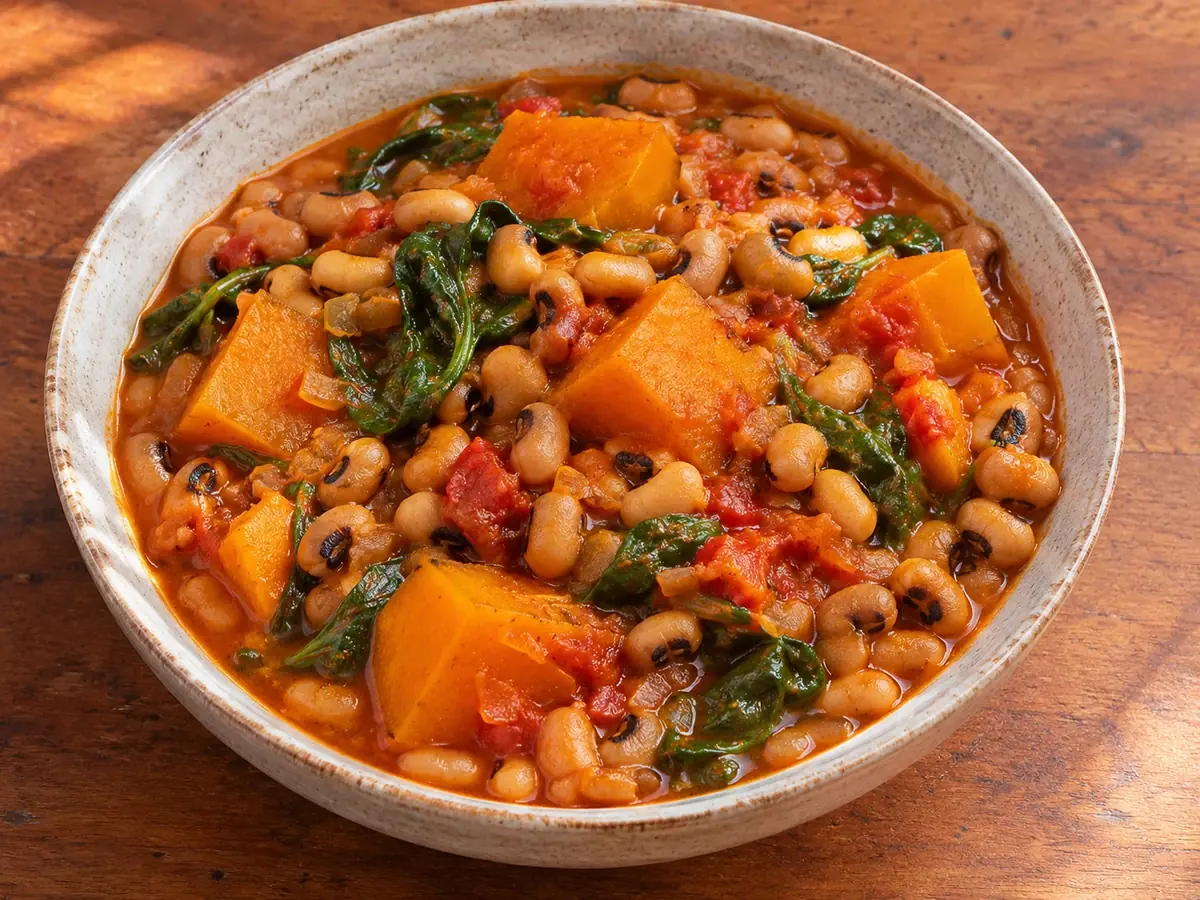
Stewed black-eyed peas with squash and spinach
Cook a stewed black-eyed peas with squash and spinach: soaking, cooking the beans, adding vegetables, and tips for a naturally thickened sauce.
Ingredients
- 300 g dried black-eyed peas
- 600 g peeled and deseeded squash
- 300 g fresh spinach
- 300 g tomatoes
- 180 g onion
- 10 g garlic
- 15 g fresh ginger
- 25 ml sunflower oil
- 1.5 liters water for cooking and more for soaking
- 3 g salt maximum
- 1 g pepper
- 1 whole chili pepper (optional)
Preparation
Drain the soaked black-eyed peas and discard the soaking water. Place the grains in a saucepan with about one and a half liters of fresh water. Bring to a boil, then maintain a steady simmer for 40 to 60 minutes, or longer depending on their age. Skim if necessary and add hot water if the grains risk emerging. Check several beans: they should crush easily under a fork, without a chalky center.
While the beans are cooking, wash the tomatoes and spinach. Chop the onion, garlic, and ginger separately. Cut the tomatoes into small pieces and the squash into regular cubes. Remove damaged spinach leaves and rinse the others carefully to remove sand. Drain them before roughly chopping; too much washing water would unnecessarily thin the sauce and complicate the final consistency adjustment.
Heat the oil in the Dutch oven. Sauté the onion for six to eight minutes over medium heat, stirring, until it is tender but lightly colored. Add the garlic and ginger for one minute. Incorporate the tomatoes, then let them stew for about ten minutes. If the bottom sticks before the tomatoes release their juice, add two spoonfuls of water. The mixture should smell of cooked vegetables, without a raw tomato taste.
Add the squash cubes and 300 ml of the hot cooking liquid from the beans, or hot potable water if you prefer. Place the whole chili pepper without piercing it. Cover partially and let simmer for 15 to 20 minutes. Test the squash with the tip of a knife: it should be tender at the edges, while still holding its shape enough to withstand mixing with the beans.
Incorporate the well-cooked and drained black-eyed peas, keeping their liquid close at hand. Let simmer for ten minutes over low heat. Mash a few squash cubes against the side of the Dutch oven, then mix gently to disperse them into the juice. Gradually add a little liquid if the preparation becomes too compact. Salt and pepper after this thickening, as reduction can concentrate the seasoning.
Add the spinach in two or three batches. Let them wilt, then cook uncovered for another five to eight minutes, until the leaves are tender and the juice is slightly coating. Remove the intact chili pepper. Taste and adjust the salt within the indicated limit, then let rest for five minutes off the heat. Serve in four portions, with plain rice if desired, without imposing an additional starch on each plate.
Introduction
A pot of vegetables and beans
Stewed black-eyed peas with squash and spinach brings together three textures: whole beans, squash, part of which thickens the juice, and leaves added at the end of cooking. This recipe aims for a short, flexible sauce, thick enough to accompany a little rice, but generous enough in vegetables to be served on its own in a deep plate. It requires no peanut paste, industrial broth, or flour for thickening.
This formulation is a contemporary proposal for volume two of Côte d’Ivoire. It uses a bean widely present in West African cuisines without attributing this combination to a specific community. Spinach is explicitly named: it should not be replaced without adaptation by cassava or taro leaves, which require different preparation. Clear naming helps both the cook and the reader looking for a recipe corresponding to available ingredients.
Cultural context
Contemporary creation based on products from the Ivorian repertoire. The proportions are not attributed to a regional tradition nor certified by the cited institutions.
Institutional references FAO INFOODS: https://www.fao.org/infoods/infoods/tables-and-databases/faoinfoods-databases/en/ — Food composition reference for subsequent nutritional calculation. No nutritional calculation of these recipes is claimed to have been performed. UNESCO: https://ich.unesco.org/fr/RL/les-savoir-faire-lies-a-la-fabrication-de-l-attieke-en-cote-d-ivoire-02086 — Context of attiéké manufacturing know-how, inscribed in 2024. Does not validate the combinations or proportions of the recipes. World Health Organization: https://www.who.int/teams/nutrition-and-food-safety/multisectoral-actions-in-food-systems/five-keys-to-safer-food-poster — General principles of cleanliness, food separation, cooking, and temperature control. The proposed shelf lives remain cautious household advice.
Tips
Beans must be tender before tomatoes Separate initial cooking avoids depending on the time needed for sometimes older beans. If the black-eyed peas remain firm, continue cooking them before incorporating them into the sauce; the squash should not wait to the point of disappearing entirely. Keep the saucepan partially covered to limit evaporation, but regularly monitor its level. A floury texture in the center means the grain is not yet ready, even if its skin begins to detach. Already cooked black-eyed peas can be suitable for a quicker meal. Use about 700 to 750 grams of drained grains, rinse them if the conditioning liquid is salty, and proceed directly to vegetable preparation. The exact mass depends on hydration; primarily adjust the amount of juice in the Dutch oven. In this case, the total duration decreases and soaking is no longer necessary: remember to modify the times if you adapt the recipe card for your notebook.
Understanding sauce thickening Squash is the main thickener. First, mash only a few cubes, then wait a minute before deciding to mash more. The beans also absorb some of the liquid during resting. A sauce that seems just fluid enough on the stove will often be thicker at the table. To loosen it, add one or two spoonfuls of hot water at a time, then stir with a wide spoon to preserve the whole grains. If the spinach releases a lot of water, let it simmer uncovered for a few extra minutes, rather than adding flour. You can also wilt them in a separate pan and drain them before adding them to the pot. Do not use a strong boil to speed things up: it breaks the beans and splashes the sauce. The desired result remains a stew with distinct elements, not a uniform purée.
Planning
Plan for soaking and choose the squash
Sort the black-eyed peas on a plate to remove small stones and damaged grains, then rinse them. Soaking for about eight hours in the refrigerator, in a large volume of water, facilitates organization and can reduce cooking time. The grains will expand: use a large enough container and keep several centimeters of water above them. The total time on the recipe card includes this soaking, but active work remains limited.
A firm-fleshed squash, such as butternut squash, is particularly suitable. The weight of 600 grams is measured after removing the skin and seeds. Cut into two to three-centimeter cubes. A very watery squash will require more reduction, while dense flesh will remain in pieces longer. Also prepare a thick-bottomed Dutch oven and a saucepan to cook the beans separately: this separation allows control over each texture.
Nutrition notes
Storage and nutritional reading Cool leftovers in small quantities in shallow containers, then quickly store them in the refrigerator. Reheat only the necessary portions, with a little water to compensate for thickening. This dish also supports freezing, although the squash will be softer after thawing in the cold and reheating. General WHO hygiene recommendations guide food separation and temperature control; they do not constitute a certified shelf life for this particular recipe. Black-eyed peas contribute to the meal's intake of plant proteins and carbohydrates. Squash and spinach contribute to its vegetable diversity. The presence of vegetables does not exempt one from adapting the portion to their menu, and no therapeutic promise is associated with the dish. Check packaged ingredients if you need to exclude allergen traces. Enjoy your meal! Offer the chili pepper separately so everyone can enjoy the sweet taste of the squash and the texture of the beans.
Conclusion
Serve at the indicated texture and adjust seasoning to the products used.
Enjoy your meal
Enjoy your meal!