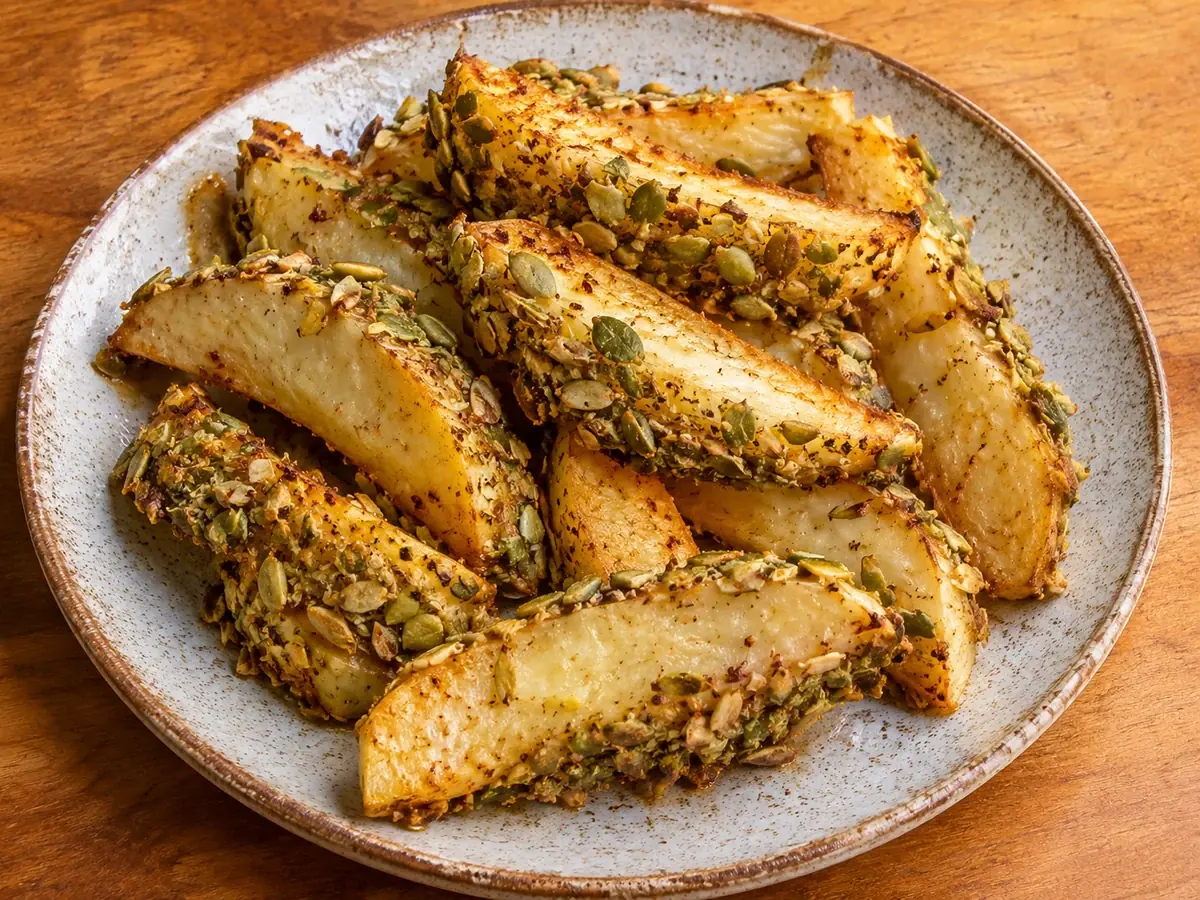
Baked yam with pumpkin seed crust
Achieve a perfectly roasted yam with a pumpkin seed crust, using precise pre-cooking, an egg-free breading, and tips for tender flesh.
Ingredients
- 1 kg peeled edible yam
- 80 g natural shelled pumpkin seeds
- 30 ml peanut or sunflower oil
- 15 ml lime juice
- 5 g fresh grated ginger
- 2 g sweet paprika
- 2 g salt maximum
- 1 g pepper
- 2 liters potable water for pre-cooking
Preparation
Place the yam wedges in a saucepan and cover them with two liters of water, adjusting the volume slightly to the shape of the pot. Bring to a simmer, then cook for 15 to 25 minutes. Pierce a thick piece: the tip should enter with slight resistance, without the edges disintegrating. Drain carefully. Leave the wedges in the colander for five minutes so their surface dries and can receive the coating.
During this pre-cooking, preheat the oven to 200 °C (static heat). Chop the pumpkin seeds with a knife or in very brief pulses in a blender. Aim for a coarse meal mixed with small shards, not an oily paste. Reserve a spoonful of chopped seeds to observe their size: if the whole mixture resembles flour, mix in a few simply crushed seeds to regain a perceptible texture.
Mix the oil, lime juice, ginger, paprika, pepper, and salt in a large dish. Place the still-warm yam wedges and turn them gently. Their surface should be slightly shiny, without sitting in a puddle. The lemon here adds an aromatic note; its role is not to cook or preserve the yam. Work with two spoons to avoid breaking the pre-cooked pieces.
Spread the crushed seeds on a plate. Place each wedge on a cut side, press very gently, then turn it over to coat a second side. It is not necessary to form a thick shell all around: a partial crust already adds texture. Arrange the wedges on a baking sheet lined with parchment paper. Collect any seeds that have fallen into the dish and distribute them over the still-moist areas, without forming large clumps.
Bake for 20 to 25 minutes, checking after 15 minutes. Turn the wedges only once, with a wide spatula, if their underside is sufficiently set. The seeds should be golden and smell lightly toasted; a dark brown hue indicates an undesirable bitterness. If the crust browns quickly, lower the oven to 180 °C and finish cooking. Check that a knife easily penetrates the center of a thick wedge.
Let rest for three minutes on the baking sheet, then transfer to a warm dish. Offer a spicy condiment separately or a small, already prepared tomato sauce, without covering the crust in advance. Divide into four side dish portions. The dish is served with a vegetable preparation and, depending on the menu, fish, beans, or poultry. Its appeal lies in the texture of the wedges: keep them whole until plated.
Introduction
Tender wedges under a thin crust
Baked yam with pumpkin seed crust is designed as a shared side dish, with a slightly crispy exterior and a tender heart. Success primarily depends on pre-cooking: the oven browns an already almost cooked yam, rather than attempting to soften a raw tuber under a layer of seeds that would burn too early. This method allows for spreading out the steps and monitoring the finish without rushing.
The previous volume included boiled, fried, and patty-style yam. Here, cutting into wedges and coating with seeds constitutes another preparation. This is a contemporary creation featuring yam and pumpkin seeds, with no claim of ceremonial or regional origin. The word "pistache," sometimes used in West African culinary repertoires for certain seeds, can be confusing; therefore, the list uses the precise name of the purchased product.
Cultural context
Contemporary creation based on products from the Ivorian repertoire. The proportions are not attributed to a regional tradition nor certified by the cited institutions.
Institutional References FAO INFOODS: https://www.fao.org/infoods/infoods/tables-and-databases/faoinfoods-databases/en/ — Food composition reference for subsequent nutritional calculation. No nutritional calculation of these recipes is claimed to have been performed. UNESCO: https://ich.unesco.org/fr/RL/les-savoir-faire-lies-a-la-fabrication-de-l-attieke-en-cote-d-ivoire-02086 — Context of the traditional knowledge related to attiéké production in Côte d'Ivoire, inscribed in 2024. Does not validate the combinations or proportions of the recipes. World Health Organization: https://www.who.int/teams/nutrition-and-food-safety/multisectoral-actions-in-food-systems/five-keys-to-safer-food-poster — General principles of cleanliness, food separation, cooking, and temperature control. The proposed storage durations remain cautious household advice.
Tips
Why the crust doesn't always hold Some seeds may fall off during serving without the recipe being a failure. An almost total lack of adhesion indicates a surface that is too dry, chopping that is too coarse, or handling that is too early. The oil and residual moisture ensure a light bond, without egg or flour. If the problem appears before cooking, press a few shards onto the warm flesh. After cooking, avoid turning the wedges again: simply gather the golden seeds and spread them over the dish. Yam can become crumbly if pre-cooked excessively. In this case, do not attempt to bread it piece by piece. Arrange the fragile wedges in a small oiled dish, sprinkle the seeds over them, and finish in the oven like an open gratin. The result will be less uniform but still pleasant. For a future preparation, reduce the pre-cooking time and test a first piece before draining the entire pot.
Variations that maintain the recipe's logic Sunflower oil can replace peanut oil without changing the process. Sweet paprika can be omitted if you want to give more prominence to the ginger. However, avoid adding a lot of chili powder directly to the seeds: it can darken quickly and mask their flavor. Sesame seeds would create a different, thinner, and more fragile crust; they also require signaling another potential allergen. For six people, use approximately one and a half kilograms of peeled yam and increase the other ingredients proportionally. Use two baking sheets rather than an overloaded single layer. The cooking time does not multiply by one and a half: it depends on the size of the wedges and heat circulation. Swap the baking sheets if the oven heats unevenly and continue only until the flesh is tender and the seeds are golden.
Organization and storage Pre-cooking can be done a few hours before the meal, provided the yam is cooled quickly and stored in the refrigerator. Dry its surface before coating. Cold wedges may sometimes require a little more time in the oven; monitor the seeds and check the center. Store leftovers in the refrigerator in a sealed container and preferably reheat them in the oven, in small quantities. The microwave softens the crust but may be suitable if the priority is to quickly reheat a portion.
Planning
Carefully select and weigh the yam
The indicated kilogram corresponds to the weight after peeling. Plan for a heavier tuber to allow for the removal of the skin and any fibrous or damaged parts. Choose a firm yam intended for consumption, without any wet spots or abnormal odors. The variety influences the flouriness of the flesh and the cooking time; the knife test remains more reliable than a timer followed without verification.
Peel with a suitable knife on a stable cutting board. If contact with the raw tuber irritates your skin, use food-grade gloves and avoid touching your face. Then rinse the flesh with potable water. Cut into wedges of comparable thickness, around three centimeters at the widest part. Thin tips will dry out while large pieces remain hard: a regular cut greatly simplifies cooking.
Nutrition notes
Nutritional benchmarks and serving Yam provides most of the carbohydrates in this side dish. Seeds and oil add fats; their presence does not automatically qualify the dish as light. No calorie or protein figures are attributed to this formulation without detailed calculation. For allergies, check the oil used and any trace mentions on packaged seeds. Enjoy your meal! A juicy vegetable garnish pleasantly complements these wedges, preserving the crispness until the last moment.
Conclusion
Serve at the indicated texture and adapt the seasoning to the products used.
Enjoy your meal
Enjoy your meal!