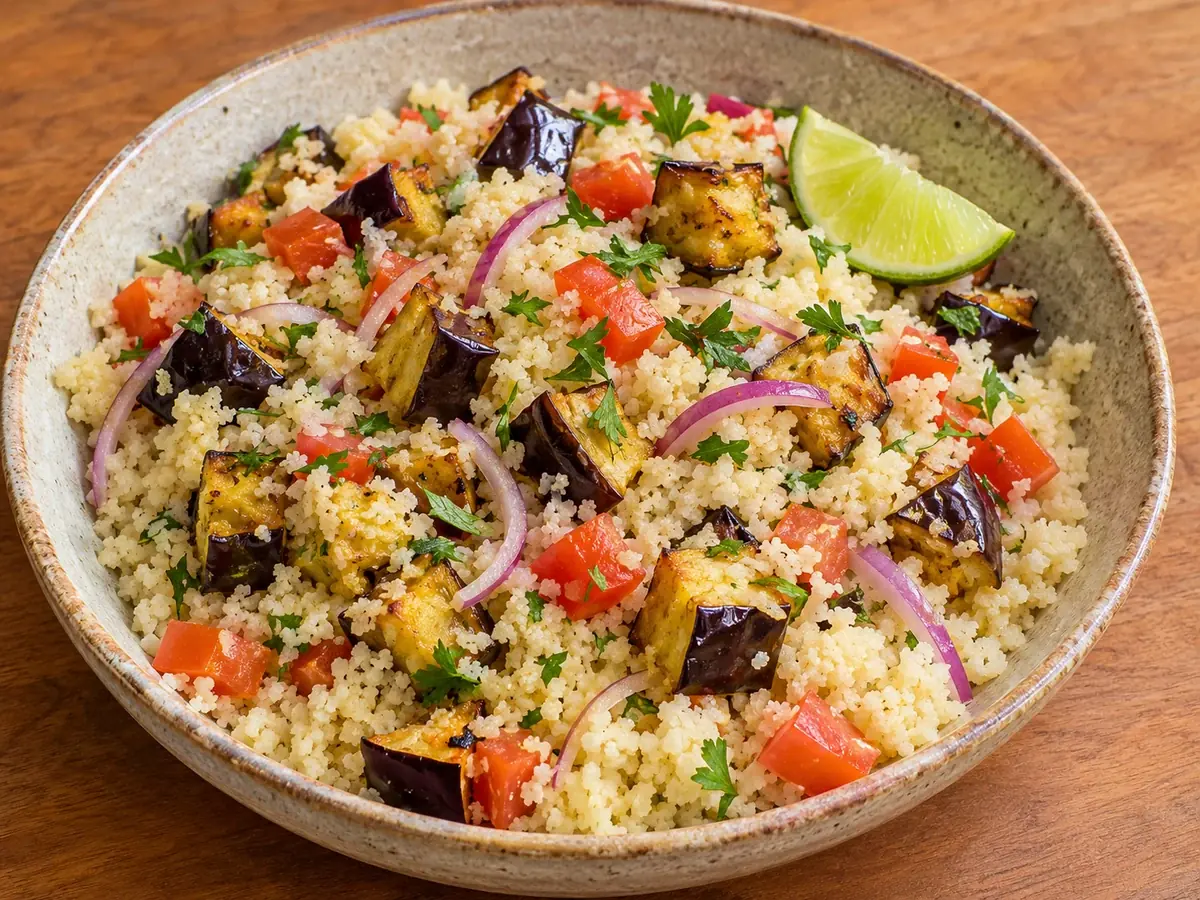
Warm attiéké with roasted eggplant and lime
Prepare a warm attiéké with roasted eggplant, tomatoes, and lime using a detailed method to keep the grains tender and the vegetables meltingly soft.
Ingredients
- 600 g of already processed and cooked attiéké
- 800 g purple eggplants
- 300 g firm tomatoes
- 150 g red onion
- 30 ml peanut oil
- 30 ml lime juice
- 10 g parsley
- 100 ml potable water to moisten if necessary
- 2 g salt maximum
- 1 g pepper
- 1 small chili pepper (optional)
Preparation
Preheat the oven to 210 °C (static heat). Rinse the eggplants, wipe them dry, and remove the stems. Cut the flesh into cubes of about three centimeters, large enough to remain tender after cooking. Mix them with 20 ml of oil and half of the salt. Spread them on the baking sheet, without crowding. Keep the remaining 10 ml of oil to season the attiéké and garnish when serving.
Bake for 30 to 35 minutes. Turn the cubes after about twenty minutes with a wide spatula, gently detaching their underside. Cooking is complete when the edges are browned and the flesh yields easily under a fork. If the baking sheet is already dry and the cubes are still firm, lower to 190 °C and extend for a few minutes. Do not aim for a dark crust on all sides at the expense of dried-out flesh.
While roasting, fluff the attiéké with clean fingers or a fork. Moisten only the dry parts, adding water by small spoonfuls: it is not necessary to use all 100 ml. Place the semolina in a suitable basket above simmering water, without contact with it. Cover and reheat for 10 to 15 minutes, gently separating any clumps halfway through cooking. The grains should be hot, tender, and easy to separate.
Cut the tomatoes into small dice. If they contain a lot of liquid, remove some of the seeds and collect the juice separately. Finely slice the red onion. To soften its pungency, quickly rinse the slices with potable water, then drain them thoroughly. Chop the parsley at the last moment. Prepare the chili pepper separately so that everyone can adjust the intensity of their plate; the goal is to preserve the flavor of the eggplant and the slight acidity of the semolina.
Pour the hot attiéké into the mixing bowl and separate it again. Add the reserved oil and 20 ml of lime juice, then mix without crushing. Incorporate the eggplants after three minutes of resting out of the oven. Then add the tomatoes, onion, and parsley. Lift the ingredients with two spoons rather than stirring vigorously. Taste before using the rest of the lime and salt: the tomatoes already contribute their own acidity.
Immediately divide into four shallow plates. Place a few eggplant cubes on top so that the garnish remains visible. Serve the chili pepper on the side. If you want a more substantial meal, offer plain cooked beans as a separate side dish, without changing the proportions of the semolina. Do not pour a large amount of sauce at the last moment: a drizzle of juice is enough and protects the contrast between the separated grains and the tender vegetables.
Introduction
A plant-based plate centered around attiéké
Warm attiéké with roasted eggplant combines tender cassava semolina, meltingly soft vegetables, and a fresh lime garnish. The temperature contrast remains slight: the eggplants come out of the oven a few minutes before assembly, while the tomatoes remain at preparation temperature. This is neither a garba without fish nor a salad drowned in vinaigrette. The appeal of this plate lies in the measured absorption of vegetable juice by the grains, which must retain their individuality.
This contemporary proposal is part of a culinary exploration of products found in the Ivorian repertoire. Its precise assembly is not presented as an ancient specialty of a particular community. The know-how related to attiéké production is documented by UNESCO; this recipe starts with an already processed product. It therefore does not describe domestic cassava fermentation and does not replace any stage of this transformation.
Cultural context
Contemporary creation using products from the Ivorian repertoire. The proportions are not attributed to a regional tradition nor certified by the cited institutions.
Institutional references FAO INFOODS: https://www.fao.org/infoods/infoods/tables-and-databases/faoinfoods-databases/en/ — Food composition reference for subsequent nutritional calculation. No nutritional calculation of these recipes is claimed to be performed. UNESCO: https://ich.unesco.org/fr/RL/les-savoir-faire-lies-a-la-fabrication-de-l-attieke-en-cote-d-ivoire-02086 — Context of attiéké production know-how, inscribed in 2024. Does not validate the assemblies or proportions of the recipes. World Health Organization: https://www.who.int/teams/nutrition-and-food-safety/multisectoral-actions-in-food-systems/five-keys-to-safer-food-poster — General principles of cleanliness, food separation, cooking, and temperature control. The proposed storage durations remain cautious household advice.
Tips
Adjusting texture without weighing down the dish A compact semolina doesn't always need more oil. It might simply be insufficiently fluffed or too moist. Start by separating it with a fork while it's hot; if it seems dry in the center, briefly steam it again. Adding cold water to the mixing bowl easily creates pasty areas. Conversely, if the tomatoes have soaked the whole dish, serve immediately rather than trying to dry it in a pan, which would damage the fresh vegetables. Eggplant absorbs oil at first, then softens with heat. Resist the urge to add more as soon as its surface appears dull. A measured amount, a hot baking sheet, and sufficient space allow for even cooking. If your oven browns mostly on one side, rotate the baking sheet when turning the pieces. The lime is adjusted after mixing: its intensity depends as much on the fruit used as on the initial acidity of the attiéké.
Preparing in advance and storing You can roast the eggplants and chop the onion in advance, then keep them in separate containers in the refrigerator. Cut the tomatoes shortly before serving to limit water release. Reheat the vegetables and attiéké separately, then assemble. For leftovers, quickly distribute the mixture into a shallow container, refrigerate without prolonged waiting, and preferably consume the next day. Avoid long periods of serving at room temperature, especially in hot weather.
Nutritional benchmarks and allergens Attiéké primarily provides carbohydrates; eggplants and tomatoes complete the plate with vegetables. The amount of oil is measured for four portions, but the recipe does not constitute an individual nutritional assessment. No specific caloric values are announced without calculation based on the products actually used. Peanut oil should be noted for those with an allergy; use an appropriate sunflower oil if necessary and check for any traces on packaged attiéké.
Planning
Choosing ingredients and organizing your work
Choose firm eggplants with shiny skin and no soft spots. Large purple eggplants are well-suited for roasting: they offer large cutting surfaces and flesh that becomes creamy. Small African eggplants can replace them, but their bitterness and seed content will significantly alter the result. For a first attempt, stick to the indicated variety to master the cooking before exploring another version.
Use fresh or defrosted attiéké, then follow the manufacturer's storage instructions. Dehydrated attiéké would require a different starting weight and appropriate rehydration; do not substitute the two products gram for gram. Prepare a large enough baking sheet, a steamer basket, and a large mixing bowl. The baking sheet should accommodate the pieces in a single layer: piled-up vegetables release water and steam instead of browning.
Nutrition notes
Useful questions before serving Can this preparation be eaten cold? Yes, after rapid cooling and refrigeration, but the attiéké will generally be firmer. Only take out the amount intended for serving. Can lime be replaced with vinegar? A small amount is possible, but add it gradually: the aroma will be different, and an identical measure risks masking the taste of the eggplants. Enjoy your meal! Serve this dish immediately after assembly to appreciate its freshness and tender texture.
Conclusion
Serve at the indicated texture and adjust seasoning to the products used.
Enjoy your meal
Enjoy your meal!