Borani
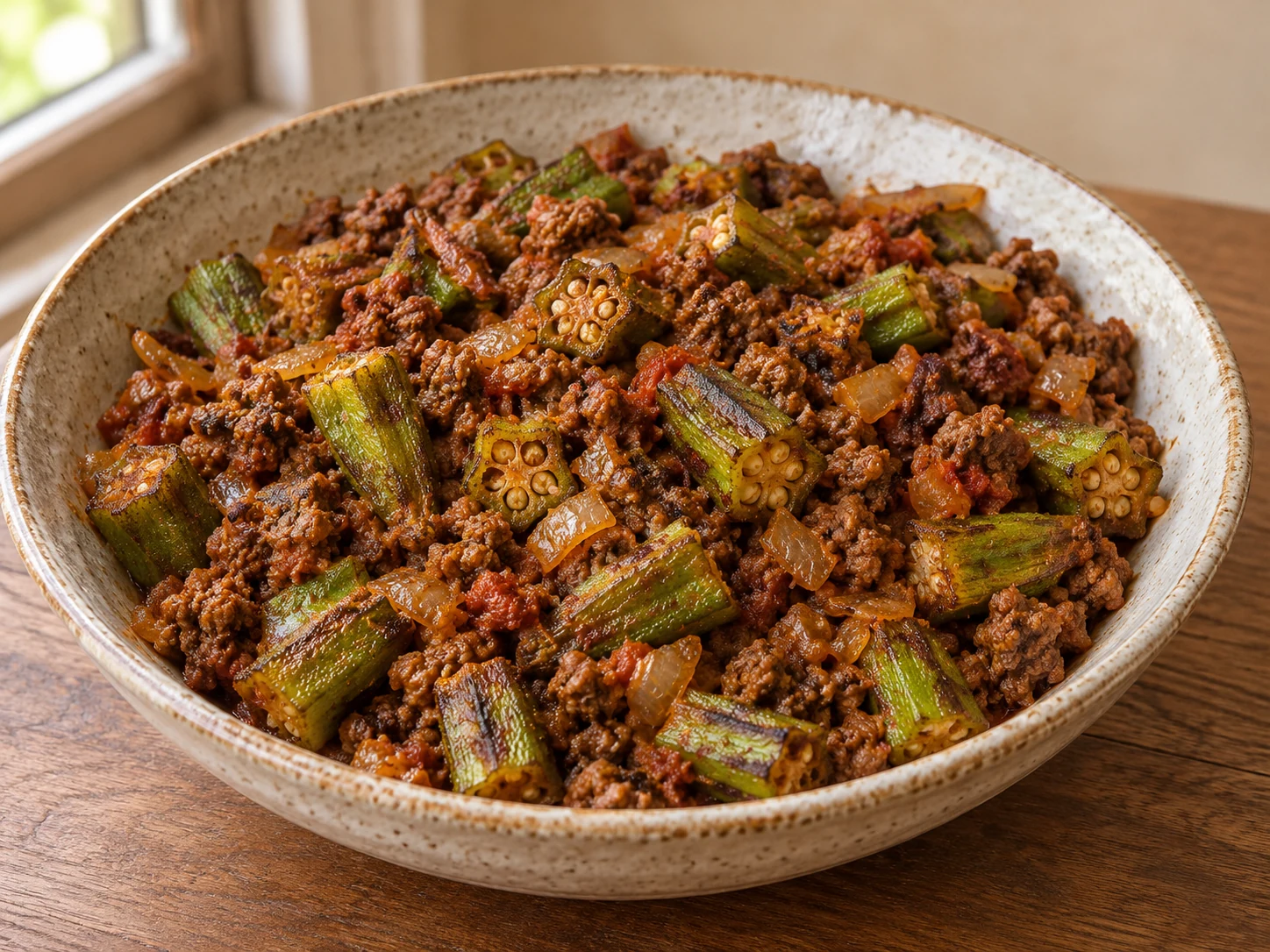
Roasted okra combined with minced beef, onion and tomato. A home adaptation of the borani described in the Sudanese repertoire.
Ingredients
- 600 g fresh okra
- 400 g minced beef
- 180 g peeled onion
- 2 garlic cloves
- 30 g tomato purée
- 100 ml water
- 25 ml neutral oil, divided into 15 ml and 10 ml
- 1 teaspoon ground coriander
- 3 g salt, adjusted to taste
- 1/4 teaspoon black pepper
Preparation
Preheat the oven to 210°C. Rinse the whole okra, drain and dry carefully with a clean cloth. Remove the stalks without cutting deeply into the pods and discard damaged parts. Cut into pieces about two centimetres long. Thinly slice the onion and finely chop the garlic on a clean board.
Mix the okra with 15 ml oil and half the salt. Spread in a single layer on a large tray. Roast for twenty to twenty-five minutes, turning once, until the surfaces begin to brown and the pieces are tender. Adjust by a few minutes for their size and your oven.
Meanwhile, heat the remaining 10 ml oil in a large sauté pan. Add the onion and cook over medium heat for six to eight minutes, stirring, until soft and lightly golden. Add the garlic and coriander and stir for thirty seconds without burning the garlic.
Add the minced beef. Break it up with a spatula and cook for eight to ten minutes, stirring regularly, until completely cooked. If the pan is small, work in two batches so the meat can brown. Do not serve with the spatula that touched raw meat unless it has been washed.
Stir in the tomato purée for one minute. Add the 100 ml water and pepper, then reduce over low heat for five to eight minutes. Aim for a cohesive, fairly thick mixture without an abundant pool of liquid. Taste with a clean spoon and adjust the remaining salt to the products used.
Add the roasted okra at the last moment. Mix gently for two minutes, just enough to combine flavours and heat everything through. Divide into four portions and serve hot. Present bread or any other accompaniment separately: these are excluded from the nutritional estimates.
Introduction
This borani combines two preparations made separately: oven-roasted okra and minced beef browned with onion, garlic and concentrated tomato purée. They are brought together at the last moment. This keeps recognisable pieces of vegetable with lightly browned surfaces rather than turning everything into a uniform, long-simmered sauce. The difference is as much about method as about the ingredient list.
Okra is often described only in terms of its thickening qualities. Here, the aim is instead to limit surface moisture to encourage roasting. Thorough drying after washing and a sufficiently large tray are therefore useful. The pieces will not necessarily become crisp like crisps: their centres should stay tender. Promising absolute crispness would be unrealistic when they will be combined with meat and tomato.
The stated quantities make four main-course portions, to be complemented according to the meal. The meat contributes flavour and a crumbly texture but should not cover the vegetables completely. The ratio of six hundred grams of okra to four hundred grams of meat gives the vegetables a visible place. Weighing helps reproduce the result, especially when the okra available is particularly small or large.
Cultural context
The Sudanese Kitchen describes borani as seasoned minced meat combined with separately cooked okra, roasted or pan-cooked. This general organisation is the starting point for the present adaptation. The proportions, oil allocation, oven temperature and cooking guidelines are offered for home cooking; they do not constitute a single formula attributable to every Sudanese family.
The name borani also appears in other culinary repertoires with different vegetables and sauces. It is therefore appropriate to explain what this version contains rather than automatically assigning yoghurt to it or claiming a detailed shared origin. This recipe contains neither yoghurt, aubergine nor peanuts. Its identity rests on okra and minced meat, not a general interpretation of the name found in another country.
Within the collection, this preparation must remain distinct from bamia simmered in sauce and from pounded okra. Ingredients may overlap without the techniques being identical. Conversely, simply changing a topping or title would not justify a new speciality. The recipe therefore clearly describes separate cooking and final assembly so the difference is understandable when choosing a dish.
Tips
Choose firm okra without soft patches; larger pods can be fibrous.
Dry the vegetables before oiling and have a sufficiently large tray ready.
Avoid stirring the meat constantly: brief contact with the pan encourages browning.
Combine shortly before serving to preserve the okra's texture.
Planning
Preparing the vegetables before handling raw meat makes organisation easier. Keep the minced beef refrigerated until cooking, then wash hands, utensils and work surfaces that have touched it. Minced meat must be fully cooked; browning on the outside of a few pieces does not establish doneness throughout a still-full pan.
Concentrated tomato purée does not have the same water content as fresh tomatoes or canned pulp. Replacing it without adjustment may make the mixture much more liquid. If using another product, reduce the sauce gradually before adding okra. The aim is not to dry the meat until tough, but to coat it in a base that clings to the pieces.
An overcrowded tray traps steam between vegetables. Use two trays or cook in two batches if needed. Turning exposes another side to heat, but there is no need to handle the pieces every minute. Their colour and tenderness give a better guide than mechanically applying one time to every oven.
Storage
If keeping some, place it promptly in a shallow container and refrigerate rather than leaving the dish out all evening. Preferably consume within forty-eight hours and reheat only the amount needed until thoroughly hot in the centre. Okra will be softer after storage; this does not mean the initial cooking was incorrect.
The meat can also be prepared ahead and the vegetables roasted shortly before the meal. Cool and store the meat separately, then reheat before combining. This arrangement better preserves browned surfaces than assembling the entire dish and keeping it hot for a long time.
Variations
Minced lamb can replace the beef: the result will have a stronger flavour and nutritional values must be recalculated. A little chilli is possible for those who enjoy it, presented as a seasoning preference. Ground coriander remains the main fragrance of this formula.
To pan-cook the okra, work in small batches in a wide pan and distribute the same measured amount of oil. Closer attention and possibly longer cooking will be needed. Uncounted extra oil would substantially change the estimates per serving. A fully plant-based version needs a different base and its own description; merely removing the meat does not automatically produce an equivalent dish.
Accompaniments
Serve with a little bread according to appetite, or a starchy accompaniment chosen for the whole meal. A simple salad adds freshness. There is no need routinely to combine bread, rice and potatoes: the choice depends on what is already being served.
For family-style serving, place borani in a shallow dish so the okra remains visible. For individual serving, divide meat and vegetables as evenly as possible. A portion consisting almost entirely of meat would not match the estimate calculated for a quarter of the complete recipe.