Aish al Basawla
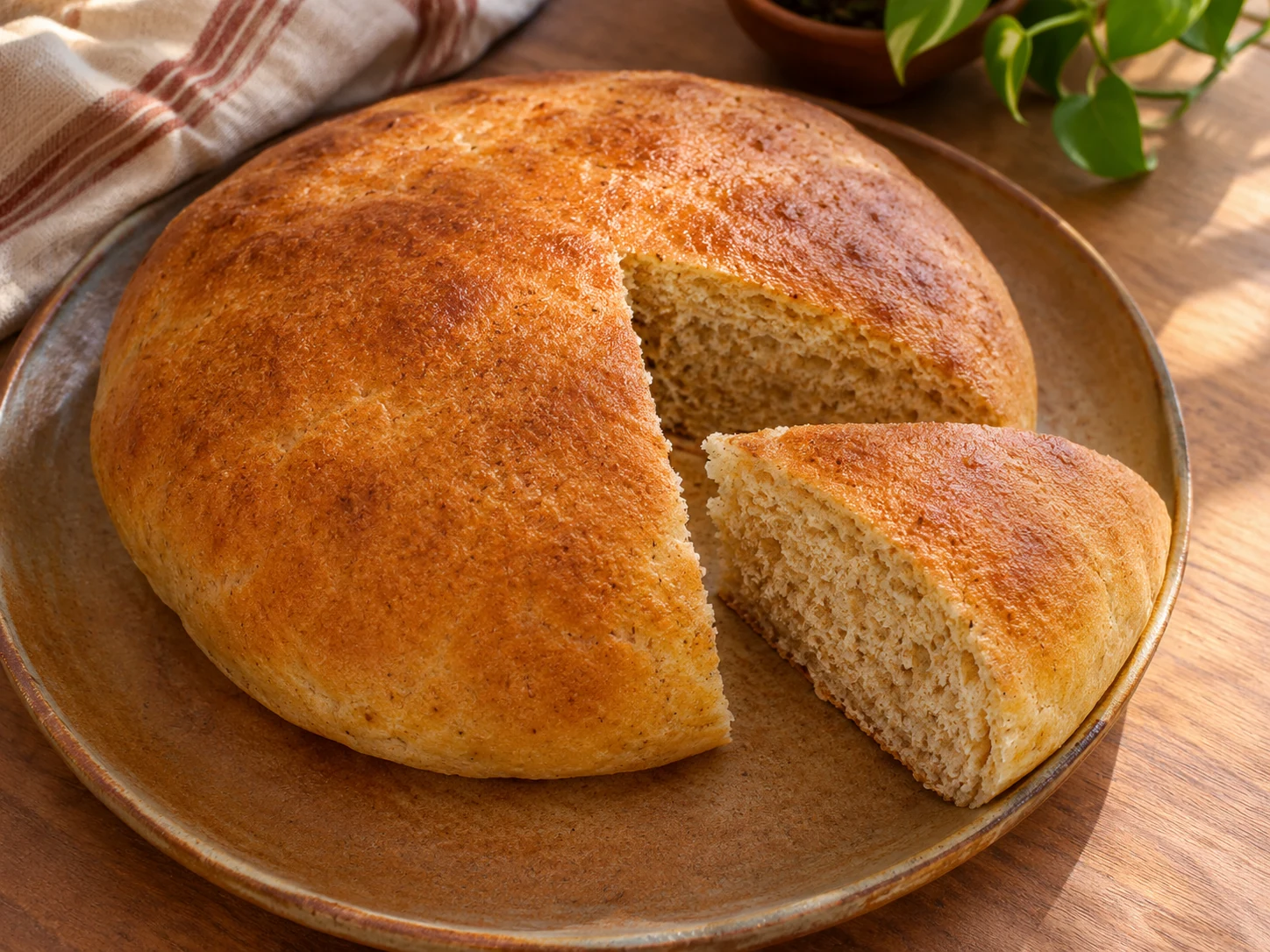
Sudanese bread made with white and partially wholemeal wheat flour, kneaded, proved and baked in a round tin. One loaf for eight portions.
Ingredients
- 300 g white wheat flour
- 200 g partially wholemeal wheat flour
- 340 ml lukewarm water, reserving 20 ml for adjustment
- 7 g instant dried baker's yeast
- 8 g sugar
- 7 g salt
- 10 ml neutral oil for the tin
Preparation
In a large bowl, mix both flours with the instant yeast and sugar, then add the salt. Pour in 320 ml lukewarm water and bring the dough together by hand or with a sturdy spoon. If your yeast requires activation first, follow its packaging instructions, taking the water from the total quantity.
Allow the flour to absorb the water for a few minutes, then knead for about 8–10 minutes on a clean surface. Add the reserved 20 ml water little by little only if the dough is too firm. It should become soft, slightly sticky and coherent enough to lift as one mass.
Shape into a ball, return to the bowl and cover. Leave to rise for about 60–90 minutes in a moderately warm place until noticeably increased in volume. A cool room extends the time needed. Do not speed things up by placing the bowl on a burning-hot surface.
Oil a round tin 24–26 cm in diameter. Gently fold the dough over itself, place it in the tin and flatten evenly. Cover again and leave to rise for about 30 minutes, or longer if it regains volume slowly.
Preheat the oven to 200°C using conventional heat. Bake for about 30–35 minutes. Observe the colour, then check underneath by carefully removing the loaf from the tin. If the base is still damp or undercooked, finish for a few minutes outside the tin.
Place on a wire rack and wait at least 30 minutes before cutting. The crumb continues to set during this rest. Divide into eight portions and serve with an accompaniment chosen separately. Do not seal the bread in an airtight container while still hot.
Introduction
Aish al Basawla is presented here as an oven-baked wheat bread. Its dough is kneaded and then allowed to rise in a tin, distinguishing it from gurasa poured into a frying pan and from very thin sorghum-based kisra. The mixture of white and partially wholemeal flour gives a substantial crumb without aiming for the texture of a fully wholemeal loaf. The proposed quantities make one round loaf to share.
The main guide is the consistency of the dough after a few minutes of resting. Freshly wetted flour may seem sticky before absorbing the water; immediately adding a lot of flour risks making the loaf dry. We therefore reserve twenty millilitres of water for adjustment and knead before changing the proportions substantially. The dough should hold together while remaining softer than biscuit or noodle dough.
Judge the rise by volume and appearance. The times are only guidelines for a kitchen at a moderate temperature. In winter, dough can need considerably longer; a hot kitchen speeds up yeast activity. This does not justify using very hot water, which can compromise its function. Using clearly identified baker's yeast and following its instructions is preferable to indiscriminately using a packet simply labelled raising agent.
Cultural context
The name Aish al Basawla appears in The Sudanese Kitchen's repertoire of Sudanese breads. The entry describes a wheat bread containing white and wholemeal flours, worked and then baked in a tin. This reference identifies a distinct preparation in the collection; it does not establish a detailed history tied to a particular town, community or period. This version therefore avoids inventing an origin story or a special ceremony.
The bread's role is understood at the table: it accompanies beans, a sauce or cheese according to the meal. These pairings must not become hidden ingredients of the loaf. A reader wishing to prepare only the cereal base can follow the recipe without buying meat or tomatoes. Keeping these separate also allows the bread to be reused with several dishes without artificially multiplying recipes for every new topping.
Other Sudanese breads remain important, but their preparation methods are not interchangeable. The title should help identify them; an image of a thin sorghum pancake would not suit this oven-baked loaf. The expected result here is a round bread with a golden crust and a crumb visible when cut. Reference used to identify the dish: https://www.sudanese.kitchen/archive ; the proportions, tin and proving time are adapted to this home formula.
Tips
Prepare the tin before knocking back the dough to avoid leaving it waiting unnecessarily.
If the surface dries during proving, improve the covering without allowing a dry cloth to stick to the dough.
Wait until partially cooled before cutting so you do not compress the crumb.
The dough pulling slightly away from the edge helps with removal but does not guarantee the centre is baked.
Planning
Scales measure salt and yeast more consistently than heaped spoons. The flour contains wheat gluten; this recipe is not suitable for a gluten-free diet. Clean the work surface and avoid tasting raw dough. The tin and bread are very hot when unmoulding: use dry protective gloves or cloths and place the tin on a heat-resistant surface. Do not leave the bread to cool entirely in its tin, where steam may dampen the base.
Serving
The recipe makes 8 portions; accompaniments are counted separately.
Storage
Wait until completely cool, then store in a clean container or bag for one to two days in a cool, dry place. In hot, humid conditions, favour prompt freezing in portions. Thaw the amount needed and warm gently in the oven. Discard any mouldy bread; removing only the visible patch does not make the rest reliably safe.
Variations
Increasing the proportion of partially wholemeal flour may require more water and produce a denser crumb. Make this change gradually after a first attempt with the stated proportions. Baking individual rolls generally shortens the oven time, but requires its own checks rather than automatically retaining thirty-five minutes. Seeds may be added to a personal version, stating their allergens and quantity.
Accompaniments
Serve with ful, a peanut salad or a stew according to the meal. The bread already provides the cereal component, so rice need not automatically be added. Sauces, cheeses and other toppings are excluded from the nutritional calculation for the bread alone. For sharing, cutting even portions allows everyone to help themselves without tearing the whole loaf apart.
Nutrition notes
Wheat mainly provides carbohydrates, as well as protein and fibre. Contains gluten.