Baasta
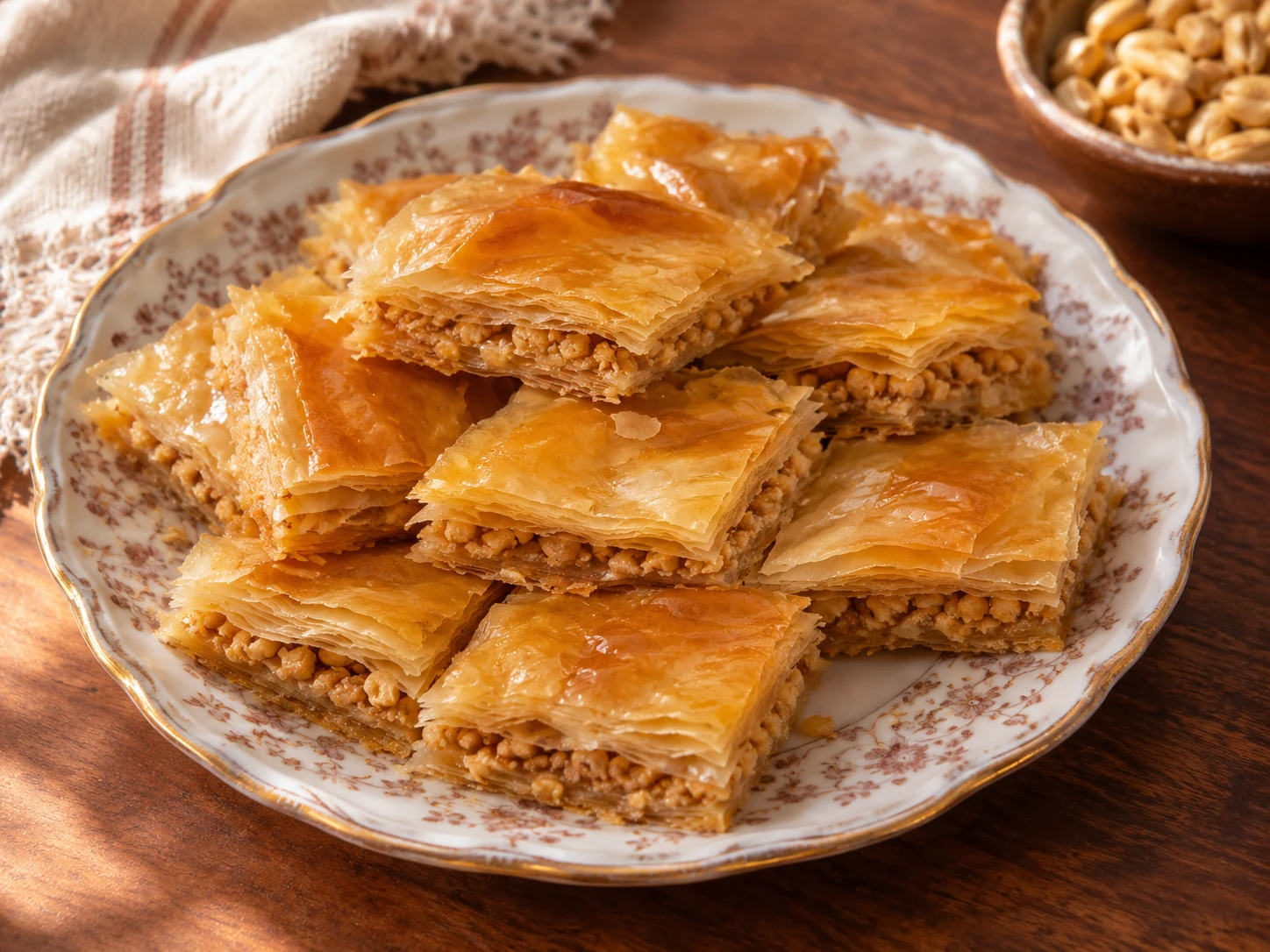
A Sudanese layered filo pastry with peanuts and cinnamon, soaked with a measured syrup. A home version making twelve small portions.
Ingredients
- 200 g filo pastry, about 12 sheets depending on size
- 150 g roasted unsalted skinless peanuts
- 80 g melted ghee for the sheets and tin
- 15 g sugar for the filling
- 1 teaspoon ground cinnamon
- 120 g sugar for the syrup
- 120 ml water for the syrup
- 15 ml lime juice
Preparation
Choose a tin measuring about 20 × 25 cm and preheat the oven to 180°C. Check that the filo sheets cover it and trim if necessary. Count the sheets so that approximately half go beneath the filling and half above it.
Chop the peanuts into small pieces without turning them into a paste. Mix with the 15 g sugar and cinnamon. Gently melt the ghee without burning it. Reserve a small amount to grease the base and sides of the tin.
Lay one filo sheet in the tin and brush it with a thin film of ghee. Add the other sheets of the first half, lightly greasing each one. Keep unused sheets beneath a clean, barely damp cloth without soaking them.
Spread the filling over the entire surface without making a mound in the centre. Cover with the remaining sheets, greasing each in turn. Use the remaining ghee on top. With a sharp knife, mark and then cut twelve portions before baking, without excessively compressing the layers.
Bake for about 30–35 minutes, watching the colour. The top should be golden and the bottom layers cooked. If the surface colours too quickly, loosely protect it with foil rather than stopping the baking prematurely. Adjust the time to the actual thickness of the assembled pastry.
While it bakes, put the 120 g syrup sugar and 120 ml water in a small saucepan. Bring to a simmer, add the lime juice and cook gently for about 8 minutes. The syrup should remain pourable. Allow it to cool until warm; do not aim for a caramel consistency.
Allow the pastry to cool, then pour the still-warm syrup over all the portions in several passes. Wait for the liquid to distribute before moving the pieces. Carefully run the knife through the cuts again if needed and serve at room temperature.
Introduction
Baasta is a pastry made of thin sheets layered with a peanut filling. After baking, syrup provides the expected sweetness and moisture. This version does not require making your own filo: the work lies in preparing the filling, lightly greasing the layers and controlling the soaking. It differs from basbousa, which uses semolina and does not have the same layered structure.
The two quantities of sugar have different roles. The fifteen grams for the filling are mixed with the peanuts, while the remaining one hundred and twenty grams belong to the syrup. Confusing them produces either an excessively sweet filling or insufficient syrup. Preparing the ingredients in two separate small containers before starting simplifies assembly and avoids discovering a mistake while the filo sheets are drying on the worktop.
The exact sheet size varies between brands. The total weight of two hundred grams is the main reference; the number of sheets is only a guide. Smaller sheets can overlap to cover the base without creating a thick pile in the middle. Small offcuts can be distributed between layers. The aim is an even assembly in which each portion contains roughly the same amount of pastry and filling.
Cultural context
The Sudanese repertoire describes baasta as a pastry related to baklava. The peanut version illustrates the use of an ingredient prominent in the country's cooking, without making this family of layered pastries an exclusively Sudanese invention. Related desserts exist in many cuisines, with different names, fats and fillings. This recipe therefore keeps the name baasta while specifying the choice of peanuts and cinnamon.
Small portions suit a pastry concentrated in sugar and fat. Twelve portions in the stated tin are a suggested way of cutting it, not a universal cultural rule. The dessert can be offered with tea or coffee, but neither the drink nor the rest of the serving tray is included in the ingredients or nutritional values.
Rolled versions and other fillings also exist. They need their own description so the photograph genuinely matches the method. Here the assembly is flat and cut into small portions; it should not be illustrated with pistachio rolls. Reference used to identify the dish: https://www.sudanese.kitchen/archive ; the measured formula, tin size and syrup quantity are adapted to this home version.
Tips
Take out filo sheets as needed to prevent them drying out.
Chop the peanuts finely enough to cut portions without tearing everything apart.
Distribute the ghee with a brush rather than pouring it into large puddles.
Cutting before baking helps preserve the fragile layers once cooked.
Planning
Hot syrup can cause burns. Use a stable small saucepan and do not touch the syrup to check its consistency. Filo sheets are fragile, but a small tear does not mean a sheet must be discarded: covering it with the next sheet is often enough. This recipe contains peanuts, wheat gluten and a dairy product, ghee. Also check the exact composition of the purchased pastry and identify the allergens when serving.
Serving
The recipe makes 12 portions; accompaniments are counted separately.
Storage
Allow to cool, then cover the dish. Refrigerate in a clean container for three to four days and take out only the amount to be served. The pastry gradually loses crispness in contact with the syrup; this texture change is expected. Do not promise identical flaky layers after several days. To freeze, wrap portions separately and thaw in the refrigerator.
Variations
A walnut or pistachio filling changes the flavour, cost and allergens. It must be identified and measured separately. For a less moist pastry, use some of the syrup and offer the rest alongside, bearing in mind that the nutritional amount consumed will then differ. Do not replace the syrup with honey without stating this in the quantities and estimate.
Accompaniments
Serve a small portion with an unsweetened drink. A well-soaked pastry does not routinely need another sweet sauce alongside it. Keep portions on a dry dish, away from savoury or very moist foods in the meal, to preserve their flavour and presentation.
Nutrition notes
An energy-rich pastry. Contains peanuts, wheat and milk in the form of ghee.