Guraiba
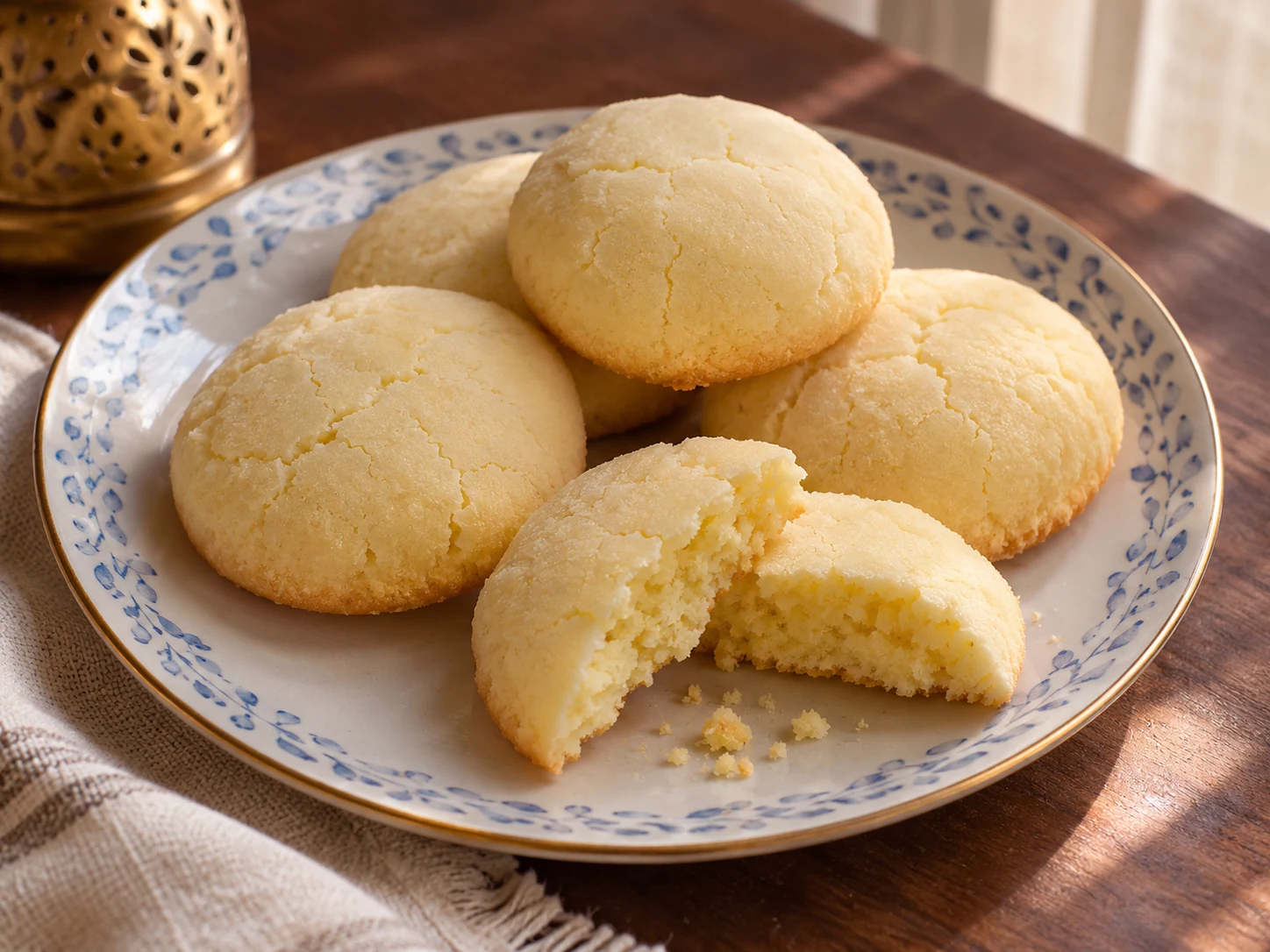
Crumbly Sudanese biscuits made with ghee and icing sugar, lightly flavoured with ground cloves. Makes twenty-four small biscuits.
Ingredients
- 300 g white wheat flour
- 180 g softened but unmelted ghee
- 90 g icing sugar
- 1 g salt
- 1 small pinch ground cloves
Preparation
Weigh all the ingredients. Allow the ghee to soften if necessary, without liquefying it. Sift the icing sugar to remove small lumps. Mix the ground cloves into the flour so the flavour is evenly distributed without any very strong patches.
Beat the ghee with the icing sugar for about 4–5 minutes until lighter and smooth. Scrape the sides of the bowl as needed. The mixture should remain creamy; if it becomes oily, chill for a few minutes before continuing.
Fold in the spiced flour and salt in two or three additions using a spatula, then gently bring the dough together by hand. Do not knead it for a long time as you would bread. It should hold together when a small portion is pressed between the fingers, without becoming elastic.
Cover and refrigerate for 20 minutes. Preheat the oven to 160°C using conventional heat. Line a baking tray with baking paper. Divide the dough into twenty-four portions as evenly as possible, roll into balls and flatten slightly.
Arrange the biscuits with space between them. Bake for about 18–22 minutes, checking from 16 minutes onwards. The tops should remain pale while the bases become lightly golden. Adjust for thickness and your oven; do not wait for the entire surface to turn brown.
Let the biscuits cool on the tray for at least ten minutes before moving them with a spatula. They are fragile when hot. Transfer to a wire rack and wait until completely cool before putting them in a container.
Introduction
Guraiba is a small, crumbly biscuit whose texture relies on a mixture of flour, clarified fat and sugar. This version uses ghee and a small amount of ground cloves distributed throughout the dough. It makes twenty-four modestly sized biscuits. The expected result is neither a cookie with a soft centre nor a flatbread: once cooled, the biscuit should break easily and melt in the mouth without having a raw dough centre.
Ghee is chosen for its low water content compared with ordinary butter. It should be soft when mixed, but should not resemble hot oil. This difference affects shaping and spreading in the oven. Ghee that is too liquid makes the dough greasy and difficult to shape; very cold ghee remains in pieces. Taking a few minutes to adjust its consistency avoids having to correct the dough later with handfuls of flour that would change the recipe.
Icing sugar distributes easily in this type of biscuit and avoids an overly grainy sensation. Do not automatically replace its ninety grams with an equal volume of sugar cubes or liquid sugar. Scales are more useful here than cups, because a cup of tightly packed flour can contain considerably more than a loosely filled cup. Consistent measurements help you understand the result of the first attempt.
Cultural context
Biscuits from the guraiba or ghorayeba family are known in several countries, with related names and toppings. The Sudanese repertoire documents a clove-flavoured guraiba, distinct from the kaak already in the collection. The short title preserves its name, while the description specifies the ghee and crumbly character of this version. It would be misleading to present it as an exclusively Sudanese creation apart from all other regional variations.
Some presentations feature a whole clove. This adaptation chooses a pinch of ground cloves rather than a hard spice inserted into every biscuit. This is practical for serving and should remain visible in both the text and image: do not show twenty-four biscuits topped with a whole spice if the recipe does not use it. The fragrance is subtle and should not become a sharp sensation that masks the biscuit.
Guraiba readily accompanies tea or coffee in small quantities. The recipe does not require additional sugar decoration and should not be confused with a syrup-soaked cake such as basbousa. Reference used to identify the dish: https://www.sudanese.kitchen/archive ; the weighed proportions and ground-clove finish are a home-cooking adaptation of this family of biscuits.
Tips
Scales help make equally sized biscuits that bake evenly.
If the dough warms up and becomes greasy, chill it briefly before shaping.
Carefully lift a test biscuit to check the base rather than judging only by the top.
Do not pack the biscuits into their container while they are still warm.
Planning
The dough contains raw flour and must not be tasted before baking. For allergy information, ghee remains a dairy product: clarification does not mean it is automatically suitable for someone with a milk allergy. The recipe also contains wheat gluten. Start each batch with a cold baking tray; an already hot tray melts the fat before the biscuit begins to set in the oven.
Serving
One portion is one biscuit out of twenty-four.
Storage
Allow to cool completely, then store in a clean airtight container away from heat and moisture for five to seven days. In a very hot room, choose a cooler place to prevent the ghee softening excessively. For longer storage, freeze the well-wrapped biscuits and let them return to room temperature in their wrapping before opening.
Variations
An almond or pistachio topping is possible for a personal version, but it adds an allergen and must be included in the ingredients. Ordinary butter does not give exactly the same result as ghee because of its water and solid components. To try this substitution, make a separate small batch rather than changing the whole batch without checking. A heavily spiced version is not the formula proposed here.
Accompaniments
Serve one or two biscuits with tea or coffee. The nutritional portion is given per biscuit for easier comparison, then everyone can adjust their quantity. A drink and any other sweets are not included. Presenting the guraiba on a dry dish protects their texture; avoid placing them in contact with very juicy fruit or a dessert with sauce.
Nutrition notes
An energy-dense biscuit to serve in small quantities. Contains wheat and milk in the form of ghee.