Gunzu
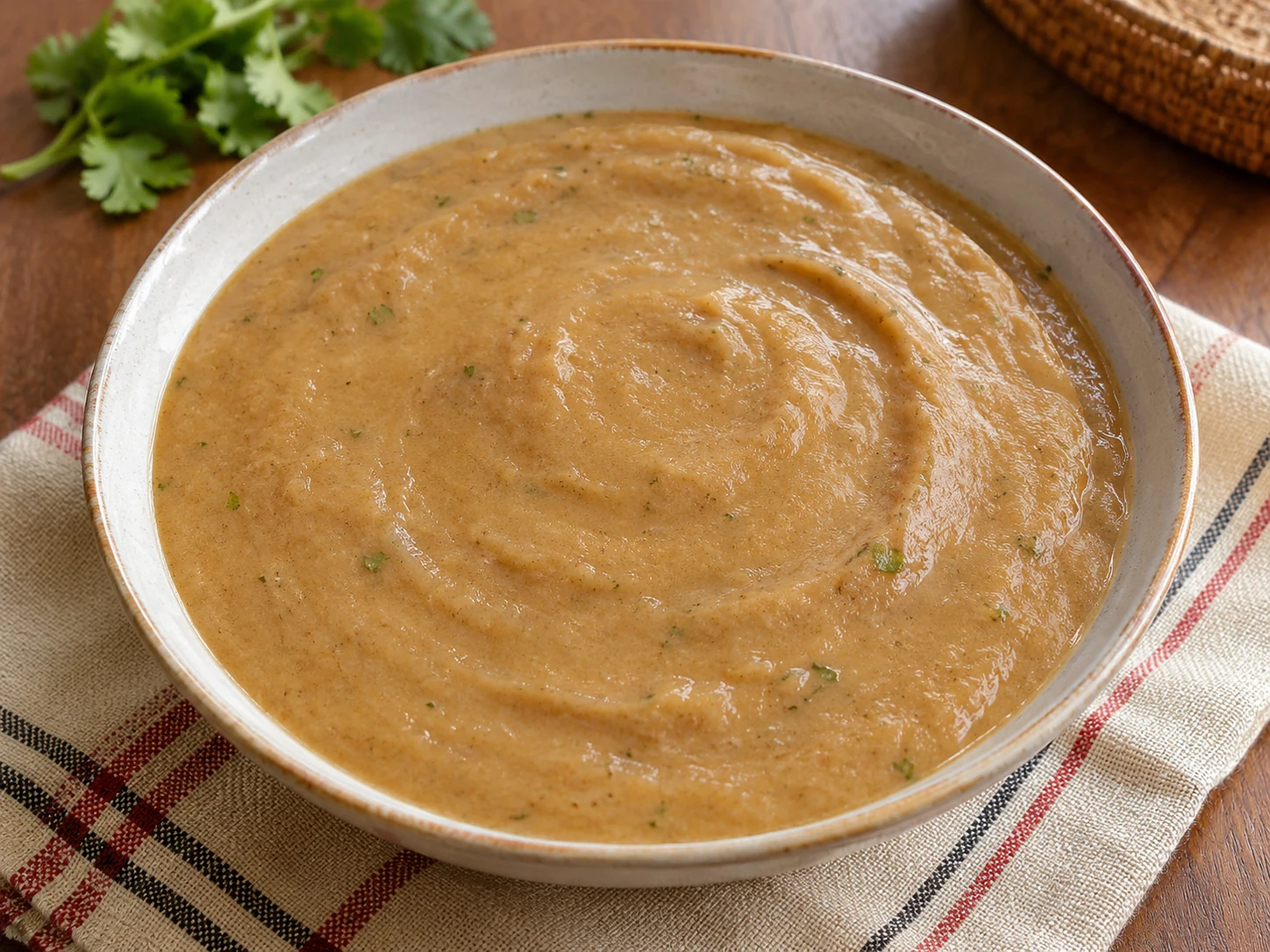
A Sudanese sauce of cooked cowpeas blended with onion, garlic and coriander. A plant-based version making six portions.
Ingredients
- 300 g dried cowpeas
- 1.5 litres soaking water, to be discarded
- 1.2 litres fresh cooking water, adjusted as needed
- 1 onion weighing 150 g
- 2 garlic cloves
- 1 teaspoon ground coriander
- 3 g salt, adjusted to taste
- 1 pinch black pepper
Preparation
Sort and rinse the cowpeas. Cover with the soaking water in a large clean container and refrigerate for 6–8 hours. Discard the water, rinse again and check that no foreign matter remains among the beans.
Peel and thinly slice the onion. Put the cowpeas in a saucepan with the onion and 1.2 litres fresh water. Bring to the boil, skim if necessary, then reduce to a simmer. Cook for about 40–60 minutes, or longer if the beans remain firm.
Peel and finely chop the garlic. Check several cowpeas for tenderness by crushing them with a fork. Add the garlic and coriander during the final ten minutes. Keep enough liquid in the pan to prevent the beans sticking before they become tender.
Remove the pan from the heat. Scoop out and reserve some broth before blending the cowpeas with the onion and remaining liquid. Use a hand blender with its head submerged to limit splashing. Do not seal the hot mixture inside an airtight blender jug.
Return to a low heat. Add salt and pepper and loosen with the reserved broth until you have a thick sauce that flows slowly from a spoon. Simmer for 5 minutes, stirring regularly, then taste with a clean utensil.
Divide into six portions of sauce and serve hot with aseeda or kisra prepared separately. If it thickens while standing, add a little hot water and reheat while stirring; do not try to loosen it by adding a large amount all at once.
Introduction
Gunzu turns cowpeas into a thick sauce rather than a salad of whole beans. The mixture is cooked, then blended with the onion and some of the broth. This produces an even texture that can accompany a firm cereal preparation without leaving the pulses at the bottom of a liquid that is too thin. The flavour is deliberately simple: onion, garlic and coriander support the cowpeas without hiding them beneath a long list of spices.
Cowpeas are the small beans often recognisable by their dark eye. They must be distinguished from the fava beans used for ful and the chickpeas used for baleela. This recipe uses their dried weight before soaking: three hundred grams. It makes six portions of sauce, rather than six large plates that would constitute a complete meal on their own. The final yield depends on how much liquid is retained when blending.
It is useful to reserve broth before blending. A purée that is too thick is easily adjusted with small additions; a very diluted mixture, however, needs a long reduction and may stick. This reserve gives you room to adjust without changing the ingredients. The sauce also thickens as it cools, which explains why leftovers may seem firmer the next day without necessarily having gone wrong.
Cultural context
The Sudanese Kitchen repertoire mentions gunzu, also called mullah ganu, as a cowpea preparation associated with the Blue Nile region. This indication of provenance is a documentary reference, not a claim that every family in that region follows an identical formula. This version measures the ingredients for home cooking and retains the distinctive principle of blended pulses.
The word mullah recalls its function as a sauce. With aseeda, the dish brings together a firm cereal component and a more fluid accompaniment. To serve, present the two separately so everyone can adjust their portion, or pour the sauce around a small serving of the cereal preparation. In either case, the aseeda is not put into the blender and is not included in the quantities or calories for the gunzu alone.
This distinction makes enriching the collection more useful than multiplying nearly identical titles. Gunzu is not simply ful with a new name and should not be illustrated with a chickpea salad. Its expected appearance is a thick beige-to-brown sauce, smooth or slightly grainy depending on blending. Reference: https://www.sudanese.kitchen/archive ; quantities and cooking times are adapted here and must remain linked to this particular formula.
Tips
Check doneness before blending: a hard bean does not become tender because it passes through a blender.
Keep the hand blender's head beneath the surface to avoid splashing.
Stir the sauce while reheating, because a blended mixture sticks more readily.
Adjust the liquid in small amounts, stirring after each addition.
Planning
Preparing the sauce in a heavy-bottomed saucepan gives more control during the final reduction. A very thin base heats unevenly and may burn the purée even when the top still looks liquid. Use a spatula or spoon that lets you gently scrape the entire base. If a burnt smell develops, stop scraping the stuck layer into the rest: carefully transfer the unaffected part to another container and assess its taste before continuing.
Serving
The recipe makes 6 portions; accompaniments are counted separately.
Storage
Divide leftovers into small containers to speed cooling, then refrigerate and consume within two days. Reheat gently until thoroughly hot, adding a little water. The sauce can be frozen in portions; after thawing in the refrigerator, stir while reheating to restore an even consistency.
Variations
For a less smooth texture, blend only some of the cowpeas and keep a few tender whole beans in the sauce. Clearly identify this variation. Another pulse may be used for a personal adaptation, but it should not be presented as the same gunzu without explanation. Do not automatically add peanuts: they are not part of the basic formula given here.
Accompaniments
Serve with sorghum aseeda or kisra, accompanied by vegetables if desired. Bread and the cereal preparation are counted separately. The combination allows you to assemble a plant-based plate without attributing medicinal properties to the dish. A small portion of sauce is enough to complete a meal that already contains other pulses.
Nutrition notes
Cowpeas provide plant protein and fibre. The cereal accompaniment is counted separately.