Ripe plantains roasted with coconut
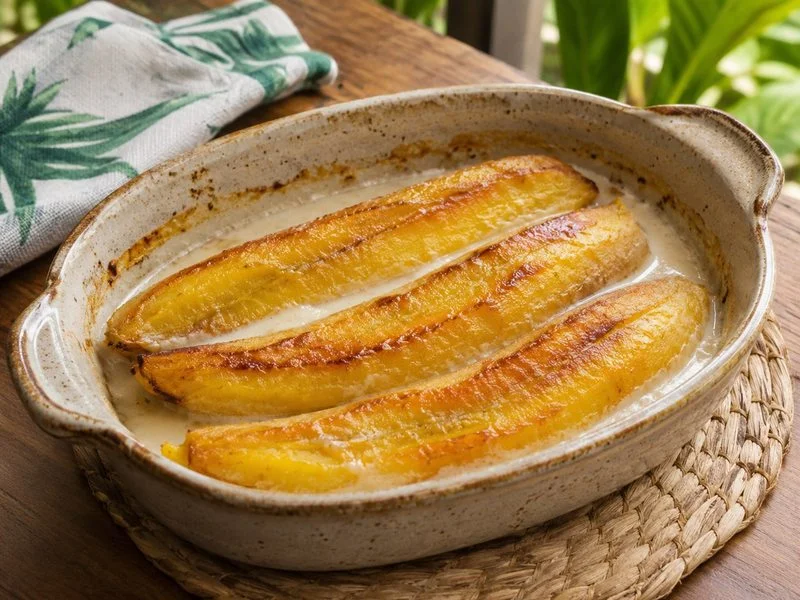
Plantain browns in the oven, then finishes with a little coconut milk that reduces around each half. Recipe 25 makes a stovetop ladob with sweet potato.
Ingredients
- 4 ripe but firm plantains
- 160 ml unsweetened coconut milk
- 15 g optional light brown sugar
- ½ tsp vanilla
- 12 ml neutral oil
- 1 pinch salt
Preparation
Heat the oven to 195 °C. Peel, halve lengthwise, coat lightly with oil and place in a shallow dish.
Roast about 20 minutes until edges colour. Meanwhile, warm coconut milk with vanilla, salt and optional sugar, then reduce slightly.
Pour the coconut milk around the plantains, spoon some over them and return to the oven until tender and the sauce thickens around them.
Cool slightly and serve two halves per person with a spoonful of the cooking sauce.
Introduction
Plantain browns in the oven, then finishes with a little coconut milk that reduces around each half. Recipe 25 makes a stovetop ladob with sweet potato.
Cultural context
SeyVillas illustrates the role of bananas in Seychellois desserts. The oven roast and short coconut finishing stage are a home adaptation.
https://www.seyvillas.com/en/guide/travel-info/on-site/food-and-drinks
Planning
Choosing ripe plantains
Buy ripe plantains with dark patches whose flesh is firm enough to halve. Dark skin alone tells you little about the pulp. Press gently in the middle and check once peeled. Save fruits that crush easily for another dish. Here the halves should hold through roasting and coating. Choose four of similar length and diameter for even browning.
Trim the ends, slit the peel lengthways without cutting deeply and halve the fruit along its curve. Coat lightly with oil. Space the halves in a shallow dish. Coconut milk spreads too thinly in a very wide dish, and a narrow one stacks the fruit. Choose one that holds them side by side with room to pour and spoon up coconut milk.
Roasting before adding coconut milk
Bake in the preheated oven and check colour near the end of the first interval. Edges can darken before the centre softens. This first stage gives a light roast surface. If smaller halves colour faster, swap positions with thicker ones or take the thin pieces out briefly while finishing. Wait to add coconut milk if the surface is wet and pale. Roast a few minutes longer if needed, checking colour. Dry roasting too long makes the tips tough.
Meanwhile heat coconut milk with vanilla and a pinch of salt. Stir it before measuring if separated. Taste some plantain before adding optional sugar. Ripe fruit can be sweet enough. Simmer briefly to distribute the vanilla and thicken slightly. It should still pour over the fruit. Reducing far on the stove leaves little sauce after baking. Stop while it flows easily off a spoon.
Coating lightly and testing the flesh
Pour the sauce around the plantains and spoon a little over each half, keeping some surface visible. Bake until the flesh is tender and the liquid thickens around the pieces. Test the thickest part with a knife point. If it resists, bake a little longer and baste again if the surface dries. If tender but the milk is runny, rest in the dish so it thickens as it cools. Overcooking makes the halves hard to lift.
Lift with a broad spatula and serve two halves per person. Spoon over the remaining coconut sauce. A shallow bowl holds it without covering the fruit. For a tasting, serve one half for a larger yield. The estimate assumes four servings and excludes optional sugar. Record how much you use. Peeled weight varies. Combine large and small halves to keep portions comparable.
Reproducing the roast
The role of bananas in Seychellois cuisine gives context for this oven adaptation. In the collection's ladob, the pieces simmer in coconut milk. Here two stages leave the halves whole with coconut sauce around them. Note ripeness, pan size and when you add the milk. To double, use two dishes of similar depth and check the fruit in each. Sauce timing depends on spread as well as volume.
For a lighter portion, serve a half with a little warm sauce. Keep the pieces whole so sauce is easy to divide. If smaller halves finish earlier, set them on a plate and add sauce when the larger ones are done. Next time choose similar sizes or use two dishes. Note the texture when you add the milk to see whether the first roast firmed the surface enough.
Nutrition notes
Nutrition and allergens
Plantain is the main carbohydrate source. Coconut milk supplies fat, including saturated fatty acids.
Estimated nutrition per serving
Calculation based on 4 servings.
Energy 325 kcal
Protein 3.1 g
Fat 11.1 g
Carbohydrate excluding fibre 56.1 g
Fibre 3.4 g
Calcium 13 mg
Iron 2.3 mg
Potassium 965 mg
Vitamin C 34 mg
Salt Not quantified in the source
The estimate uses 180 g of flesh per plantain. Optional sugar is excluded.