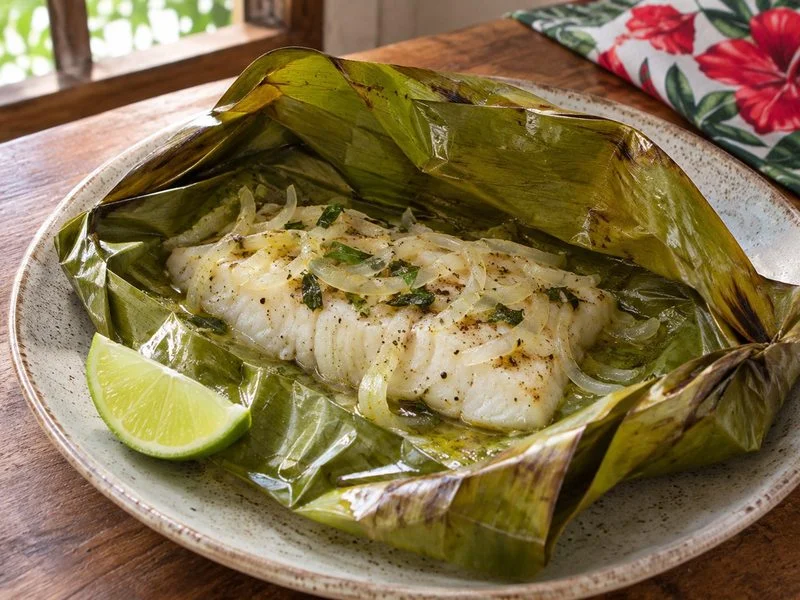
Fish in banana-leaf parcels
Each fillet cooks with aromatics inside its own banana-leaf parcel. The wrapping keeps in the juices and differs from the stovetop letoufe in recipe 65.
Ingredients
- 4 white fish fillets, 150–170 g each
- 4 large food-grade banana leaf pieces
- 60 g onion
- 2 garlic cloves
- 10 g ginger
- 15 ml oil
- 1 lime
- Salt and pepper
Preparation
Clean leaves and briefly soften in hot water, then dry. Check fish for bones.
Mix finely chopped onion, garlic, ginger and oil. Divide over the seasoned fillets and centre each on a leaf.
Fold sides over and put parcels seam down in a dish. Bake at 190 °C. Open the first carefully at 15 minutes and probe the thickest fillet. Continue until 63 °C at the centre.
Open away from your face to release steam. Add lime and serve each fish in its open leaf.
Introduction
Each fillet cooks with aromatics inside its own banana-leaf parcel. The wrapping keeps in the juices and differs from the stovetop letoufe in recipe 65.
Cultural context
FabulousFusionFood records fish cooked in banana leaves in Seychelles. This version bakes individually wrapped fillets.
https://www.fabulousfusionfood.com/seychelles.php
Planning
Choosing fillets and preparing leaves
Ask for four white fish fillets of similar thickness. Even weights help portioning, but thin fillets cook faster. Check for bones before seasoning. Group pieces with thin ends on one side to check first. Pat dry and chill while preparing leaves. Buy food-grade banana leaves large enough to enclose each fillet and avoid broad splits that let juice escape.
Rinse and dry the leaves. Soften briefly in hot water, then dry before laying them on the board. Cut beside a tough rib or place it outside the fold. Test the fold on an empty leaf. It should fold over the centre without tearing. Turn a split leaf or move the fish away from a tear. Set out four pieces and a spare.
Sharing out the seasoning and closing the parcels
Slice onion very thinly because fish cooks quickly and thick pieces can stay hard. Chop garlic and ginger and mix with oil. Put some beneath each fillet and spread the rest over it. Season lightly. Keep lime for serving. Centre the fillets with a margin of leaf. Use one per parcel for even cooking. For smaller portions, cut shorter pieces instead of folding the flesh over.
Fold the first side and ends inward, then bring the opposite edge over and place seam down. Leave room so parcels do not crush each other. Set aside a place to open one for testing. Rewrap a torn parcel and put the seam down again. A small gap at the top loses less juice than a long split underneath. Fix it before baking while the leaf is cool.
Checking with a probe and opening at the table
Bake as directed. Take an edge parcel for the first check. Open away from your face and let steam escape before inserting a probe in the centre of the thickest part. If below the target, close it and cook longer. Test another if sizes differ. Remove ready parcels without stacking. They hold heat and the fish can firm up further in a hot dish. Open them so the juices stay near the flesh.
Serve in the open leaf and squeeze lime at the last moment. The leaf is for cooking and presentation. Spoon the juices so onion does not fall under the leaf. Offer plain rice or roasted vegetables alongside. Nutrition uses a reference white fish and excludes starch. Fat content varies with the fillet. Record fish, thickness and time to target temperature to reproduce it.
Preparing multiple parcels and checking each batch
Set out leaves and seasoning before portioning the fish for a crowd. Chill finished parcels until baking. Group smaller pieces so you can remove them without moving others. Check both dishes if using two, since oven position affects timing. Serve the parcels open or individually without losing juices. This keeps the documented Seychellois banana-leaf method visible.
Share any leftover seasoning over the last fillets before closing. A concentration of ginger and garlic changes one parcel's flavour. Use a clean teaspoon to check each portion. If a pale or thick leaf is stiff, put the flexible edge on the last fold. Open just when the plate is ready. If juices leaked into the dish, spoon them out and serve separately, provided the fish reached the target. Spoonfuls are easier to share than tipping the leaf over the plate.
Nutrition notes
Nutrition and allergens
Fish supplies protein and oil provides added fat. The recipe contains fish.
Estimated nutrition per serving
Calculation based on 4 servings.
Energy 174 kcal
Protein 28.8 g
Fat 4.6 g
Carbohydrate excluding fibre 2.6 g
Fibre 0.4 g
Calcium 33 mg
Iron 0.7 mg
Potassium 708 mg
Vitamin C 6 mg
Salt Not quantified in the source
Fresh cod is the reference white fish. The banana leaf is not eaten.