Fresh coconut jam
Grated coconut remains visible in this soft spread. Cocada and coconut nougat are shaped into little bites. The yield depends on how long the liquid reduces.
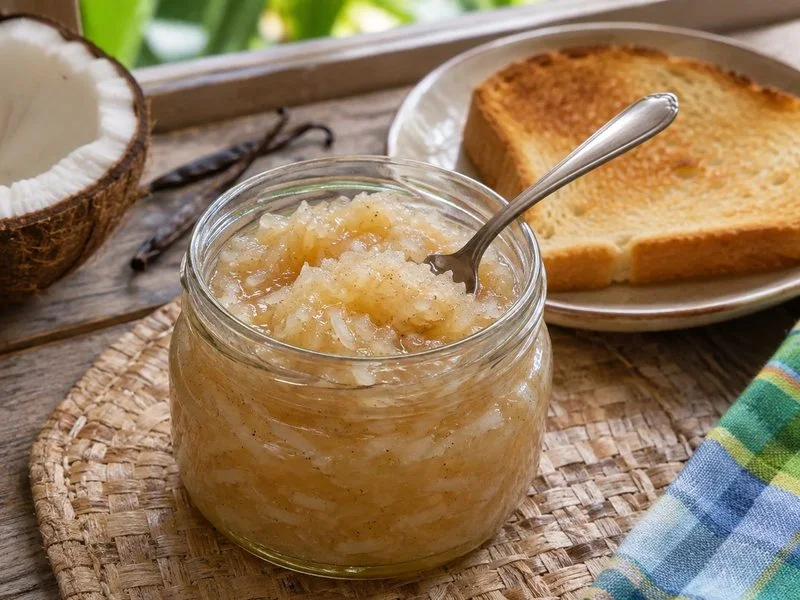
Ingredients
- 180 g finely grated fresh coconut
- 85 g sugar
- 160 ml water
- ½ vanilla pod
- 1 pinch salt
Preparation
Heat water and sugar in a small saucepan, stirring until dissolved. Split the vanilla pod lengthwise.
Add vanilla, salt and coconut. Bring to a simmer over medium heat, then lower as it thickens.
Stir more often towards the end. Stop when coconut is tender and a spoonful spreads on a cold plate. Add a little hot water if it dries before softening.
Remove the pod, transfer to a clean small container, cool quickly and refrigerate. Serve sparingly on bread or with plain cake.
Introduction
Grated coconut remains visible in this soft spread. Cocada and coconut nougat are shaped into little bites. The yield depends on how long the liquid reduces.
Cultural context
Seychelles News Agency mentions locally produced coconut jam. This version is a refrigerated spread.
https://www.seychellesnewsagency.com/articles/21431/news-alert
Planning
Preparing the coconut and pan
Use a fresh coconut with firm flesh. Remove hard bits and finely grate the required amount. Cut long strands before weighing. Fine strands coat a spoon easily and spread well on bread. For more texture, leave a few strands longer without changing the total weight. Mix both sizes in a bowl before adding them. Keep the coconut grated so it remains visible after cooking.
Measure water and sugar separately. Split the half vanilla pod and leave the seeds with it if you want to retrieve them together. In a small, fairly wide pan, thickening is easy to see. A narrow one evaporates more slowly and a large frying pan can dry the edges before the coconut is tender. Set out a cold plate, a spoon and a small clean container for transferring the spread and cooling it.
Starting by dissolving the sugar
Add water and sugar first. Heat and stir until no grains are visible, then add salt, vanilla and coconut. Keep the syrup clear so it cooks and coats the strands. Stir to wet all the coconut and bring gradually to a simmer. Scrape strands from the sides back to the centre with a spatula.
At first the mixture seems thinner than the final spread. Simmer until a spatula begins to expose the base. Lower the heat and stir more frequently from then on. Scrape base and sides, leaving out any over-dry pieces. If the coconut is still firm when the liquid has almost gone, add hot water and continue gently. It should spread with a spoon even after cooling. A lump pulling away in one piece will be too dry.
Using the cold-plate test
Cool a spoonful on the plate and nudge it with the spoon. It should hold briefly and spread under light pressure. If a clear ring of liquid runs away from the mound, reduce a few more minutes. If it forms a firm ball and the syrup is already very sticky, remove the pan from the heat and stir in drops of hot water. Test another spoonful. The hot mixture always seems looser than the spread in the jar.
Once the test looks right, remove the pod and stir to coat every strand. Transfer to a small clean container. Level uneven areas lightly with the back of a spoon. Cool quickly and refrigerate. This is a fresh spread. The jar's yield depends on evaporation and the water released by the coconut. Use a clean spoon when serving and keep bread crumbs out of the jar.
Measuring portions for serving
Serve in a small dish with bread or plain cake. Spread a thin layer on toast so the strands stay visible and hold together. If the spread is stiff from the fridge, let just the amount needed soften in a small dish. Vanilla comes through when coconut and sugar are shared in a small bite. Serve small portions when there are other sweets at the table.
The estimate divides the batch into thirteen, but finished weight varies. Weigh the cooled spread without the container and divide by the actual number of portions. Weigh multiple jars separately. Portion weight is especially useful here because a heaped spoonful and a thin layer differ. Record the cold-plate test to reproduce the consistency with a drier coconut or a different pan diameter.
Before doubling, check you can stir the whole surface in one motion. A deeper batch in a narrow pan takes longer to reduce. Keep the starting depth the same when comparing batches, or make two small ones in succession.
Nutrition notes
Nutrition and allergens
Sugar contributes carbohydrates and coconut contributes fat. Calculate the amount per serving from the finished weight.
Estimated nutrition per serving
Calculation based on 13 servings.
Energy 74 kcal
Protein 0.5 g
Fat 4.6 g
Carbohydrate excluding fibre 7.4 g
Fibre 1.2 g
Calcium 2 mg
Iron 0.3 mg
Potassium 49 mg
Vitamin C < 1 mg
Salt Not quantified in the source
Thirteen portions from the stated yield of twelve to fifteen. The vanilla pod is removed.