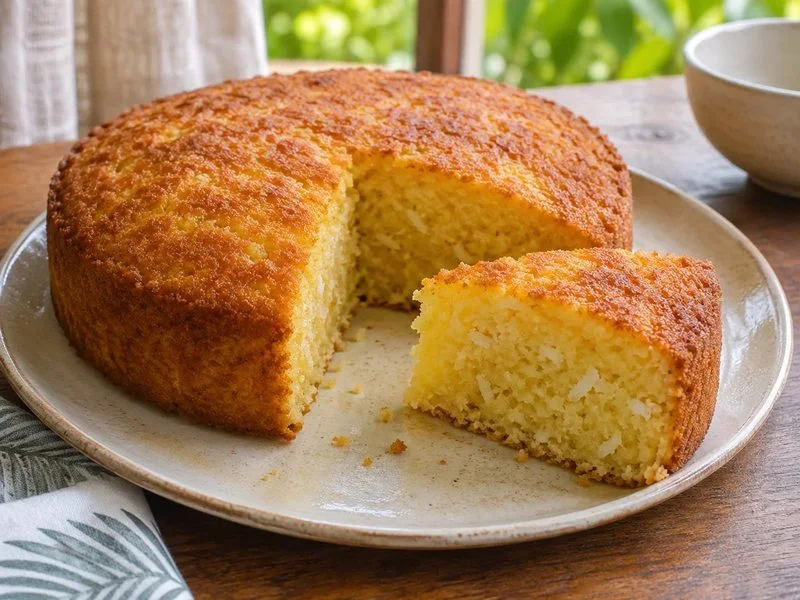
Gato koko, Seychelles coconut cake
A moist grated coconut cake baked in a round tin. The tart in recipe 108 combines shortcrust and filling. Here eggs, flour and coconut form one batter to cut into slices.
Ingredients
- 150 g wheat flour
- 100 g finely grated fresh coconut
- 2 eggs
- 95 g sugar
- 75 g melted butter, lukewarm
- 90 ml unsweetened coconut milk
- 6 g baking powder
- 1 tsp vanilla
- 1 pinch salt
Preparation
Heat oven to 175 °C. Line a round 20 cm tin. Mix flour, baking powder and salt separately.
Beat eggs and sugar until pale. Drizzle in butter, then add coconut milk and vanilla.
Fold in dry ingredients and add grated coconut last. Stop as soon as even.
Pour into the tin and bake on the middle shelf. At 35 minutes, test the centre. Continue if the blade is wet with batter or the centre gives way.
Rest 10 minutes in the tin, turn onto a rack and slice once cool.
Introduction
A moist grated coconut cake baked in a round tin. The tart in recipe 108 combines shortcrust and filling. Here eggs, flour and coconut form one batter to cut into slices.
Cultural context
Seychelles Nation lists gato koko among Seychellois sweets. This recipe proposes a home batter.
https://www.nation.sc/articles/7470/seychellois-cuisine-and-its-importance
Planning
Weighing the coconut and preparing the tin
Gato koko uses coconut in two forms. Grated flesh shows in each slice, and coconut milk goes into the eggs and butter. Weigh the flesh after removing hard bits. A fine grater gives strands short enough to distribute. With a coarse grater, chop the longest strands to help mixing. The weight is for fresh coconut. Its moisture varies and affects the batter. Stir coconut milk before measuring it.
Line the base of a 20 cm round tin with a flat paper disc and prepare the sides so the cake releases when lukewarm. A wider tin gives a shallower cake that may bake faster. In a narrower tin check the centre more carefully. Measure the diameter before setting the baking time. Use the middle oven shelf so the cake bakes through. Get the tin ready before adding flour and baking powder.
Mixing a soft batter
Whisk eggs and sugar until paler. The butter should still be liquid and lukewarm. Pour it in gradually while stirring, then add coconut milk and vanilla. Stir coconut milk that has separated so you do not add a rich layer followed by a watery one. Keep the wet ingredients in one bowl where you can judge the texture. Once smooth, combine flour, baking powder and salt in a second bowl.
Fold the dry ingredients in with a spatula. Add the fresh coconut last and fold from bottom to top several times. Stop when the strands are evenly dispersed and no flour pockets remain. Break up any clump with the spatula tip instead of beating the whole batter. Pour straight into the tin. Turn it a quarter turn as you level an uneven top. Wipe any splashes off the sides before baking.
Checking the centre before turning out
Watch the colour near the end. The edge can brown while the centre still needs time. Insert a blade in the centre and look at what comes out. A few soft crumbs suit a moist cake. A streak of wet batter needs more time. Close the oven without keeping the tin out for long. Test again in or near the centre, especially with a moister coconut than last time.
Rest in the tin for the stated time. Run a small blade around the sides once they release easily. Loosen any point that still pulls before lifting the cake. Transfer to a rack to keep condensation away from the base. Cool fully before cutting so the crumb sets and slices neatly. A hot cake can seem fragile and hold together well at serving temperature.
Sharing and comparing batches
Cut eight wedges with a long knife. Mark the quarters and divide each in two. For a spread of small sweets, serve thinner slices flat to show the crumb. The coconut tart can give another texture at the same table. Gato koko contains coconut throughout the batter. Serve plain to show that texture or offer fresh fruit separately.
Record the tin diameter, cooled cake weight and the time the centre took to cook. Use the same tin to compare wetter coconut or a different coconut milk. The estimate uses eight slices and a reference coconut milk. Check the product label for figures closer to the ingredients you use.
If the slices have to stand on a platter, put them there only after cooling. The bases will stay firmer and the crumb will break less when lifted.
Nutrition notes
Nutrition and allergens
Butter and coconut provide fat. Flour and sugar provide carbohydrates. The recipe contains wheat, egg and milk.
Estimated nutrition per serving
Calculation based on 8 servings.
Energy 268 kcal
Protein 4.2 g
Fat 15.3 g
Carbohydrate excluding fibre 27.3 g
Fibre 1.7 g
Calcium 60 mg
Iron 1.2 mg
Potassium 110 mg
Vitamin C 1 mg
Salt Not quantified in the source
Values are per slice of cake.