Banke Nwel roast duck
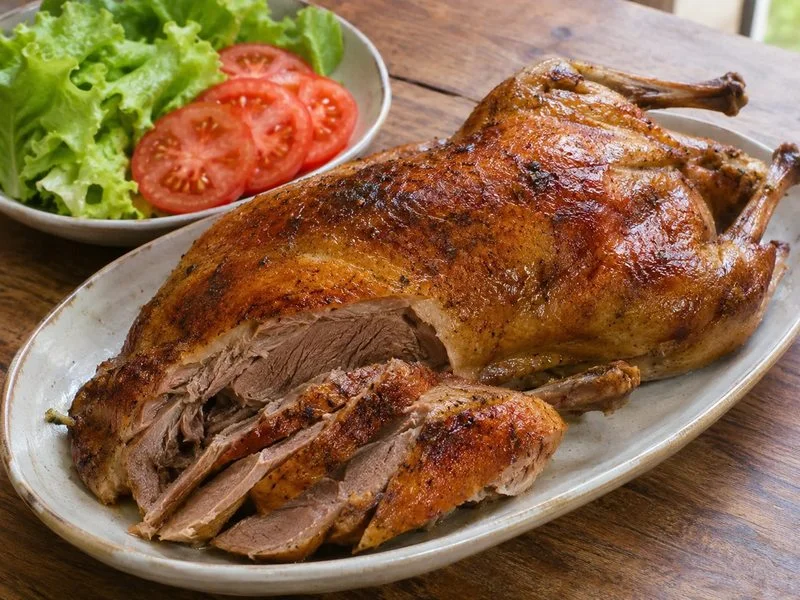
A whole roasted duck with lettuce and tomato salad, served in the tradition of Banke Nwel. The seasoning and roasting method are adapted to home cooking.
Ingredients
- 1 gutted duck, 2–2.3 kg
- 2 onions
- 4 garlic cloves
- 20 g ginger
- 4 sprigs thyme
- 1 lemon
- 7 g salt
- Pepper
- 1 lettuce and 3 tomatoes, to serve
Preparation
Heat the oven to 170 °C. Dry the duck, trim accessible fat and prick only the fatty skin.
Rub the cavity with salt and pepper and put in thyme and lemon wedges without packing it. Put sliced onion, garlic and ginger under a rack in the roasting pan with a little water.
Roast breast up on the rack. Check the pan and remove excess fat carefully if necessary. Begin taking temperatures after 1 h 30 min.
Cook to 74 °C at the thickest breast and inside the thigh and wing, without touching bone. Rest 15 minutes before carving.
Serve with lettuce and tomato. Skim the pan juices and serve separately.
Introduction
A whole roasted duck with lettuce and tomato salad, served in the tradition of Banke Nwel. The seasoning and roasting method are adapted to home cooking.
Cultural context
Seychelles Nation documents roast duck or chicken at this Christmas banquet, with lettuce, tomato and bread.
https://www.nation.sc/articles/2740/living-heritage-project-banke-nwel-brings-back-a-long-lost-tradition
Planning
Organising the roast and the meal
Ask for a dressed duck of about 2 kg. Check it fits on a rack in the roasting tin with room around it. The tin needs room to catch the rendered fat. If the bird is tight against the sides, heat reaches the thighs and flanks less evenly. Prepare aromatics before handling the bird and reserve a clean board for carving. Make the salad on a separate surface. Wash and drain the lettuce before the roast finishes so you have time for the pan juices.
Place onion, garlic and ginger under the rack to flavour the liquid. Cut thick pieces so they do not dry out immediately. The water need not reach the skin. Check the level once the rack is in place. Put the thyme and lemon loosely in the cavity. Leave the wedges easy to remove after resting. Carve the duck into portions and offer the juices separately from the salad.
Preparing the skin and watching the roast
Pat the skin dry, especially around the thighs. Remove accessible clumps of fat and prick fatty skin shallowly as directed, without reaching the flesh. Put the bird breast up and set the tin on an oven shelf so heat can circulate. At the first check, inspect the liquid. If almost none remains and the aromatics darken, add hot water at the edge of the tin and keep it away from the skin.
If too much fat collects, take some out with a baster or heatproof ladle. Keep the tin steady instead of tilting it over the hot hob. Decide what to check before opening the oven so you can close it promptly. A different bird weight changes the timing. Treat the time as a guide and follow the stated internal temperatures. The surface can brown before the thickest part is ready.
Checking several points and resting the bird
Measure the breast, then check the inner thigh and wing close to their thickest parts. Insert the probe into flesh without touching bone. If a small movement changes the reading abruptly, measure again from another angle. Check all the specified points before removing the bird. If one part is ready and another needs longer, monitor the slowest part. The skin may brown faster on one side.
Rest the duck on a board that catches juices. Use the time to remove the thyme and lemon, portion the salad and finish the juices. Separate visible fat before straining or reducing. If there is very little liquid, taste it before deciding whether to add hot water. Serve it in a small dish so the salad stays fresh and everyone can take as much as they like.
Carving and sharing fairly
Remove the legs at the joints. Then cut along the carcass to take off the breasts and slice them for the platter. For six smaller portions, account for bones and skin. A whole leg and a breast slice may yield very different edible weights. Serve lettuce and tomato on the side, with bread if you want to follow that detail of the banquet menu. The serving draws on a historic meal and the roast is adapted to a home oven.
For a first trial, weigh the edible pieces separately and note how much skin is served. The nutrition assumes five portions and an estimated weight of meat with skin. Some guests will prefer lean breast slices and others more skin. Lay the pieces out clearly and keep the juices separate. These choices affect the richness more than the amount of onion or tomato served with the roast.
For a smaller portion, serve a breast slice and a small piece of boned thigh. This lets you share the cuts without including bone in the serving weight.
Nutrition notes
Nutrition and allergens
The purchase weight includes bones. To estimate protein and fat per serving, weigh the meat served and note how much of the skin is eaten.
Estimated nutrition per serving
Calculation based on 5 servings.
Energy 554 kcal
Protein 30.7 g
Fat 43.4 g
Carbohydrate excluding fibre 7.1 g
Fibre 2.2 g
Calcium 54 mg
Iron 4.9 mg
Potassium 645 mg
Vitamin C 22 mg
Salt Not quantified in the source
Five portions from an estimated 760 g of cooked duck with skin. Pan juices are excluded. Less skin lowers the fat.