Breadfruit and trevally balls
Mashed breadfruit forms the base of these fish balls. Recipe 31 covers fish balls and recipe 99 a breadfruit and octopus gratin. Here the high proportion of breadfruit and bite-sized shaping give a different result.
Ingredients
- 500 g firm breadfruit flesh, trimmed before cooking
- 240 g skinless trevally fillets
- 40 g wheat flour, partly for shaping
- 2 garlic cloves
- 8 g ginger
- 8 g parsley
- 2 sprigs thyme
- Salt and pepper
- Neutral frying oil
Preparation
Cube and boil the breadfruit until tender. Drain well, let the steam escape, then mash.
Poach trevally separately to 63 °C at the thickest point. Drain, flake and feel for bones.
Mix fish, mash, herbs, chopped garlic and ginger. Add some flour if needed to bind. Shape 16 balls and dust with the remaining flour.
Test-fry one ball at 170–175 °C. Check that it holds and stays moist. Fry the rest in batches, drain on a rack and serve hot.
Introduction
Mashed breadfruit forms the base of these fish balls. Recipe 31 covers fish balls and recipe 99 a breadfruit and octopus gratin. Here the high proportion of breadfruit and bite-sized shaping give a different result.
Cultural context
Seychelles Nation features breadfruit and fish balls in a collection of Creole recipes. Breadfruit remains the main ingredient in this adaptation.
https://www.nation.sc/articles/2212/celebrating-our-kreolite-with-authentic-creole-recipes
Planning
Preparing the fish and breadfruit separately
Breadfruit should make up most of the mixture. Choose firm fruit and weigh the flesh after removing the skin and core. Cut even cubes so the smallest ones do not disintegrate before the others cook. Drain and let the steam escape. A wet mash takes more flour to shape and leaves less breadfruit flavour. Mash while warm with a fork and spread in the bottom of the bowl briefly if it seems wet.
Cook the fish in a separate pan. Ask for fillets with the main bones removed, then check them by touch. Poach at a gentle simmer and check the thickest piece against the recipe's temperature. Drain the flesh on a plate and flake it in small batches with a fork. It should mix into the mash with small flakes still visible. Remove any bones you find. Large flakes can crack the sides of a ball.
Making a mixture you can shape by hand
Mix the breadfruit and fish once both stop steaming. Add finely chopped ginger and garlic, then thyme leaves and parsley. Use as little flour as possible at first and save the rest for coating. Squeeze some mixture in your palm. If it holds, shape the pieces without more flour. If it crumbles, try squeezing another portion with slightly damp hands before deciding it needs more binder.
Divide into four groups of four. Use scales to spot any oversized piece. Roll the balls without compressing them for long. Tuck in protruding fish so it stays in the ball during frying. Roll each one in a thin coat of flour and shake off the excess. Arrange in one layer on a dry plate. Chill the waiting balls if frying in batches. Set out the draining rack before putting the first ball in the oil.
Testing the first fish ball
Heat the oil to the specified temperature and slide in one ball. Let the surface firm up before turning. If it splits straight away, retrieve the pieces and check whether the filling is too wet. If it forms a crust but a long crack exposes fish, check the shaping and flake size. A thick coating can split as you turn it. Shake more flour off the remaining balls if this happens.
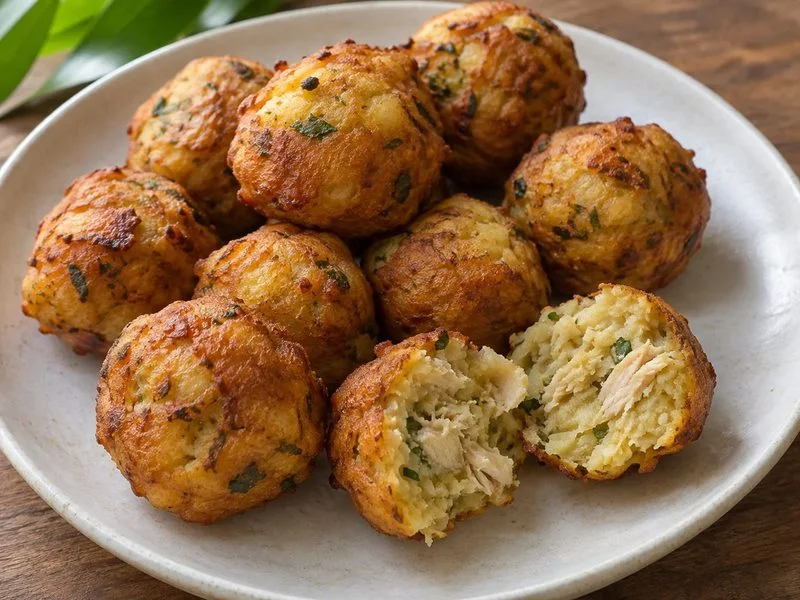
Use the first ball to test the seasoning. Remove once golden, drain and cut in half. The centre should hold together and show small pale flakes and herbs. Leave room in later batches and let the temperature recover between them. Move the balls with a skimmer without pressing on the soft crust. Place them side by side on a rack, away from steam from other dishes if they have to wait.
Serving hot and checking the result
Serve hot with satini or salad, preferably in separate dishes. A spoonful of frisiter satini from the collection adds another texture. Serve the sixteen pieces in groups of four or individually as snacks. The nutrition is per ball and excludes the condiment. Check whether the size fits one or two bites. Larger balls change the cooking time and yield.
Keep track of the trimmed breadfruit weight, draining time and final number of pieces. A well-bound mixture holds when squeezed in the palm. Scales and a test ball give you repeatable checks on a first attempt. If the batch is fragile, change one factor next time, such as draining the breadfruit, before changing the ratio of mash to fish.
Cut a ball open at the table to show the flakes. If they all fall out when cut, flake the fish a little more finely next time.
Nutrition notes
Nutrition and allergens
Breadfruit provides most carbohydrates and trevally supplies protein. The recipe contains wheat and fish. Oil absorption remains to be measured.
Estimated nutrition per serving
Calculation based on 16 servings.
Energy 76 kcal
Protein 3.6 g
Fat 2.5 g
Carbohydrate excluding fibre 9.0 g
Fibre 1.7 g
Calcium 15 mg
Iron 0.4 mg
Potassium 225 mg
Vitamin C 10 mg
Salt Not quantified in the source
Values are per ball, using Ciqual trevally data and assuming 32 g of oil absorbed by the batch.