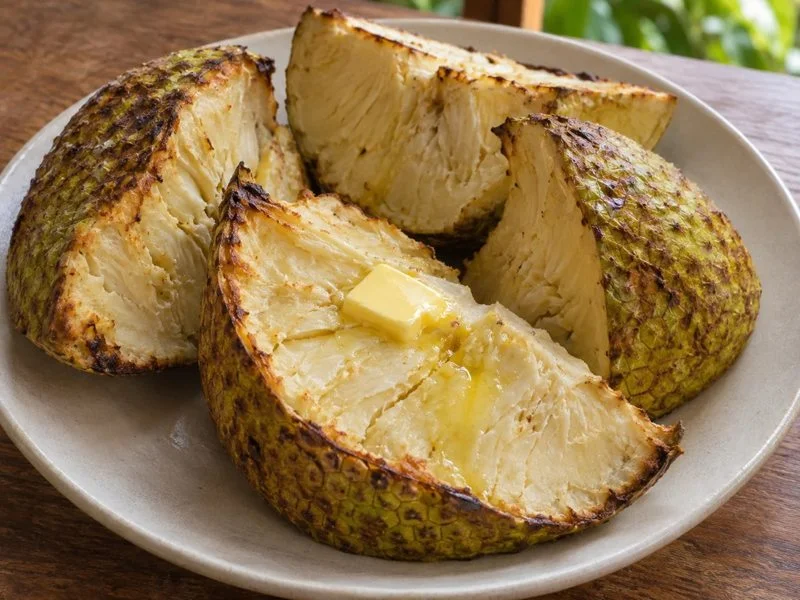
Roasted breadfruit with butter
Roast the breadfruit whole in its skin, then serve it in wedges with a little salted butter. The flesh should be tender and floury. Recipe 33 uses breadfruit for fried slices.
Ingredients
- 1 firm mature breadfruit, 1–1.3 kg
- 25 g unsalted butter
- 2 pinches salt
Preparation
Heat the oven to 200 °C. Scrub the breadfruit and dry it. Trim the stalk without cutting deeply.
Put on a tray and score a cross in the skin. Roast on the middle shelf. From 45 minutes, check around the core with a skewer. Continue in 10-minute intervals if it resists.
Rest about 10 minutes until safe to handle. Quarter on a stable board, discard the fibrous core and cut away the skin with a small knife.
Melt a knob of butter on each warm wedge and add salt at the table. Serve as a starch with a saucy dish. Cover the wedges loosely with an upturned plate if service is briefly delayed.
Introduction
Roast the breadfruit whole in its skin, then serve it in wedges with a little salted butter. The flesh should be tender and floury. Recipe 33 uses breadfruit for fried slices.
Cultural context
Air Seychelles' magazine describes roasted breadfruit served with butter and salt. This recipe adapts the serving method to a home oven.
https://www.airseychelles.com/portals/silhouette/2024/SilhouetteJul-Sep-2024.pdf
Planning
Buying breadfruit for roasting
Choose a mature, firm breadfruit that feels heavy for its size. The skin may be green or brownish. Firmness is a better guide than colour for a fruit that must withstand roasting whole and then being cut into wedges. Soft fruit will be sweeter and harder to lift out in pieces. At the market, explain that you plan to bake it and serve it with butter as a starchy side. If only small fruit are available, check how they fit on the tray and plan to test each one separately at the end.
The specified weight is for the whole fruit. Discard the skin and fibrous core after roasting. The serving weight depends on the fruit's shape, the size of the core and how much flesh comes away with the skin. Weigh the trimmed flesh for four comparable portions. If the yield is low, serve it alongside other sides. Cooking time alone cannot predict how many edible wedges you will get.
Getting the tray ready
Breadfruit may roll on a smooth surface. Wash and dry it, then put it on its most stable side on a shallow-rimmed tray. Remove the stalk without cutting out a large piece of flesh. Make the specified slash through the upper skin only. Grip the knife firmly and work on a stable board before transferring the fruit. The slash may open as the fruit roasts and gives you a place to insert a skewer without piercing the skin elsewhere.
Preheat the oven and set the tray on the middle shelf. Leave space around the whole fruit. If other dishes are in the oven, keep it clear of tall pans. Use the first part of cooking to prepare the rest of the meal. Set out small pieces of butter so you can spread them over the hot fruit. Have an oven glove and a clean cutting board ready before taking it out.
Testing for tenderness near the core
Towards the end of the stated time, insert a skewer close to the core. If you can do so safely, test from above with the tray still on the shelf. The outer skin may be firm and brown while the centre still resists. The firmness of the flesh tells you more than browning alone. The skewer should slide in without a sudden push. Check a second spot if the fruit is wider on one side.
If one side of a large fruit colours faster, carefully rotate the tray halfway through cooking or at the first check. Cook in short increments after that first test. Let the fruit rest on its tray until you can move it with oven gloves. Set it on a non-slip surface with the widest part underneath. Use a chef's knife to halve it lengthways. Let the steam escape and move your hands clear before cutting further.
Preparing and serving the wedges
Cut each half into wedges and trim away the fibrous core, keeping as much flesh as possible. Run a blade close to the skin to lift it off. For serving with a spoon, you can leave the skin on as a holder and tell diners to scoop out the flesh. Remove the core yourself. Butter melts more readily on a freshly cut face than on cooler edges. Add it immediately after cutting, then salt lightly.
A saucy dish makes the most of breadfruit's floury texture. A thick wedge can hold a spoonful of curry, and thinner wedges work well at a table with several sides. Serve smaller portions with jackfruit seed curry because its sauce and seeds already make a substantial dish. For future trials, note the approximate diameter, edible weight and actual cooking time. Those details tell you more than the colour of the roasted skin.
If a wedge breaks as you remove the skin, gather the pieces on a warm plate and melt the butter over them. Serve by the spoonful with a Creole sauce.
Nutrition notes
Nutrition and allergens
Breadfruit provides most of the starch and fibre. Butter supplies fat and is the source of the milk allergen.
Estimated nutrition per serving
Calculation based on 4 servings.
Energy 257 kcal
Protein 2.3 g
Fat 5.5 g
Carbohydrate excluding fibre 45.8 g
Fibre 10.1 g
Calcium 37 mg
Iron 1.1 mg
Potassium 1012 mg
Vitamin C 60 mg
Salt Not quantified in the source
The estimate uses 825 g of flesh from a 1.0–1.3 kg fruit. Weigh after trimming for greater accuracy.