Creole baked red snapper
The whole fish roasts on a bed of tomatoes and onions. Oven cooking and the soft vegetables distinguish this adaptation from the grilled fish in recipes 01, 02, 14 and 23.
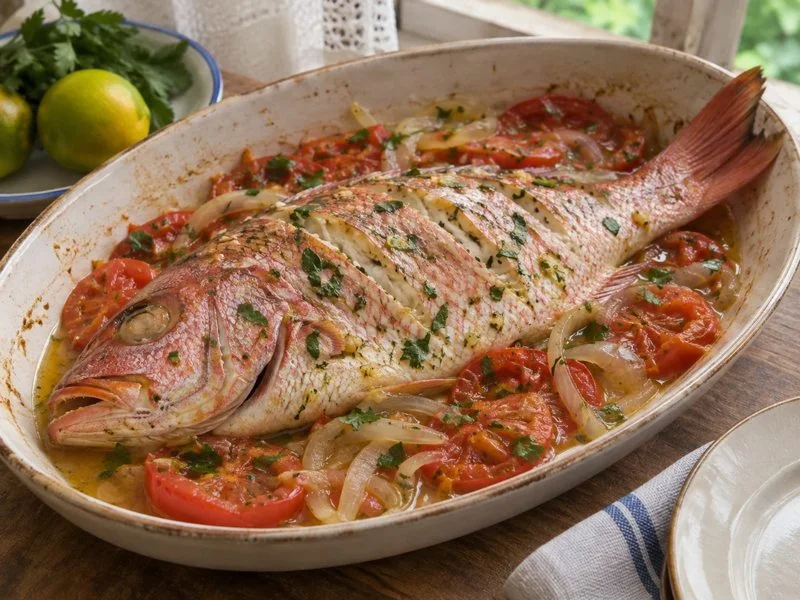
Ingredients
- 1 gutted and scaled red snapper, 1.2 kg
- 400 g ripe tomatoes
- 200 g onions
- 3 garlic cloves
- 15 g ginger
- 1 lemon
- 25 ml neutral oil
- 4 sprigs thyme
- 10 g parsley
- Fresh chilli, salt and pepper
Preparation
Pat the fish dry and make two or three shallow cuts on each side without reaching the backbone.
Crush garlic, ginger, parsley and chilli with half the lemon juice. Rub into the cuts and over the skin. Refrigerate for 45 minutes.
Slice tomatoes and onions. Oil a snug baking dish, spread the vegetables and thyme over the base, then put the fish on top and brush with the remaining oil.
Bake at 190 °C. Start checking after 25 minutes and cook until the thickest part reaches 63 °C, without touching the bone with the probe.
Lift the fillets and check for bones. Serve with the cooked vegetables and remaining lemon.
Introduction
The whole fish roasts on a bed of tomatoes and onions. Oven cooking and the soft vegetables distinguish this adaptation from the grilled fish in recipes 01, 02, 14 and 23.
Cultural context
UN Tourism presents a recipe for whole baked red snapper by Seychellois chef Flavien Joubert.
https://www.untourism.int/africa/african-gastronomy/seychelles
Planning
Choosing a fish for the oven
This recipe starts with a whole red snapper. Ask the fishmonger to gut and scale it, and check that your baking dish leaves a few centimetres of clearance around its head and tail. The specified weight is for the cleaned fish with the backbone in place. For four servings, allow enough rice or breadfruit to accompany the flesh. Two smaller fish will yield different proportions of skin, flesh and bones and usually cook faster. If using two, leave room between them on the same tray and check each one separately.
The thin areas near the tail heat up before the fleshy section behind the head. Position the fish so the side of the dish does not bend the tail back towards the flesh. Pat the outside and cavity dry with kitchen paper to help the aromatics adhere. Cut only the slashes you need for the seasoning. They should open the skin and the surface of the flesh without dividing the pieces you will lift off after cooking.
Distributing the aromatics and vegetables
Crush the ginger finely enough to keep long fibres out of the slashes. If the rhizome is very fibrous, grate it and discard the strands left on the grater. Chop the parsley leaves and, if you wish, keep the tender stalks for the vegetable bed. Leave the sprigs of thyme whole for easy removal after cooking. Start with a small piece of chilli and spread the paste thinly. A pocket of seasoning in one slash will give you one bite that is far hotter than the rest.
Slice the onion more thinly than the tomato. A thin onion ring softens in the time it takes the fish to cook. You can slice very ripe tomatoes a little thicker so some pieces are still visible when the dish leaves the oven. Spread the slices over the whole dish, with a little more underneath the belly. Slices close to the sides brown more readily and develop a more concentrated flavour. If the tomatoes release a lot of water on the board, lift the slices into the dish without pouring in all the liquid.
Watching the dish as it cooks
Preheat the oven so the stated timings apply. A thin tray heats up quickly around the edges. A large, thick dish may take longer for the vegetables and their juices to start bubbling. Watch the juices first. They should simmer gently around the fish and the onions should soften. If the vegetables start to dry along one edge, spoon a little juice from the centre over the exposed slices. Leave the fish in place. The vegetables support its underside and lifting it may tear the skin.
Insert the probe from the side into the thickest part behind the head. If it touches bone, withdraw it slightly and check again. Once the fish is ready, if the juices are too thin, lift it onto a serving platter and return the vegetables to the oven on their own for a few minutes. This lets the juices reduce while the fish stays moist. Set out the platter and utensils for filleting before this final step so you can serve both elements hot.
Lifting and sharing the fillets
First separate the flesh along the backbone with the edge of a spoon or a thin spatula. Lift off the top fillet in pieces if the fish is large. Remove the visible bones, then gently lift the backbone from the tail end. Check the second fillet, especially around the head and belly. Share the thicker pieces and the tail pieces between the plates, then add the tomatoes and onions.
Serve the juices separately if people prefer to adjust the heat or acidity themselves. Squeeze the reserved lemon at the last moment. First taste a bite of fish with a piece of tomato. Firm or less sweet tomatoes may provide enough acidity on their own. Plain boiled rice soaks up the juices. Roasted breadfruit is a starchier accompaniment that you can serve in wedges alongside the vegetables. The fish and vegetables share the same cooking juices, so there is no need to make another sauce.
A first trial helps you work out how many vegetables fit your dish. Record the weight of the whole fish and of the flesh after filleting. Use this yield to adapt the recipe for six people. Keep the fish in a single layer even if you have to divide the vegetables between two dishes.
Nutrition notes
Nutrition and allergens
The gross weight includes the head and bones. The flesh provides protein. The amount of salt depends on the seasoning. The recipe contains fish.
Estimated nutrition per serving
Calculation based on 4 servings.
Energy 235 kcal
Protein 29.5 g
Fat 7.9 g
Carbohydrate excluding fibre 8.8 g
Fibre 2.4 g
Calcium 78 mg
Iron 1.0 mg
Potassium 933 mg
Vitamin C 32 mg
Salt Not quantified in the source
The estimate uses 540 g of edible flesh from a 1.2 kg whole fish before cooking.