Fufu
A hot dough made from cassava and corn flour, worked with a spatula to accompany sauces. Water proportions and cooking time primarily follow the packaging of the chosen mixture.
Rating · 5/5 (1 ratings)
Ingredients
- 600 g commercial food-grade fufu mix, based on processed cassava flour and corn flour; check cooking method and proportions on the package
- 1.5 liters potable water to start, or the quantity indicated by the manufacturer; separately provide 300 ml hot water for adjustments
- 2 g salt, optional; reduce or omit if the sauce is already salted
- For serving, separately: a vegetable sauce, fish, or cooked meat, depending on the planned meal
Preparation
Read the label completely before starting. Weigh 600 g of the mixture and measure the water. Prepare a thick 4 to 5-liter saucepan, a sturdy spatula, a whisk for the beginning, and a lid. If the packaging requires a cold start, follow that method rather than the hot start described here.
Prepare the sauce before the fufu and keep it warm. Bring 1.5 liters of water to a simmer in the saucepan, then add salt if desired. Also heat the reserve water in a small saucepan or kettle. Already hot water will allow you to correct the texture without abruptly cooling the dough.
Reduce to medium heat. Gradually pour in the flour in a fine stream while whisking, in small additions. Do not leave a layer of flour on the surface: incorporate it before continuing. When the whisk becomes difficult to handle, switch to the spatula without forcing a fragile utensil.
Work the mass by folding it from the edge towards the center and pressing it against the side. Turn the saucepan if necessary to reach the entire bottom. Adjust the heat so that the dough cooks without forming a burnt crust. Hold the handle firmly with a dry protection; thick splatters can burn.
Continue for the entire cooking time prescribed for your product; allow about 20 to 30 minutes for meal organization, to be adapted to the label. Mix regularly, scraping the corners. A dough that detaches from the side indicates its consistency, but does not replace the indicated cooking time.
If the mass cracks, resists excessively, or retains dry areas, add one or two spoonfuls of hot water at a time. Fold and crush until incorporated before adding more water. If it is too soft, first continue cooking while stirring; thickening continues with hydration.
Avoid correcting an almost finished dough with a large handful of dry flour. If an addition of mix is still necessary, incorporate it little by little and then ensure the required cooking time for this newly added flour. Do not serve a powdery center just because the outside appears smooth.
When the required cooking is complete and the dough is homogeneous, cover and let rest for 3 to 5 minutes off the heat. It should keep its shape without becoming hard or rubbery. For a first attempt with an unknown brand, note the volume of water actually used to reproduce the texture at the next meal.
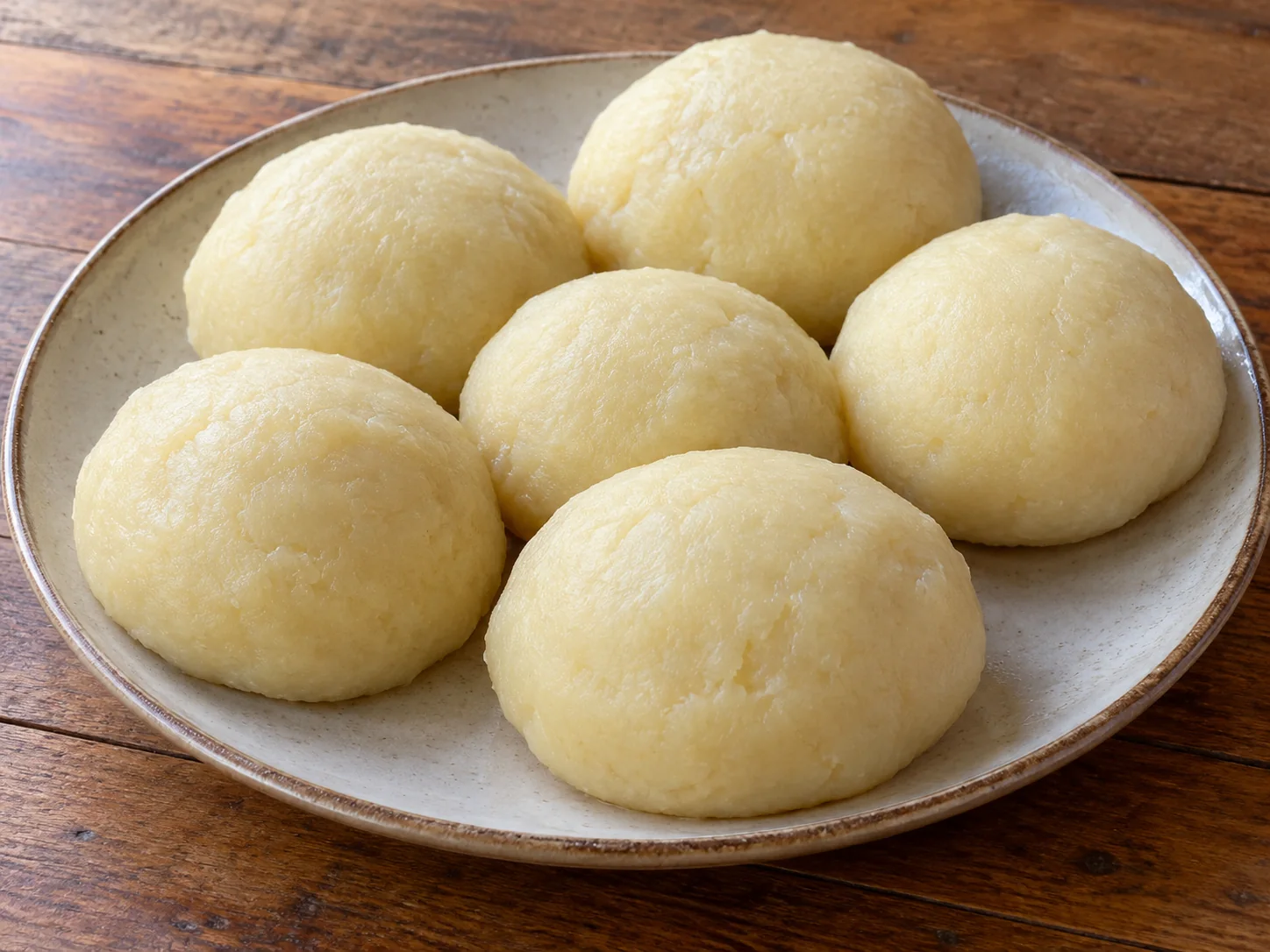
Lightly wet a heat-resistant bowl or ladle, scoop out the dough with a utensil, and shape six portions. Avoid kneading the hot dough with bare hands. Place the portions in a covered dish and serve quickly with the sauce, allowing each person to adjust the quantity to their appetite.
Quickly divide leftovers into small containers and refrigerate within two hours, without letting a large ball cool overnight. Keep at 4 °C or less and preferably consume within 48 hours. Reheat only the necessary portion, with a little water or by steaming, until it is thoroughly hot; discard any leftovers if their preservation is uncertain.
Introduction
Fufu is a starchy side dish that takes its place alongside sauces, pondu, fish, and stewed meats. This recipe provides a home preparation using a commercial cassava and corn flour mixture intended for fufu. The desired result is a homogeneous dough, flexible but able to hold its shape in a ball, without dry flour lumps. Its subtle taste allows the vegetables and sauce served with it to shine.
There is no universal flour-to-water ratio: the fineness of grinding, the proportion of corn, and any pre-cooking of the product alter absorption. The quantities below provide a starting point for six side dish portions. If the manufacturer indicates a different volume or method, their instructions take precedence. An instant mix is not worked in the same way as a flour requiring prolonged cooking.
Use exclusively food-grade flour processed and packaged by a reliable supplier, explicitly intended for this preparation. This recipe does not describe the making of flour from fresh roots, nor a domestic cassava detoxification process. The presence of cassava in a sachet does not mean that all flours or starches can be substituted. Tapioca starch, for example, can result in a very sticky mass and does not automatically replace fufu mix.
Cultural context
In DR Congo, the name fufu encompasses family habits and flour choices that cannot be summarized by a single national formula. Cassava, corn, and their mixtures yield different colors, firmnesses, and flavors. This version therefore does not claim to replace the practices of a particular household. It makes explicit the useful benchmarks for a person who has packaged flour and a domestic saucepan.
FAO documentation distinguishes foufou, prepared by working flour in hot water, from chikwangue, which results from a wet transformation then packaged and cooked. The technical study cited focuses on the neighboring Republic of Congo: it clarifies this distinction without constituting, by itself, an investigation into all practices in the DRC. These two side dishes are not interchangeable in their preparation, even if they can accompany the same sauces.
Serving can be done in individual portions or in a communal dish depending on table customs. If eating with fingers, one waits for a comfortable temperature and washes hands before the meal. A spoon is just as suitable. It is not necessary to present a single consumption gesture as a universal cultural obligation.
Tips
Weigh the mixture: a packed cup of flour can significantly change the proportion.
Keep the packaging handy to respect the product's specific cooking time.
Add hot correction water in small quantities, then work before re-evaluating.
A smooth appearance does not prove that flour added at the end of cooking is sufficiently cooked.
A heavy pot and a sturdy spatula facilitate working with a thick dough.
Serve covered quickly: prolonged waiting uncovered dries out the surface.
Planning
Read the label completely before starting. Weigh 600 g of the mixture and measure the water. Prepare a thick 4 to 5-liter saucepan, a sturdy spatula, a whisk for the beginning, and a lid. If the packaging requires a cold start, follow that method rather than the hot start described here.
Serving
Lightly wet a heat-resistant bowl or ladle, scoop out the dough with a utensil, and shape six portions. Avoid kneading the hot dough with bare hands. Place the portions in a covered dish and serve quickly with the sauce, allowing each person to adjust the quantity to their appetite.
Storage
Quickly divide leftovers into small containers and refrigerate within two hours, without letting a large ball cool overnight. Keep at 4 °C or less and preferably consume within 48 hours. Reheat only the necessary portion, with a little water or by steaming, until it is thoroughly hot; discard any leftovers if their preservation is uncertain.
Variations
For a fufu made solely from cassava or solely from corn, choose a food-grade flour intended for this use and follow the proportions and time indicated on its packaging. Do not automatically replace 600 g with an equal volume: products absorb differently. A slightly softer texture is obtained with small additions of hot water; a firm version primarily requires controlled hydration, not a massive late addition of flour.
Accompaniments
Serve with pondu, stewed beans, fish liboke, or chicken moambé. Provide enough sauce to moisten each bite, without drowning the ball in advance. Vegetables and a protein source usefully complement this side dish. Sauces and garnishes are not included in the quantities or nutritional estimate of this recipe.
Nutrition notes
Fufu primarily provides carbohydrates, thus energy. Its protein, fiber, and micronutrient content depends on the actual mixture used and its potential enrichment. It is neither a guaranteed source of vitamins nor a complete meal on its own. Pair it with vegetables and fish, beans, or meat according to your preferences. A portion of this recipe contains approximately 100 g of dry flour before hydration; adjust it to your needs. The energy estimate is around 350 kcal per portion excluding sauce, to be verified on the package. No therapeutic benefits are attributed to this preparation.
Conclusion
The decisive benchmark remains a suitable food-grade flour, correctly hydrated and cooked according to its instructions. Serve the homogeneous dough still hot with an already prepared sauce, adjusting the portion to the rest of the meal. Note your proportions to reproduce the result with the same mixture.
Enjoy your meal
Bon appétit! — Bolei elamu! 🇨🇩