Alfintà
🥣 Thin millet griddle cakes cooked in a lightly oiled pan, not puffed or deep-fried fritters: a yeast-free home adaptation.
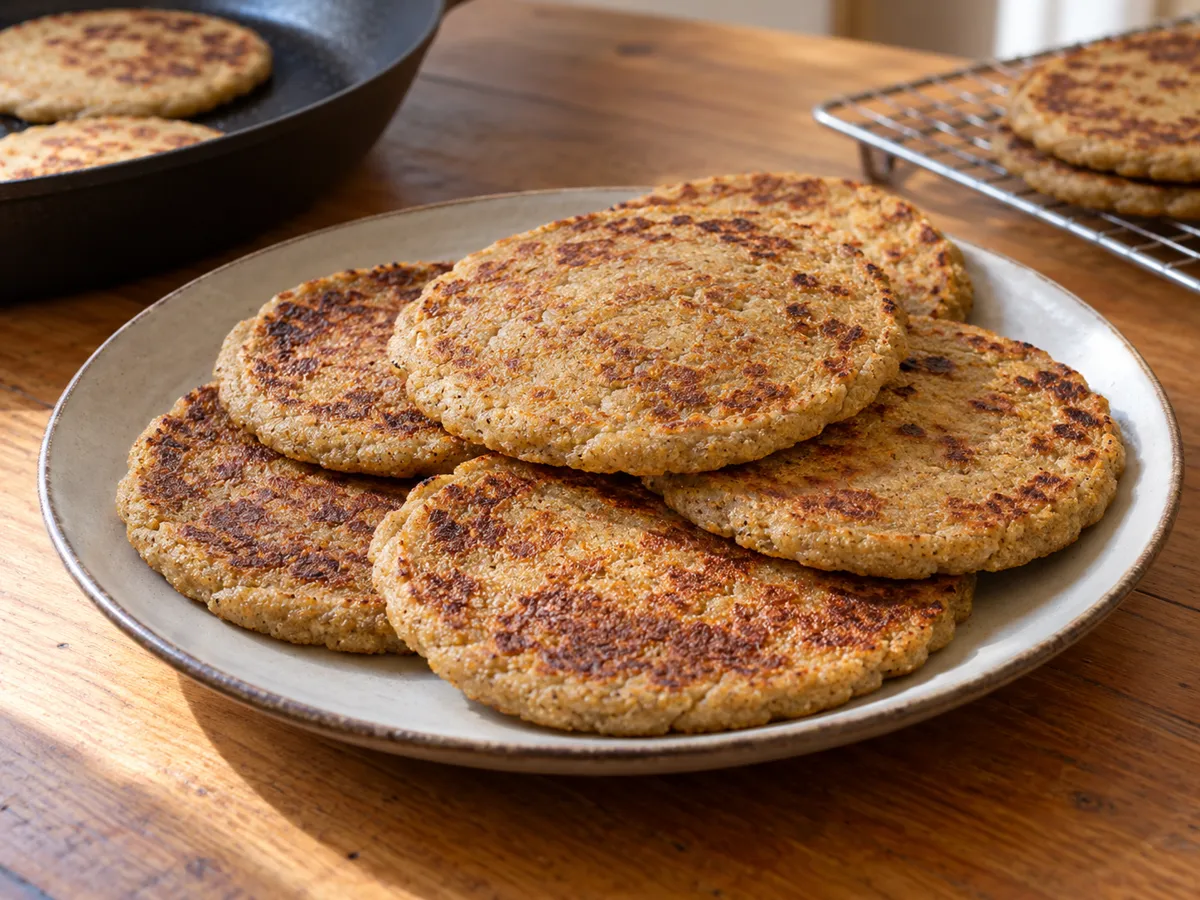
Ingredients
- 🥣 300 g fine millet flour, divided into 120 g for scalding and 180 g for the final mixture
- 🥣 180 ml freshly boiled water for scalding
- 🥣 150 ml room-temperature water for the final mixture
- 🥣 20 g neutral vegetable oil for all the cooking
- 🥣 3 g fine salt
- 🥣 30 ml room-temperature water at most, only to correct a mixture that is too firm
Preparation
🧑🍳 Weigh the ingredients, sift the flour and keep its portions separate. Prepare a heatproof bowl, a sturdy spoon, a wide spatula and a 28 cm nonstick pan. Set the oil aside in a small bowl to control its use across all batches. Do not taste raw flour or uncooked mixture.
🧑🍳 Pour the 180 ml boiling water over the 120 g flour, stirring immediately with the spoon. Crush lumps against the bowl until the mixture is thick and uniform. Do not use your hands: the mixture can burn. This partial scalding hydrates and gelatinizes some of the starch, helping the cakes hold together without gluten or yeast.
🧑🍳 Gradually incorporate the 150 ml room-temperature water and the 3 g salt, then add the remaining 180 g flour. Mix into a thick, spoonable mixture that spreads under light pressure. Cover and rest for 20 min: this hydrates the flour particles but is neither fermentation nor proofing.
🧑🍳 After resting, stir and check the consistency. If the mixture cracks when flattened, gradually add corrective water without exceeding 30 ml. If it flows like crêpe batter, wait a little longer before shaping; coarse flour may need more hydration. Do not automatically add water, as an overly fluid mixture produces fragile cakes.
🧑🍳 Heat the pan over medium heat for 2 min, then brush on a thin film of oil. Mentally divide the mixture into 12 portions. Add 3 well-spaced portions and flatten them with the back of a slightly damp spoon into disks approximately 10 cm across and 5 mm thick. Do not pour oil around them to make them float.
🧑🍳 Cook the first side for about 3 min without moving the cakes. Wait until the edges firm up and golden patches appear underneath. Slide the spatula beneath the entire surface, then turn gently. If a cake tears, allow the next ones to set slightly longer before turning; if it darkens quickly, reduce the heat.
🧑🍳 Cook the other side for about 4 min, adjusting the heat to prevent excessive browning. Open a cake from this first batch: its center should be set, with no wet, sticky mixture or raw flour taste. If the middle remains raw despite dark surfaces, lower the heat and shape thinner cakes next. Continue cooking any undercooked pieces.
🧑🍳 Repeat for 4 batches in total, using the 20 g oil across the entire cooking process. The 30 min allowance includes preheating and the planned batch cooking; corrections may take longer. Place cooked cakes on a rack rather than immediately sealing them in a container, and serve while pleasantly warm.
Introduction
🌾 Alfintà is presented here as an accompaniment of millet griddle cakes, flat, tender in the center and lightly golden outside. This recipe offers a measured home adaptation for a family kitchen equipped with a frying pan. It does not claim to establish a single historical recipe or reproduce every Malian practice associated with this name. The intended result is a cake that can be held or cut, with a clear cereal flavor and a denser texture than a wheat crêpe.
The distinction from millet fritters is essential: these disks are not balls of risen dough and never enter a deep-frying bath. No raising agent is used to puff them up. Their appeal instead comes from the contrast between a toasted surface and a tender center, achieved with a sufficiently cohesive mixture. The proportions make 12 small cakes for 4 people, an accompaniment portion rather than a complete meal.
Cultural context
🌍 Millet has an important place in Sahelian diets, including those of Mali, and can be prepared in many different forms. This diversity encourages us not to confuse every preparation made from the same cereal. Porridge, thick cereal paste, griddle cakes and fritters involve distinct cooking techniques, even when their ingredients resemble one another.
The spelling Alfintà and the precise attribution of this preparation should remain open to verification through Malian culinary sources or people familiar with this usage. Without an independent source here, no particular community, dated antiquity, ceremony or religious obligation is attributed to these cakes. The scalding, proportions and cooking method detailed below are practical choices for this adaptation; they do not prove a universally traditional method.
Tips
💡 Choose a pan with an intact coating: a damaged surface increases sticking and unnecessarily encourages extra oil.
💡 Slightly dampen the spoon rather than the entire mixture to smooth each disk. Even thickness matters more than a perfectly drawn circle.
💡 Allow the rest before judging consistency. A mixture that seems sandy just after mixing may become more cohesive as the millet absorbs water.
💡 Do not aim for a puffed texture: adding yeast or switching to deep-frying would change the nature of this accompaniment.
💡 If a gluten-free diet is necessary, check flour certification and utensil contamination risks; naturally gluten-free millet alone does not guarantee the whole preparation.
Planning
🧑🍳 Organizing the work surface before heating the water avoids interrupting scalding when lumps are forming. Use fine flour intended for human consumption, without a rancid smell, and a stable bowl. Different milling may change water absorption; observing the mixture is more reliable than mechanically adding liquid to reproduce an identical consistency.
The 30 min preparation includes weighing, mixing and the 20 min rest. Keep cooking utensils within reach during this rest. The pan must allow each disk to be turned without touching the others; a smaller pan requires more batches and therefore extra time. A wide spatula supports the entire cake, while a damp spoon helps even its thickness without adding much water.
Serving
🍽️ Present the cakes on a shallow platter, slightly overlapping to show their golden surfaces without making a compact stack. A small basket lined with a clean cloth also works, provided they are not enclosed beneath an airtight lid: trapped steam would soften the exterior.
Allow 3 cakes per person and bring sauces in separate bowls. For individual plates, arrange the disks in a fan and leave space for accompaniments. Cutting into quarters makes sharing easier, but whole cakes retain warmth better. The serving platter must be clean and separate from the bowl that held the uncooked mixture.
Storage
❄️ These cakes are best on the day they are made. To keep leftovers, let them release heat on a rack, then place them in a clean container in a refrigerator at 4 °C or below, no later than 2 h after cooking. Do not wait until completely cold if this exceeds that limit. Eat within 48 h.
For longer storage, freeze cooled cakes with layers separated and use within 2 months to preserve quality. Thaw in the refrigerator. Reheat in a pan until the center reaches 74 °C; add a little water and cover briefly if they dry out, then uncover to firm the surface. Avoid repeated reheating. Discard cakes with mold, an unusual smell or excessive time at room temperature.
Variations
🌿 More aromatic version: incorporate a small pinch of ground ginger after resting without immediately changing the water quantity. This is a home-cooking suggestion, not a documented regional variation.
🌿 Herb version: add a little finely chopped, well-dried parsley. Waterlogged herbs make the mixture less consistent; keep their quantity modest to maintain cohesion.
🌿 Lower-salt version: reduce salt according to the meal's needs and favor a fragrant rather than salty sauce. Nutritional values must then be recalculated; the millet and binding method remain unchanged.
Accompaniments
🍽️ A tomato and onion sauce with little oil adds moisture and an acidic note. Serving it separately preserves the cakes' surface until they are eaten.
🍽️ Stewed vegetables and cooked niébé can complement the accompaniment with fiber and plant protein. Adjust portions to appetite and do not regard the cakes alone as a nutritionally complete meal.
🍽️ Grilled fish or peanut sauce work according to the table's preferences. Identify the peanut allergen when offering that sauce; toppings are not included in this recipe's estimates.
🥤 Offer water or a mild, unsweetened ginger infusion, served separately from the flatbreads to avoid wetting their surface. These drinks are not included in the nutritional estimates.
Nutrition notes
💪 Millet mainly supplies carbohydrates, along with plant protein and fiber in amounts that depend on milling. Less refined flour may retain more fiber without automatically making the recipe appropriate for every medical situation. These cakes are neither a treatment nor a guarantee of individual fullness. For a varied meal, combine them with vegetables and an appropriate protein source.
The estimate per serving is based on the entire batch: 300 g millet flour, 20 g oil and 3 g salt, divided by 4 servings. All planned oil is counted, even if a little remains in the pan. Water provides no energy. Sauces, drinks and toppings are excluded. The figures are rounded, indicative, and vary with flour brand or modifications; the named vitamins and minerals are not quantified intakes.
Conclusion
✨ A partially scalded mixture, adequate resting and moderate cooking produce millet griddle cakes suitable as an everyday accompaniment. Adjust texture and thickness before adding more ingredients. This remains a cautious home adaptation, to be enriched by accounts and reliable sources about Alfintà. Enjoy your meal — Aw ni dumuni! This local phrase remains a suggestion, not confirmed.
Enjoy your meal
🥰 Enjoy your meal! Aw ni dumuni — suggested phrase, not independently confirmed here; its spelling and usage need verification.