Tô dafin
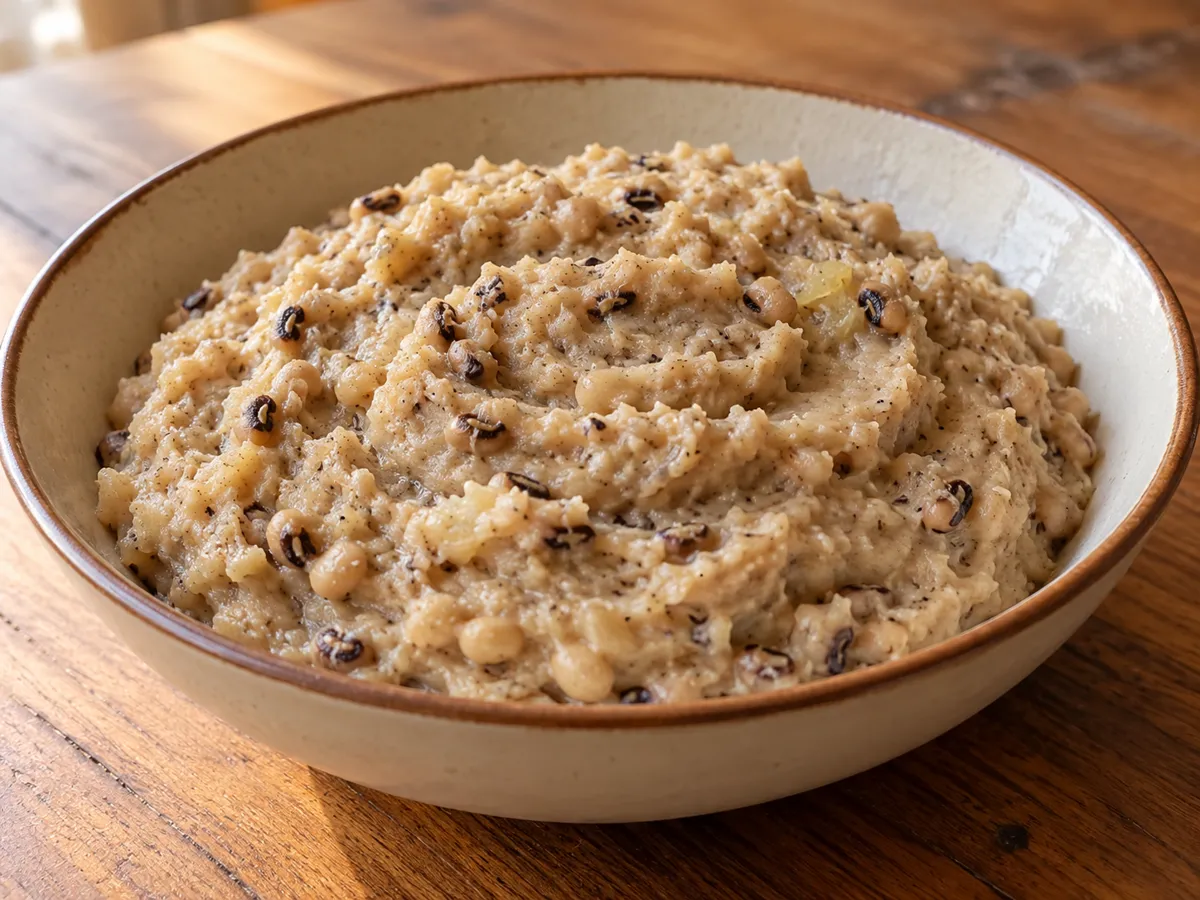
🥣 A creamy cowpea purée with softened onions, distinct from cereal tô.
Ingredients
- 🥣 400 g whole dried cowpeas
- 🥣 150 g onion
- 🥣 6 g garlic
- 🥣 30 ml sunflower oil
- 🥣 4 g salt
- 🥣 2 L drinking water for soaking, to discard
- 🥣 1.5 L drinking water for cooking
- 🥣 250 ml additional drinking water, to heat only if needed
Preparation
🧑🍳 Sort the dried cowpeas on a light-colored plate. Remove small stones and damaged beans, then rinse in a colander. Put the beans in a large container with the 2 L soaking water. Cover and refrigerate at no more than 4 °C for 8 h. Allow enough room for them to swell.
🧑🍳 Discard all the soaking water, rinse the beans and drain. Peel the onion and garlic, then chop them separately. Put the cowpeas in a heavy-bottomed saucepan with the 1.5 L cooking water. Prepare a second small saucepan for the aromatics and keep the additional water available.
🧑🍳 Bring to a full boil and maintain it for 10 min, watching for boilovers and removing foam if it gets in the way. Then reduce the heat and simmer for about 40 min with the lid ajar. The beans must remain submerged; add heated additional water if the level drops too far.
🧑🍳 During the final 10 min of this simmering period, heat the oil in the small saucepan. Soften the onion for 8 min over medium-low heat, stirring; add the garlic for the remaining 2 min. Look for soft, translucent onion without dark browning. Remove from the heat if the aromatics are ready before the cowpeas.
🧑🍳 Check several beans after these 50 min of cowpea cooking: they should crush easily under a fork, without a firm or dry, floury center. If necessary, continue simmering before proceeding; the stated 60 min are indicative. Drain over a heat-resistant container to save the cooking liquid.
🧑🍳 Return the beans to the saucepan and crush them with a potato masher. Incorporate the onion, garlic, their oil and the 4 g salt. Add the reserved liquid in small amounts, just enough to make the purée supple. Work carefully on any whole beans remaining rather than trying to disguise their hardness with more water.
🧑🍳 Finish over low heat for 10 min, stirring regularly with a broad spatula, especially along the bottom. The purée should hold on the spoon while spreading without breaking apart; it will thicken slightly on the plate. If it sticks, immediately lower the heat and add a little reserved liquid. Serve as soon as the texture is right.
Introduction
🌾 The Tô dafin presented here is a purée of niébé, the bean also called cowpea, not a paste made by cooking millet, sorghum or maize flour. This distinction changes the expected result: the aim is the mildness of a thoroughly softened legume, a creamy yet substantial consistency, and a gently vegetal flavor. Small pieces of skin remain noticeable in this whole-bean adaptation; they are not a fault that must be eliminated completely. Softened onion adds a sweet note, garlic stays in the background, and oil gives a more supple mouthfeel. The recipe makes a simple main course for 4 people, without an incorporated garnish. Its color depends on the cowpeas purchased: a pale variety produces a beige purée, while more pigmented beans may darken it. Appearance should therefore not be compared only with a photograph to judge success. The decisive criterion is a purée that is pleasant to eat, with no hard beans, and sufficiently cohesive to receive the accompaniments chosen separately.
Cultural context
🌍 This entry associates Tô dafin with Mali and uses this name for the requested cowpea preparation, without making it a definition valid for every Malian cuisine. Elsewhere, the word tô may suggest cereal preparations; this similarity in vocabulary is not enough to identify their ingredients. Names, textures and seasonings can vary with languages, families and places. No specific historical source is provided here to date the emergence of this dish, attribute its invention to a particular group or associate it with a ceremony. Refrigerated soaking, weighed quantities and the two saucepans described are a reproducible home-cooking choice, not a reconstruction of an ancient protocol. If someone familiar with this preparation shares another method, clarifying its context will be more useful than declaring a single official version. This caution distinguishes respect for a culinary name from the adaptations needed to cook at home with available equipment.
Tips
💡 Test several beans, not just the first one that split: uneven cooking can leave resistant centers in an apparently smooth purée.
💡 Use a spatula that follows the bottom of the saucepan. Stirring only the surface does not protect the lower layer, especially as the purée becomes dense.
💡 To correct a texture that is too dry, incorporate liquid in small additions and wait for it to be absorbed before repeating. This avoids excessive adjustment that is difficult to undo.
Planning
🧑🍳 Organize the work around the advance soaking: start the previous day or early enough to allow a full 8 h before active preparation. The 25 min of preparation include sorting, rinsing, chopping and handling; the 60 min of cooking include boiling, simmering and finishing, with the aromatics prepared in parallel. Older cowpeas may exceed this schedule. Choose a saucepan wide enough to stir without splashing purée, but not oversized, to limit evaporation. A potato masher gives more control than an immersion blender and preserves a slightly rustic texture. With a blender, work briefly in the saucepan off the heat, keeping the head submerged to prevent splashes. Keep the cooking liquid within reach: the amount actually absorbed depends on the beans and the diameter of the vessel. Do not automatically pour in the whole reserve, as the purée would quickly change from a supple consistency to a soup that is difficult to thicken without sticking.
Serving
🍽️ Divide the purée between shallow bowls or a shallow serving dish. Gently smooth the surface with the back of a spoon, leaving a few ripples that make its texture visible. For individual portions, place a broad spoonful in the center rather than a very tall mound: accompaniments can remain separate and everyone can assemble their own mouthfuls. Present vegetables and condiments in separate small containers so that the mild color of the cowpeas is not hidden before serving. Leaving the plate rim clear makes it easier to scoop the purée. For communal presentation, provide a dedicated serving spoon and plates for dividing the portions. Avoid elaborate decoration that could suggest ingredients absent from the recipe are part of the preparation.
Storage
❄️ Do not leave the thick saucepan to cool overnight on the worktop. Quickly divide leftovers among clean, shallow containers, then refrigerate within 2 h of cooking, without waiting for complete cooling at room temperature. Keep the refrigerator at no more than 4 °C and eat within 3 days. For freezing, use sealed, dated portions; aim for 2 months to preserve quality. Thaw in the refrigerator, never on the counter. Reheat only the amount needed with a little water, stirring to eliminate cold spots, until the center reaches 74 °C. Cold purée appears firmer: this change alone does not mean it has spoiled. However, an unusual smell, mold or storage outside the stated limits requires discarding it; the absence of an odor does not guarantee safety.
Variations
🌿 For a smoother finish, pass the fully cooked beans through a food mill before returning the aromatics. The skins retained alter the yield and estimated fiber.
🌿 For a garlic-free version, omit that ingredient and keep the onion. This personal adaptation slightly changes the aroma without turning the purée into a cereal preparation.
🌿 For a firmer purée, limit the liquid added after mashing rather than greatly extending cooking. This texture choice is not presented as a documented regional variation.
Accompaniments
🍽️ Separately cooked vegetables, such as carrots and cabbage, provide contrasting shapes and keep the purée clearly identifiable on the plate.
🍽️ A tomato and cucumber salad, dressed separately, offers a fresh contrast to the soft texture; its ingredients are not included in this recipe.
🍽️ A spicy condiment served in a small bowl lets everyone control its heat. Plain water simply accompanies this meal without adding sugar.
Nutrition notes
💪 Cowpeas provide plant protein and fiber; their inclusion can contribute to a satisfying meal without promising any specific medical effect. Their plant-derived iron is not absorbed in the same way as iron from animal sources, and this recipe is not a treatment for a deficiency. The figures are an estimate per serving based on the entire batch: 400 g whole dried cowpeas, 150 g onion, 6 g garlic, 30 ml sunflower oil and 4 g salt, divided into 4 equal servings. Water provides no energy. Accompaniments, condiments and variations are excluded. Losses from soaking, draining and cooking are not precisely measured; the rounded figures therefore remain indicative, particularly for fiber and micronutrients. Adding liquid changes the weight of a serving, but not the initial amount of oil distributed among diners. Sodium depends mainly on added salt; a salty condiment would increase the meal's total.
Conclusion
✨ The success of this adaptation depends on genuinely tender cowpeas and a controlled finish, rather than a fixed quantity of liquid to be reached at all costs. Keeping the purée simple allows its substance to be appreciated and accompaniments to be chosen without blurring its identity. Enjoy your meal, and Aw ni dumuni, with the linguistic reservation explained below.
Enjoy your meal
🥰 Enjoy your meal! Aw ni dumuni: proposed expression, unconfirmed. Without a verified linguistic source, its spelling, exact meaning and use as a wish before a meal remain to be confirmed.