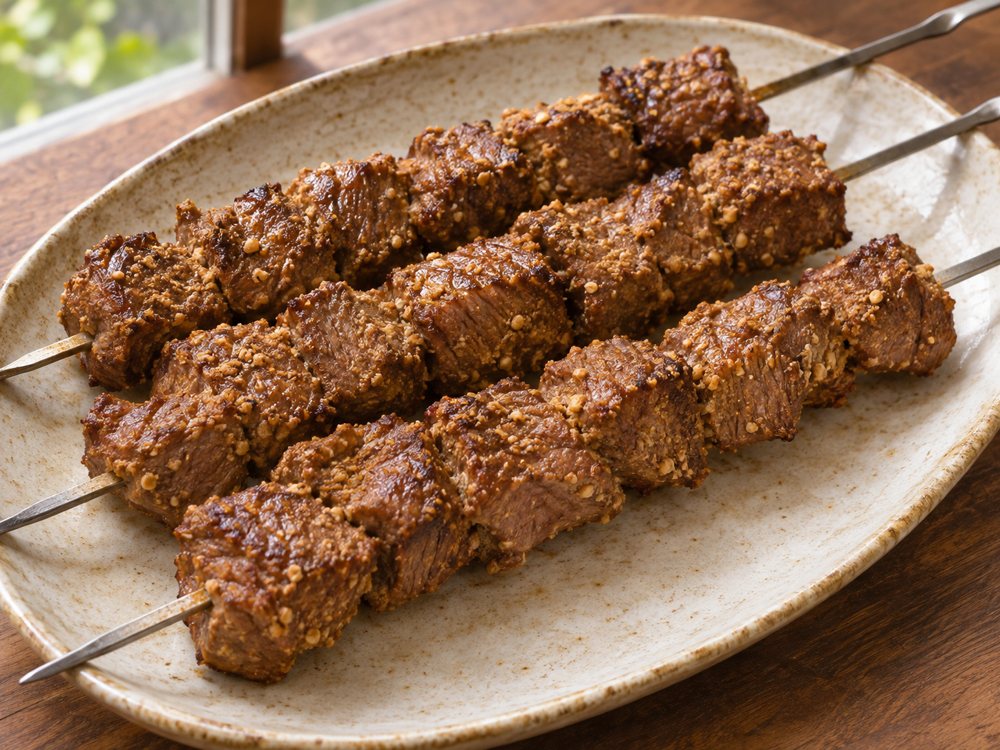
Agashe with peanuts
🍢 Agashe, or Agashi, refers to spicy grilled meats similar to Sahelian skewers, where meat is seasoned then roasted over fire until tender and fragrant.
Ingredients
- 1 kg tender beef in regular cubes
- 🧅 2 onions, 3 cloves garlic, and 1 piece fresh ginger
- 🌶️ 1 to 2 chilies, paprika, pepper, cumin, and ground coriander
- 80 g finely ground roasted peanuts, required in this variant
- 🫗 4 tablespoons oil and the juice of one lemon
- 🧂 Moderate salt and optionally a pinch of nutmeg or cloves
- 🍅 To serve: onion, tomato, cucumber, lemon, flatbread, rice, or millet ball
Preparation
1️⃣ Cut the meat into regular pieces and keep it chilled. Blend or pound onion, garlic, ginger, chili, oil, lemon, and spices to form a marinade.
2️⃣ Coat the meat with this marinade, cover, and let rest in the refrigerator for at least 1 hour, ideally longer.
3️⃣ If using wooden skewers, soak them. Thread the meat without packing too tightly or prepare the pieces for a grill.
4️⃣ Cook over embers, a grill, or a hot plancha for 6 to 9 minutes per side depending on thickness, turning only when the surface easily detaches. Measure at least 63 °C inside the largest cubes, then rest 3 min off heat.
Distribute 80 g ground roasted peanuts over meat at the end of cooking or immediately after leaving heat. Avoid burning the coating and declare peanuts.
6️⃣ Let rest for a few minutes then serve with raw vegetables, lemon, flatbread, rice or millet ball, and separate chili. 🇹🇩
Introduction
🍢 Fire, spices, and patience. Agashe, sometimes spelled Agashi, evokes spicy grilled meats that can be likened to the great Sahelian traditions of roasted meat, fragrant skewers, and fire cooking. In Chad, as elsewhere in the Lake Chad Basin and Sahel region, grilled meat is as much a quick meal as it is a symbol of conviviality. It can be sold on the street, prepared in a family courtyard, served at a gathering, or presented as an accompaniment to a larger meal. What matters is not just the cut of meat, but how it is treated: seasoned just right, cooked for the proper time, and allowing the fire to concentrate the flavors without drying out the meat. 🔥
📜 Sahelian kinship, Chadian expression. Spicy skewers circulate under various names in the Sahel, because grilling, drying, meat trading, and seasoning practices have long spread among herders, markets, caravanners, cities, and encampments. Chad, located at the crossroads of several cultural worlds, naturally shares this logic. Agashe/Agashi can thus refer, depending on the household, to marinated then grilled meat, a skewer coated with spices and sometimes ground peanuts, or a style of quick grilling served with onion and chili. It would be wrong to impose too narrow a definition; it is more honest to speak of a family of preparations where meat and fire converse with market spices. 🌍
🐄 Livestock, markets, and meat selection. Chad has a long pastoral culture and a strong connection to herds, whether beef, mutton, or goat. This does not mean that every household eats meat abundantly every day; on the contrary, meat can be a measured pleasure, reserved for certain occasions, shared with care, or bought in small quantities. This is precisely why grilled meats are so appreciated: they concentrate flavor. A good piece, well cut, well spiced, can be more satisfying than a diluted preparation. The choice of meat will depend on the budget and the occasion. Beef offers a firm chew; mutton brings more fat and depth; goat gives a livelier flavor that loves aromatic marinades. 🥩
🕌✝️ Social and cultural contexts. Agashe can appear in very diverse situations: evening meals, entertaining friends, markets, festivals, breaking fasts, family tables, or impromptu barbecues. In a country where Muslim, Christian, and other traditional families coexist, grilled meat adapts to dietary rules, the animal's origin, and local customs. Some prefer halal meat bought from a trusted butcher; others attach more importance to freshness, marinating time, and cooking. It is not necessary to sacralize the dish to recognize its cultural value. One only needs to see how much it accompanies moments when one wants to please, share, and nourish generously. 🤝
👨🏾🍳 Building flavor. The marinade serves less to mask the meat than to prepare it for the fire. Onion, garlic, ginger, lemon, chili, and spices form a classic base because they bring moisture, warmth, freshness, and depth. Oil helps distribute flavors and slightly protects the surface, but it should not turn the meat into an oily preparation. When ground peanuts are used, they add a roasted note and a slightly sandy texture reminiscent of some neighboring Sahelian grilled dishes. However, they must be used sparingly: too many peanuts burn quickly on the embers. A good marinade penetrates, perfumes, and slightly dries on the surface during resting, to promote a beautiful browning. 🌶️
Cooking requires attention and restraint. Overly aggressive embers blacken the spices before the inside is ready; too low heat causes juices to escape and hardens the meat. The ideal is a lively but controlled heat, with a clean and lightly oiled grill. Pieces are spaced slightly on the skewer for air circulation. Avoid piercing them unnecessarily and only turn when the first side detaches itself. After cooking, a few minutes of resting are enough to redistribute the juices. Many failed grilled dishes don't lack spices; they lack patience. ⏳
🗺️ Regional and contemporary variations. Some versions lean towards dry, well-seared beef; others prefer more tender and fragrant mutton. In urban contexts, skewers are often served with plenty of onion, tomato, and cucumber. In more rural settings, a flatbread, a millet ball, or a simple fresh chili may suffice. Spice blends vary: more cumin here, more paprika there, a little clove elsewhere, sometimes a peanut or sesame powder added at the last moment. In the diaspora, ovens and planchas sometimes replace embers, but the goal remains the same: fragrant surface, perfectly cooked core, and as much smoky flavor as possible. 🌍
🍽️ Serving, accompaniments, and drinks. Agashe is often eaten with fingers, on skewers or in strips, accompanied by onion rings, fresh tomato, lemon, a separate chili sauce, and a simple starch. A thin flatbread, white rice, a millet ball, a little cassava, or even a crisp salad can complete the plate. The contrast between hot meat and fresh raw vegetables is essential. For drinks, fresh water, light mint tea, a lightly sweetened ginger or tamarind juice work very well. The idea is not to overpower the spices with too heavy a drink, but to offer a refreshing break between bites. 🥤
💪 Nutritional contribution and balance. Like many grilled dishes, agashe primarily provides quality protein, iron, zinc, and B vitamins. The amount of fat varies depending on the meat chosen and the presence of peanuts or oil in the marinade. The raw vegetables served add vitamin C and freshness, which pleasantly balances the plate. To keep the preparation healthy, avoid charring the meat and limit fatty flare-ups. Controlled cooking, a stable fire, and good quality meat yield a much more satisfying result than a burnt crust. The value of the dish therefore lies as much in the mastery of fire as in the richness of the ingredients. 🌱
✨ Braised conclusion. Agashe / Agashi summarizes a very simple and powerful truth: when meat is well chosen, well seasoned, and well grilled, it is enough to create a festive moment, even in a modest setting. This dish connects the market, livestock, fire, the hand that marinates, the person who watches the embers, and the table that gathers. It also reminds us that Sahelian cuisine knows how to be direct without being poor, spicy without being confusing, and generous without unnecessary complication. Enjoy your meal: Bi-naa! Barka da abinci! Saʿîdan! 🍖
Cultural context
A home variant distinguished by its seasoning; not a single definition of all Sahelian grilled meat. https://www.foodsafety.gov/food-safety-charts/safe-minimum-internal-temperatures
Tips
🧊 Always marinate meat in the refrigerator, never at room temperature.
🔥 Maintain red embers without large flames.
🍢 Slightly space pieces on skewers for even cooking.
⏳ Let rest for a few minutes before serving.
🌶️ Offer chili separately to allow everyone to adjust the heat.
Variations
🗺️ Beef, mutton, or goat; more lemony, spicier version, with ground peanuts or a simpler spice blend; cooked over embers, plancha, oven, or grill.
Accompaniments
🧅 Onion, tomato, cucumber, lemon, fresh chili, flatbread, white rice, millet or cassava ball. 🥤 Water, ginger juice, tamarind, light mint tea.
Nutrition notes
💪 Meat provides complete proteins, iron, zinc, phosphorus, and B vitamins. Raw vegetables complement the plate with vitamin C and water; optional peanuts add energy and magnesium.